Foundations
Week 1: Repentance & Confession
Learn
Opening Reflection Questions
Take a moment to consider: What comes to mind when you hear the word "repentance"? How would you describe your own experience with repentance—both the easy moments and the difficult ones? What aspects of repentance have challenged or deepened your spiritual journey?
The Language of Repentance
The Hebrew word for repentance is teshuvah, which literally means "to turn" or "to return" or—a complete change of direction back toward God. It is often used in the context of prophetic calls to repentance. Hebrew also has the word nacham, which means to be sorry, regret, or relent. It can be used of people and even of God (e.g., 1 Sam 15:11) and can suggest either a change in intent or simply an expression of sorrow. The Greek New Testament uses metanoia, meaning "a change of mind" or "afterthought"—not merely feeling sorry, but a fundamental transformation of thinking that leads to a changed life. As we discuss and practice repentance, let's try to remember to draw upon this rich constellation of ideas.
Augustine's Framework
In his Confessions, St. Augustine provides a profound framework for true repentance that begins with revelation rather than introspection: first, recognizing the holiness of God; second, confessing the heinousness nature of our sin in light of His holiness; and finally, embracing God's grace and loving forgiveness through Christ. Notice the order—repentance starts with seeing God rightly, not seeing ourselves rightly. It ends not in despair but in reveling in the grace of God.
True and False Repentance
We'll begin our exploration with Charles Finney's lecture, reading the introduction and "A Change of Heart" sections together now. This will set the foundation for our week of practice, where we'll discover that genuine repentance produces not mere regret, but a fundamental reorientation of our hearts toward God.
A Note on Journaling
Throughout our journey together, I encourage you to keep a notebook dedicated to your interMission experience. This isn't meant to be burdensome—simply jot down insights that strike you, questions that arise, or moments when God seems to be speaking. This will, hopefully, encourage synthesis of your experiences over time and prepare you for sharing with our community each week.
Daily Practices
Practice 1
The church has long recognized seven "penitential psalms" (6, 32, 38, 51, 102, 130, 143) as particularly suited for confession and repentance. We will walk through five of these as part of our daily practice this week.
- Psalm 32: Read and meditate
- Prayer: Penitential Prayer of St. Augustine:
O Lord,
The house of my soul is narrow;
enlarge it that you may enter in.
It is ruinous, O repair it!
It displeases Your sight.
I confess it, I know.
But who shall cleanse it,
to whom shall I cry but to you?
Cleanse me from my secret faults, O Lord,
and spare Your servant from strange sins.
- St. Augustine of Hippo (AD 354-430)
- Reading: True & False Repentance - "Repentance Leading to Salvation"
- Reflection Question: How does Finney's description of genuine repentance leading to confession and restitution challenge or confirm your understanding of what it means to truly turn from sin?
Practice 2
- Psalm 38: Read and meditate
- Prayer: From the CRC Psalter Hymnal
Most holy and merciful Father,
We confess to you and to one another,
that we have sinned against you
by what we have done,
and by what we have left undone.
We have not loved you with our
whole heart and mind and strength.
We have not fully loved our neighbors as ourselves.
We have not always had in us the mind of Christ.
You alone know how often we have grieved you
by wasting your gifts, by wandering from your ways.
Forgive us, we pray you, most merciful Father;
And free us from our sin.
Renew in us the grace and strength of your Holy Spirit,
for the sake of Jesus Christ your Son our Savior.
Amen.
- Reading: True & False Repentance - "Repentance Leading to Death"
- Reflection Question: What signs of "worldly sorrow" versus "godly sorrow" do you recognize in your own life or spiritual journey?
Practice 3
- Psalm 51: Read and meditate
- Prayer: The prayer that justified a tax collector
"God, have mercy on me, a sinner." -- Luke 18:13
- Reading: True & False Repentance - "Bondage and Legalism"
- Reflection Question: How does Finney distinguish between heart-driven reformation and fear-driven constraint? Where have you experienced each in your own walk with God?
Practice 4
- Psalm 102: Read and meditate
- Prayer: A Prayer from John Wesley
O merciful Father, do not consider what we have done against you;
but what our blessed Savior has done for us.
Don't consider what we have made of ourselves,
but what He is making of us for you our God.
O that Christ may be "wisdom and righteousness, sanctification and redemption"
to every one of our souls.
May His precious blood cleanse us from all our sins,
and your Holy Spirit renew and sanctify our souls.
May He crucify our flesh with its passion and lusts,
and cleanse all our brothers and sisters in Christ across the earth.
Amen.
- Reading: True & False Repentance - "A Hardening of Heart"
- Reflection Question: According to Finney, what is the difference between how true Christians and those with false repentance respond to repeated seasons of conviction and revival? How have you seen this dynamic play out in your own life or in the lives of others?
Practice 5
- Psalm 130: Read and meditate
- Prayer: A prayer from an unknown author
You call us to
love as you love,
care as you care,
seek justice,
mercy and truth
in a world that has yet to feel
the warmth of your embrace.
But we fail to heed your call,
draw back from those in need,
say nothing when we see
injustice.
Become invisible.
Forgive us, you whose love
is better than life,
you whose Grace extends to all.
Forgive us, and enable us
to be the people we could be,
that your name might be
on the lips of all people.
Amen
- Reading: True & False Repentance - "Where do We Stand?"
- Reflection Question: As you conclude this week's readings, how would you now describe the difference between true and false repentance? What evidence of genuine repentance do you long to see in your own life?
Week 2: Rule of Life
Learn
Opening Reflection Questions
Are you familiar with the concept of a rule of life? If so, what sort of connotation does it have for you? Have you ever written a rule of life? If so, what catalyzed that process and how was the experience of creating it. How was the experience of living it?
Definitions
"A Rule of Life is a trellis that helps us abide in Christ and become more fruitful spiritually. It is an intentional, conscious plan to keep God at the center of everything we do." - Peter Scazzero
"A rule of life is a set of rhythms and practices we choose to live out in order to make space for our highest priorities, values, relationships, and callings." -- The Evangelical Catholic
"A rule of life is a schedule and set of practices and relational rhythms that help us create space in our busy world for us to be with Jesus, become like Jesus, and do what Jesus did—to live "to the full" (John 10v10) in his kingdom, and in alignment with our deepest passions and priorities." -- Practicing the Way / Bridgetown Church
The Rule of Life in Scripture
While the phrase "rule of life" may sound foreign to Protestant ears, the concept is deeply biblical. The Torah itself provided a comprehensive rule of life for Israel—structuring their days, weeks, and years around encounter with God. Consider how the Shema commanded: "These commandments that I give you today are to be on your hearts... Talk about them when you sit at home and when you walk along the road, when you lie down and when you get up" (Deuteronomy 6:6-7).
Jesus himself lived according to intentional rhythms. The Gospels reveal his "rule":
- Jesus regularly sought solitude to pray: "Very early in the morning, while it was still dark, Jesus got up, left the house and went off to a solitary place, where he prayed." (Mark 1:35)
- Jesus regularly worshipped in community: "He went to Nazareth, where he had been brought up, and on the Sabbath day he went into the synagogue, as was his custom." (Luke 4:16)
- Jesus regularly withdrew for rest and renewal: After intense ministry, "But Jesus often withdrew to lonely places and prayed." (Luke 5:16)
- Jesus regularly practiced fasting and taught his followers to do the same: His 40-day fast (Matthew 4:2), plus teaching that assumed his followers would fast (Matthew 6:16-18)
- Jesus regularly participated in remembrance and celebration: Regularly going to Jerusalem for Passover and other feasts
- Jesus regularly shared life in close community: Living, ministering, traveling, and sharing meals with the twelve apostles.
Notice that Jesus' rule wasn't rigid legalism but a life-giving structure that enabled him to fulfill his mission while maintaining intimacy with the Father.
History
When learning about rules of life, you will quickly encounter St. Benedict (~480-547 AD), who is considered the founder of Western monasticism. His 'Rule' provided structure for communal monastic life, informing both relationships within the community and individual spiritual formation under the guidance of the abbot.
Benedict has a compelling story: as a young man of about 20, he fled the moral bankruptcy of Roman society to live as a hermit. Despite being alone in a cave, word of his virtues and character began to spread, eventually attracting a community of disciples. After challenging experiences with this initial community, he founded a monastery at about age 50 that became the foundation of the Benedictine order. Benedict, influenced by earlier Rules, wrote his Rule in his later years—not as abstract theory but as wisdom distilled from decades of communal spiritual living.
This Week's Journey
This week is simply an introduction. I'm convinced that everyone already has a rule of life—some are just more intentional about it than others. It's also been my observation that those who live with greater intentionality tend to experience more consistent spiritual growth. This week, we'll learn more about rules of life and document what we're already doing. This isn't aspirational; it's observational. After exploring various spiritual practices over the coming months, we'll return to the rule of life to help you craft one that incorporates any helpful resources that you've discovered. But for now, we simply observe and record what we've been doing.
A Note on Grace
A rule of life is not about earning God's favor or proving our devotion. It's about creating space to receive what God freely offers. As Dallas Willard reminds us, "Grace is not opposed to effort, it is opposed to earning." A rule of life is simply our effort to position ourselves to receive grace.
Daily Practices
Practice 1
- Psalm 119:164: Seven times a day I praise you for your righteous laws.
- Prayer: A Benedictine prayer:
Lord God, whose Son Jesus Christ shared our life,
working with his hands and serving others:
we dedicate to you this day's work.
May the tasks we undertake be done in obedience to your will,
and may the service we render give glory to your name;
through Jesus Christ our Lord.
Amen.
- Reading: The Rule of St. Benedict - Prologue, Chapters 16 & 19 (The Rhythm of Prayer)
- Reflection Question: How might regular, even brief, prayer times serve as anchors rather than burdens in the flow of your day?
Practice 2
- Ephesians 5:21: Submit to one another out of reverence for Christ.
- Prayer: A prayer of St. Benedict
O gracious and holy Father,
give us wisdom to perceive you,
intelligence to understand you,
diligence to seek you,
patience to wait for you,
eyes to see you,
a heart to meditate on you,
and a life to proclaim you,
through the power of the Spirit of Jesus Christ our Lord.
Amen.
- Reading: The Rule of St. Benedict - Selections from Chapter 7 (The Twelve Steps of Humility - read steps 1-3 and 10-12) and chapters 5 (Obedience), 71 (Mutual Obedience).
- Reflection Question: How might your view of mundane tasks change if you saw them as opportunities for holy obedience and humility?
Practice 3
- 1 Thessalonians 5:11: Therefore encourage one another and build each other up, just as in fact you are doing.
- Prayer: Prayer from the Celtic monastic tradition
God to enfold me, God to surround me,
God in my speaking, God in my thinking,
God in my sleeping, God in my waking,
God in my watching, God in my hoping,
God in my life, God in my lips,
God in my soul, God in my heart.
Kindle in my heart, O God, the flame of love for my neighbor.
Amen.
- Reading: The Rule of St. Benedict - Chapters 35 (Kitchen Servers), 36 (The Sick), and 72 (Good Zeal)
- Reflection Question: How does Benedict's vision of community life—where everyone serves and receives service—reflect God's design for the Church?
- Exercise: Recording Your Current Rule of Life
Take 20-30 minutes to honestly observe and record your current rhythms and practices. Remember, this is not aspirational—simply document what you actually do. You might consider:
Daily Rhythms: When do you wake/sleep? When do you pray (even briefly)? When do you eat? What routines begin and end your day?
Weekly Rhythms: What does Sabbath look like for you? Church attendance? Regular commitments? Time with family/friends?
Monthly/Seasonal/Annual Rhythms: What patterns exist over longer periods? Fasting? Giving? Practicing hospitality? Retreat? Service? Celebration?
Practices: What spiritual practices do you currently engage (even sporadically)? Bible reading? Prayer types? Worship? Service?
Relationships: What rhythms exist in your key relationships? Regular meals? Phone calls? Time with mentors? Time with mentees? Time with community?
This is simply data gathering about your current life patterns. No one will judge you for your honesty.
Practice 4
- Habakkuk 2:20: The Lord is in his holy temple; let all the earth be silent before him.
- Prayer: A prayer based on the writing of St. John of the Cross: "The Father spoke one Word, which was His Son, and this Word He speaks always in eternal silence, and in silence must it be heard by the soul."
God of the Word spoken in silence,
You who whispered creation into being,
open the ears of my heart to hear You in the quiet.
As You revealed to Elijah,
not in the wind, the earthquake, or the fire,
but in the sound of sheer silence,
so teach me to wait and listen.
Let Your Word find its home within me
as I rest in that sacred stillness
where You forever speak Your Son.
Through Jesus Christ our Lord.
Amen.
- Reading: The Rule of St. Benedict - Chapters 6 (Concerning Silence) and 42 (Silence after Compline)
- Reflection Question: What would it mean to guard certain times as sacred for reading Scripture or sitting in silence?
Practice 5
- 1 Thessalonians 4:11-12: "...make it your ambition to lead a quiet life: You should mind your own business and work with your hands, just as we told you, so that your daily life may win the respect of outsiders..."
- Prayer: A prayer from Brother Lawrence (author of The Practice of the Presence of God)
O my God, since You are with me,
and I must now, in obedience to Your commands,
focus my mind on these outward tasks,
I ask You to give me the grace
to remain in Your presence.
Please help me in all I do,
accept all my work,
and take hold of all my affections.
Amen.
- Reading: The Rule of St. Benedict - Chapters 48 (Daily Work) and 57 (Artisans of the Monastery)
- Reflection Question Looking at your documented rule of life from Day 3, in what ways do your daily tasks currently serve (or fail to serve) as spiritual practice?
- Integration Question: Did any themes from the Rule stand out to you this week? Is there anything you would like to explore or adopt more intentionally in the future?
Week 3: Scripture Engagement
Learn
Opening Reflection Questions
When you think about Scripture, what's the first thing that comes to mind? What draws you to Scripture, and what, if anything, causes you to neglect it? Consider both the seasons when God's Word felt alive and vibrant, and times when it seemed distant or difficult.
The Foundation of Faith
Christian faith rests entirely upon God's self-revelation. As creator of all that was, is, and will be, God has left His fingerprints throughout creation. The beauty and glory we witness in the natural world reflects God's own character and, for those with eyes to see, reveals "his invisible attributes" and "eternal power and divine nature" (Romans 1:20). Some theologians also argue that God has also revealed himself through conscience, reason, and the sweep of history itself---all of this is what we call general revelation.
Yet I have never met, nor have I even heard of, anyone who discovered the Gospel through general revelation alone. The clues embedded in creation, while pointing toward a Creator, cannot lead us to the cross or the glories of the resurrection. Thanks be to God that He has not left us groping in the dark, piecing together fragments of His character from the world around us! By His grace, God has chosen to make himself known specifically for the purpose of redemption.
The Bible contains God's specific self-revelation. Despite having numerous human authors writing across millennia in various literary genres, Scripture maintains a coherent theme runs throughout: a holy and loving God pursuing and redeeming an undeserving people. This remarkable coherence results from the work of the Holy Spirit, who is the revealer of truth (John 16:13). As Paul reminds Timothy, "All Scripture is God-breathed and is useful for teaching, rebuking, correcting and training in righteousness, so that the servant of God may be thoroughly equipped for every good work" (2 Timothy 3:16-17). Through this inspired revelation, we can know who God is and who we are in relation to him.
The Written Word and the Word Made Flesh
Let me be clear: we do not worship the Bible, but the God of the Bible. God's ultimate revelation came in the God-Man Christ Jesus, the Word made flesh (John 1:14). It is Jesus who is "the image of the invisible God" (Colossians 1:15) and in whom "all the fullness of God dwelled" (Colossians 1:19). So, the answer to the perennial question "What is God like?" is "God is like Jesus, because Jesus is God." But this leads us to ask, "Who is Jesus?"---which draws us back to engage with the inspired revelation of the written Word.
An Invitation to Deeper Engagement
Depending on your tradition and spiritual journey, it is possible to follow Jesus faithfully for years while somehow missing the major themes and threads that weave Scripture together. Many believers attend worship services and Bible studies regularly yet remain unfamiliar with entire books of the Bible, much less the overarching narrative that connects Genesis to Revelation. I believe this represents a form of spiritual malnourishment. You can survive and even grow, but you will be stunted because you are not accessing the fullness of what God has deemed to be essential revelation.
This week, we will explore five distinct yet complementary ways of engaging with Scripture. Each practice offers a different lens through which to encounter God's Word---from reading entire books to diving deep into individual passages, from study to prayer to contemplative meditation. Our goal is not to master techniques but to be equipped with knowledge of various ways to grow through engaging with Scripture.
Daily Practices
Practice 1
- John 6:63: The Spirit gives life; the flesh counts for nothing. The words I have spoken to you---they are full of the Spirit and life.
- Prayer: A prayer of St. John Chrysostom
O Lord Jesus Christ, open the eyes of my heart that I may hear your Word, and understand and do your will, for I am a sojourner upon the Earth. Hide not your commandments from me, but open my eyes, that I may perceive the wonders of your Law. Speak unto me the hidden and secret things of your wisdom. On you do I set my hope, O my God, that you shall enlighten my mind and understanding with the light of your knowledge; not only to cherish those things which are written, but to do them; For you are the enlightenment of those who lie in darkness, and from you comes every good deed and every gift.
- Exercise: Bible Reading (Part 1)
We often forget that the Bible is a book of books, and some of those books are meant to be read in a single sitting. Individual verses may speak to us, but focusing exclusively on bits and pieces is likely to leave us ignorant of the original author's main intent. The gospels and epistles are particularly suited for reading at one time. Think about it---if you received a letter from your childhood best friend, wouldn't you read it straight through? Would you skip around and read only certain parts?
Today's practice is simple. Pick an epistle and read through it in its entirety in one sitting. Select a place free from distraction, turn off your phone, pray for the presence of the Holy Spirit, and read for the scope of what the author is saying. Why did they write this letter and what are they communicating? Record your observations in your journal.
You can pick any epistle you like. If you have no preference, I'd suggest reading 1 Peter and 2 Peter. Since they are letters written to gentile believers living in a culture hostile to their faith, there may be resonance with our own lives and experiences.
- Reflection Questions: What was this experience like for you? Are you likely to engage in it again? Why or why not?
Practice 2
- Isaiah 55:11: so is my word that goes out from my mouth: It will not return to me empty,
but will accomplish what I desire and achieve the purpose for which I sent it. - Prayer: A prayer from the Reformed tradition
Gracious God, we do not live by bread alone, but by every word that comes from your mouth. Make us hungry for this heavenly food, that it may nourish us today in ways of eternal life; through Jesus Christ, the bread of heaven.
Amen
- Exercise: Bible Reading (Part 2)
While reading through entire books provides invaluable perspective, it's not always practical for daily engagement. A gospel like Luke would take about two and a half hours to read completely---manageable on a retreat, but challenging for regular practice.
There's also value in reading more slowly and deliberately, allowing us to digest what God might be communicating to us. This is where we can engage Scripture in a more intentionally interactive way. There are many approaches; for simplicity, I have selected one called the SOAP method. Normally you would begin with prayer and then select a passage. For this practice, I recommend that you use Ephesians 2:1-10 and follow the outline below:
Scripture: Write down any verses or phrases that strike you.
Observation: What do you see in the passage? Who is the author and audience? What is the genre? Does the text contain descriptions, imperatives, exhortations, or something else?
Application: Ask the Holy Spirit to reveal how the passage could be applied to your life. What impact does it make on your beliefs, attitudes, or actions?
Prayer: Respond to God in prayer. Give thanks for His revelation and how He is applying it to your life. Ask for grace to help you apply this truth.
- Reflection Questions: What was this experience like for you? Are you likely to engage in it again? Why or why not?
Practice 3
- Luke 24:27: And beginning with Moses and all the Prophets, he explained to them what was said in all the Scriptures concerning Himself.
- Prayer: A prayer from the Reformed tradition
Living God, help us so to hear your holy Word that we may truly understand;
that, understanding, we may believe and
believing, we may follow in all faithfulness and obedience,
seeking your honor and glory in all that we do;
through Christ our Lord.
Amen.
- Exercise: Personal Bible Study
Bible reading as described above is a great spiritual discipline, but there will likely be times when you'll want to go even deeper. When you want to better understand the historical context of the original author and audience, explore the nuance of a critical word or phrase, or understand how Scripture refers to and interprets itself (which it does frequently!), this is Bible study.
The best starting point is a good study Bible, which will have insightful introductions to each book, cultural and archaeological insights for specific verses, and footnotes pointing out alternative translations and connections to other passages. In addition, an excellent electronic resource is the Blue Letter Bible (https://www.blueletterbible.org/). Though it has fewer translations than BibleGateway, it provides easy access to cross-references, commentaries, and Bible dictionaries. It also provides Strong's Numbers, which assigns a code to every word in the original languages so you can easily look up their exact meaning and usage in other passages. This a gift to all serious students of the Word of God.
For today's exercise, use the Blue Letter Bible to study Romans 8:1-17. Read through the entire section first, then go back and examine each verse. Is anything confusing or intriguing? Use the 'Cross-Refs' tools to identify verses with related ideas. Use the 'Interlinear' tab to explore other uses of the underlying Greek word for 'free' in Romans 8:2 (hint, click on G1659). Explore the wealth of information available.
- Reflection Questions: Were you aware of this resource? Are you likely to use it again? Why or why not?
Practice 4
- Hebrews 4:12: For the word of God is alive and active. Sharper than any double-edged sword, it penetrates even to dividing soul and spirit, joints and marrow; it judges the thoughts and attitudes of the heart.
- Prayer: From the Book of Common Prayer (1552 edition)
Blessed Lord, you have caused all Holy Scripture to be written for our learning - grant us that we may in such a way hear them, read, mark, learn and inwardly digest them; that by patience and comfort of your holy Word, we may embrace and ever hold fast the blessed hope of everlasting life, which you have given us in our Savior Jesus Christ.
Amen
- Exercise: Praying Scripture
Ideally all of our prayers would be informed by Scripture, but there are also Scriptures that are meant to be prayed and sung---chief among these are the Psalms. When we pray the Psalms, not only are we praying in agreement with the communion of saints across time and place, but we can be confident that we are praying in agreement with God. The Psalms provide an avenue to pour out our joys, sorrows, frustrations, rage, and earnest desires before Him when our own words fail us.
Today's exercise is simple: pick a Psalm and pray it aloud. Read it through once first to catch the sentiment, then bring your heart into alignment with that sentiment and pray it to God. Since I cannot know your spiritual state today, I recommend Psalm 27, which is one of my favorites. However, if you know of another Psalm that better suits the current state of your soul, please feel free to pray through that Psalm instead.
- Reflection Questions: What was this experience like for you? Are you likely to engage in it again? Why or why not?
Practice 5
- Psalm 119:97: Oh, how I love your law! I meditate on it all day long.
- Prayer: A prayer from St. Jerome
Lord, thou hast given us thy Word for a light to shine upon our path;
grant us so to meditate on that Word, and to follow its teaching,
that we may find in it the light that shines more and more until the perfect day;
through Jesus Christ our Lord.
Amen.
- Exercise: Lectio Divina (Divine Reading)
As with the formation of a rule of life, if you look up lectio divina you will soon encounter references to St. Benedict of Nursia. As you might remember from Chapter 48 of his Rule, manual work was to be interspersed with 'spiritual reading', which in Latin is lectio divina. The spiritual reading in St. Benedict's community was a slow and contemplative reading of Scripture, essentially a meditation. Though Benedict didn't invent this method of prayerful Scripture reading, his name is now permanently attached to the practice.
Just as Bible study differs from Bible reading, and both differ from praying Scripture, it's best to think of lectio divina as a related but distinct spiritual practice. Historically, it has primarily been a communal practice where one individual led others through the steps below. While you're encouraged to try this at home, you might have a richer experience practicing this with others.
Please use Isaiah 40:25-26 to practice lectio divina following the guidelines below. The four traditional steps are noted by their Latin names.
Preparation: Turn off devices. Get into a position that combines comfort and alertness. Take a few deep breaths and invite the Holy Spirit to speak to you through Scripture.
Lectio (Reading/Listening): Select a short passage---ideally a few sentences at most. Read it slowly, deliberately, and aloud, allowing you to interact with Scripture through seeing, hearing, and speaking the Word. Rest for a moment. Did a word, phrase, or image strike you? Read the passage a second time, again slowly and aloud, listening for what calls for attention. You may read a third time to confirm the word, phrase, or image that God impressed upon you.
Meditatio (Meditating): Take the word or phrase and ruminate on it. If alone, repeat it aloud; if with others, repeat it in your mind. Do this slowly and deliberately. How is this connecting with your life? What is God trying to communicate?
Oratio (Praying): Take the word, phrase, or image and its connection to your life and bring them before God in prayer. This will be entirely based on what God has been communicating---it could be thanksgiving, praise, grief, repentance, or petition. Simply respond to and interact with God.
Contemplatio (Contemplating): Cease active prayer and simply rest in His presence. Be still and silent before Him. Gaze upon His beauty and revel in the miracle that the God who created the universe invites you to commune with Him.
Response: If you feel convicted during this practice, write it down in your journal with a date by which you will act. Did you feel nudged to ask for or extend forgiveness? Were you convicted to fast? Asked to write an encouraging note? Write it down and do it!
- Reflection Questions: What was this experience like for you? Are you likely to engage in it again? Why or why not?
- Integration Question: As you conclude this week's practices, how has your understanding of Scripture as God's revelation deepened? What practices of engagement with God's Word do you want to cultivate going forward (if any)?
Week 4: Scripture Memorization
Learn
Opening Reflection Questions
What has been your experience with memorizing God's Word? What might God be inviting you to discover about this ancient practice?
A Personal Story of Spiritual Authority
When I was still a seminary student in Boston, I had the privilege of meeting Bishop Gilbert Thompson. To this day, I struggle to put into words exactly how to describe him. He simply had presence. A weighty, undeniable spiritual authority surrounded him. You could feel it when he was in the room. And when he prayed, it felt as if heaven itself drew near. Some men quote scripture. The Bishop prayed it. From memory, he'd pray whole paragraphs straight from the Word. That's when I learned that when Scripture is so deeply embedded in your soul that it shapes your prayers, you pray with a different kind of authority—an unwavering confidence that you are praying in alignment with God's will.
Scripture Designed for Memory
The Old Testament itself reveals God's intention for His words to be memorable. Psalm 119, a great celebration of God's Word, is structured as an acrostic poem—each section beginning with consecutive letters of the Hebrew alphabet, creating a memorable framework for meditation. Throughout the Hebrew Bible, we find parallelism, repetition, wordplay, and rhythmic patterns that make the text not just readable but memorable. While we cannot prove that all the prophets sang their prophecies, we do know that prophecy and music were often intertwined (1 Samuel 10:5-6), suggesting that God's revelations came in forms designed to lodge in human memory.
The Practice in Jesus' Time
While popular stories about Jewish children memorizing the entire Torah by age 12 are not historically supported, we do know that memorization played a critical role in first-century Jewish life. Jesus himself reveals the fruit of a mind saturated with Scripture. When tempted in the wilderness (Matthew 4), he responds to each temptation not by consulting a scroll but by quoting from Deuteronomy—words clearly treasured in his heart. Throughout his ministry, Jesus weaves Scripture naturally into his teaching, often beginning with "It is written..." and proceeding to quote extensive passages from memory. His final words on the cross echo memorized psalms, showing how deeply God's Word sustained him even in his darkest hour.
The Early Church's Practice
The early Christians developed systematic memorization practices driven by both devotion and necessity. New Testament manuscripts were rare and expensive, and personal Bible ownership was virtually impossible for ordinary believers. In response, entire communities organized their lives around memorizing Scripture.
The evidence is remarkable: Origen's father required him to memorize passages daily from childhood, and Origen is said to have eventually internalized most of both Testaments. John Chrysostom memorized the entire New Testament during a two-year retreat. The Pachomian monastic communities required new members to memorize twenty Psalms or two epistles just to join, with the goal of eventually memorizing the entire New Testament and Psalms.
These feats of memorization weren't exceptional, they were expected. Presbyters were required to know all 150 Psalms by heart. Irish monastics would gather daily to recite the entire Psalter from memory, and medieval monks incorporated memorization into their daily work.
Why Memorize Scripture Today?
In our age of instant digital access to dozens of Bible translations, why invest the effort required for memorization?
To resist temptation: Like Jesus in the wilderness, we need God's truth readily available when facing spiritual attack. As the psalmist declares, "I have hidden your word in my heart that I might not sin against you" (Psalm 119:11).
To be ready for ministry: When we encounter someone in need, we can offer the living Word of God. Whether evangelizing, encouraging, counseling, or correcting, memorized Scripture equips us for spontaneous ministry.
To transform our prayers: When we pray Scripture, we pray with confidence, knowing we're aligned with God's will. Like Bishop Thompson, we can bring heaven near through Spirit-filled, Word-saturated prayer.
To renew our minds: Scripture calls us to be "transformed by the renewing of our minds" (Romans 12:2), and modern neuroscience confirms that memorization practices do change brain structure. Through memorizing God's Word, we are participating in the very transformation Paul describes.
Wisdom from a Seasoned Practitioner
Dr. Andrew Davis, author of An Approach to Extended Memorization of Scripture, has memorized over 40 entire books of the Bible. He advocates memorizing entire books rather than isolated verses because understanding the context prevents misunderstanding. His practical method emphasizes several key principles:
- Review before adding: Always prioritize reviewing previously memorized material over learning new verses
- Space your repetition: Multiple shorter sessions surpass single intensive efforts
- Include verse numbers: This helps prevent skipping verses and enables quick reference in ministry
- Engage visual memory: "Read each new verse ten times, covering each word as though photographing it with your eyes"
This week's exercises follow Dr. Davis' methodology.
An Invitation to Begin
This week isn't about mastering memorization techniques or feeling overwhelmed by others' achievements. It's about taking a first step, or perhaps returning to a practice you've neglected, with fresh understanding and realistic expectations. Whether you memorize a single verse or entire chapters, the goal remains the same: to hide God's Word in your heart, that it might transform you from the inside out.
As you begin this journey, be patient with yourself. The saints who memorized entire books didn't achieve this overnight—they built slowly, verse by verse, sustained by the conviction that God's Word is "more precious than gold... sweeter than honey" (Psalm 19:10).
Daily Practices
Practice 1
- Ephesians 1:3: Praise be to the God and Father of our Lord Jesus Christ, who has blessed us in the heavenly realms with every spiritual blessing in Christ.
- Prayer: A prayer inspired by the writings of St. Augustine
O Lord, you have made us for yourself,
and our hearts are restless until they rest in you.
Teach us to meditate on your law day and night,
that we may be like trees planted by streams of water.
Amen.
- Memorization: Ephesians 1:3
Today you begin memorizing Ephesians 1:3. Find a quiet place where you can read aloud without distraction. Read Ephesians 1:3 out loud ten times, including the verse number each time. Look carefully at each word as you read, as if you were taking a photograph with your eyes. Pay attention to the rhythm and flow of the passage. After reading it ten times, cover your Bible and recite the verse from memory ten times, always including "Ephesians one three" at the beginning. Don't worry about perfection—if you stumble, simply glance at the text to refresh your memory and keep going.
- Reflection Questions: What does it mean that God has "blessed us in the heavenly realms with every spiritual blessing in Christ"? How might having this truth memorized encourage you in daily life?
Practice 2
- Ephesians 1:4: For he chose us in him before the creation of the world to be holy and blameless in his sight. In love
- Prayer: A prayer inspired by the writings of St. Augustine
O Lord, you have made us for yourself,
and our hearts are restless until they rest in you.
Teach us to meditate on your law day and night,
that we may be like trees planted by streams of water.
Amen.
- Memorization: Ephesians 1:4
Begin today by reciting yesterday's verse. Say Ephesians 1:3 ten times from memory, including the verse number. If you need to peek at your Bible to refresh your memory, that's perfectly normal. Now read Ephesians 1:4 out loud ten times, looking carefully at each word and including the verse number. Notice how this verse connects to yesterday's verse with the word "For." After reading ten times, cover the text and recite Ephesians 1:4 from memory ten times, always including the verse number.
- Reflection Questions: How does God choosing us "before the creation of the world" affect your understanding of your identity in Christ?
Practice 3
- Ephesians 1:5: he predestined us for adoption to sonship through Jesus Christ, in accordance with his pleasure and will—
- Prayer: A prayer inspired by the writings of St. Augustine
O Lord, you have made us for yourself,
and our hearts are restless until they rest in you.
Teach us to meditate on your law day and night,
that we may be like trees planted by streams of water.
Amen.
- Memorization: Ephesians 1:5
Start by reciting yesterday's verse: say Ephesians 1:4 ten times from memory, including the verse number. Feel free to check your Bible if needed. Next, recite the verses you've learned so far together: say Ephesians 1:3-4 as one continuous passage, including verse numbers. This helps you see how the verses flow together as a unified thought. Now work on your new verse. Read Ephesians 1:5 out loud ten times, paying careful attention to each word and including the verse number. Cover your Bible and recite Ephesians 1:5 from memory ten times.
- Reflection Questions: How does the image of adoption help you understand your relationship with God?
Practice 4
- Ephesians 1:6: to the praise of his glorious grace, which he has freely given us in the One he loves.
- Prayer: A prayer inspired by the writings of St. Augustine
O Lord, you have made us for yourself,
and our hearts are restless until they rest in you.
Teach us to meditate on your law day and night,
that we may be like trees planted by streams of water.
Amen.
- Memorization: Ephesians 1:6
Begin by reciting yesterday's verse: say Ephesians 1:5 ten times from memory, including the verse number. Look at your Bible if you need to refresh your memory. Then recite all the verses you've learned together: say Ephesians 1:3-5 as one flowing passage, including all verse numbers. Notice how Paul's thought is building toward something. Now learn your new verse. Read Ephesians 1:6 out loud ten times, looking carefully at each word and including the verse number. Pay attention to how this verse completes the thought that began in verse 3. After reading, cover your Bible and recite Ephesians 1:6 from memory ten times.
- Reflection Questions: How does understanding grace as a free gift inform your approach to spiritual growth and obedience?
Practice 5
- Ephesians 1:7: In him we have redemption through his blood, the forgiveness of sins, in accordance with the riches of God's grace
- Prayer: A prayer inspired by the writings of St. Augustine
O Lord, you have made us for yourself,
and our hearts are restless until they rest in you.
Teach us to meditate on your law day and night,
that we may be like trees planted by streams of water.
Amen.
- Memorization: Ephesians 1:7
Start by reciting yesterday's verse: say Ephesians 1:6 ten times from memory, including the verse number. Check your Bible as needed. Then recite all your verses together: say Ephesians 1:3-6 as one continuous passage, including all verse numbers. Now learn your final verse for this week. Read Ephesians 1:7 out loud ten times, studying each word carefully and including the verse number. After reading, cover your Bible and recite Ephesians 1:7 from memory ten times.
- Reflection Questions: How might meditating on the riches of God's grace influence the way you think about the forgiveness of your sins?
- Integration Question: As you conclude this week of memorization, recite Ephesians 1:3-7 together as one passage. How has hiding God's word in your heart this week impacted your understanding of your identity in Christ?
Prayer
Week 5: The Four Waters of Prayer
Learn
Opening Reflection Questions
How would you describe your current experience of prayer—both the joys and the struggles? Have there been seasons when prayer felt natural and life-giving, and others when it felt dry or difficult?
Communion with God through Prayer
On our syllabus, the previous weeks were titled "Foundations & Scripture Engagement." This new portion of our time together is called "Communion with God through Prayer." The title encapsulates what I hope we will experience during these weeks together: genuine intimacy with God through prayer.
My Introduction to Mystics & Saints
In 2001, I took a class at Boston College titled something like Historic Resources for a Contemporary Spirituality. At that point, the only Christian literature I was really familiar with was the Bible. My classmates, however, spoke about medieval mystics as well as Thomas Merton and Henri Nouwen as if they were childhood family friends. From day one, I knew I was out of my league. I was 27 in a room with many people twice my age. I was Protestant and they were Catholic. I was ignorant and they were enlightened. Yet the professor and classmates welcomed me and indulged my curiosities.
As much as I appreciated our class discussions, what I appreciated more was being forced to read primary sources. With some exceptions, I found myself deeply moved as I engaged directly with what the mystics and saints of long ago had to say. It is my hope that you will have a similar experience as you engage with some of these texts this week and in the weeks to come.
The Context of St. Teresa's Ministry
Teresa of Ávila was born in 1515 in Ávila, Spain, during the height of the Spanish Golden Age. When she entered the Carmelite Order in 1535, it was a time of great upheaval in the Western Church. The Protestant Reformation began in 1517, and the Catholic Church was responding with reforms, particularly through the Council of Trent (1545-1563). The Spanish Inquisition was active, and mystical experiences—especially those of women—were often met with suspicion. Teresa's own visions and writings were at times scrutinized by Church authorities.
Beyond her influential spiritual writings, Teresa was a determined reformer. She founded seventeen convents of the Discalced ("barefoot") Carmelites across Spain, emphasizing poverty, simplicity, and deep contemplative prayer. Working alongside St. John of the Cross, she helped launch a parallel reform among male Carmelites. Together, their efforts revitalized the Carmelite order and contributed to the Catholic spiritual renewal of the 16th century.
Introducing the Four Waters
We begin our focus on prayer with the Four Waters of Prayer because it provides a framework for understanding how the life of prayer develops. When we first begin to take the spiritual life seriously, most of us struggle to make prayer a priority. And even when we do set aside time, we often find that prayer feels surprisingly difficult. We may block out time for God only to discover that we have little to say and even less ability to listen. And, when we've finished, we may feel like we've been talking to the ceiling. Did we somehow miss the whole point? Was God even there? Does prayer even matter?
I love the honesty of the Four Waters metaphor. At the beginning, prayer is hard and it does feel like work. However, the promise is clearly held out that if you persevere, it gets easier and there is the potential for experiencing spiritual bliss. In this way, St. Teresa Ávila's writing is as hopeful as it is beautiful and realistic.
The Four Waters of Prayer appears in Teresa's autobiography, The Life of Teresa of Jesus, which she completed around 1565. Teresa wrote it at the command of her confessor and the Inquisition, who were investigating her mystical experiences. The autobiography, therefore, is more of a spiritual testimony and defense of her experience rather than a personal narrative. The manuscript was held by the Spanish Inquisition for years and was only published in 1588, three years after Teresa's death. It soon became foundational in Catholic spiritual direction. In addition to the Carmelites, the Jesuits incorporated Teresa's insights into their own spiritual formation practices.
An Invitation
As we begin this exploration of the Four Waters, I invite you to consider prayer not merely as an activity you perform, but as a relationship that grows and deepens over time. Remember to give yourself grace! If you find yourself in the "first water" stage of prayer, where it feels like hard work drawing water from a well, do not be discouraged. Know that Teresa spent nearly twenty years in that stage. Instead, allow yourself to be filled with hope and expectation. The God who drew Teresa through seasons of dryness into profound intimacy is the same God who invites you into deeper communion through prayer. The Four Waters remind us that the spiritual life is not about perfection but about patience, persistence, and openness to God's transforming grace.
Daily Practices
Practice 1
- John 15:1: I am the true vine, and my Father is the gardener
- Prayer: A prayer inspired by St. Teresa
Let my desire be to see you God;
My sorrow, that I am not enjoying You;
My joy, that You can bring me to Yourself.
Amen
- Practice: Read The Life of Teresa of Jesus
Read Chapter 11 selections: The Garden
- Reflection Questions: Teresa begins with the image of God as the one who "uproots the weeds and will plant good seeds." How does this shift the responsibility for spiritual growth from your effort to God's grace? How might viewing your spiritual life as a garden that brings God delight transform your approach to spiritual disciplines?
Practice 2
- Genesis 2:15: The Lord God took the man and put him in the Garden of Eden to work it and take care of it.
- Prayer: A prayer inspired by St. Teresa
Let my desire be to see you God;
My sorrow, that I am not enjoying You;
My joy, that You can bring me to Yourself.
Amen
- Practice: Read The Life of Teresa of Jesus
Read Chapter 11 selections: The Well
- Reflection Questions: Teresa describes the "dryness, dislike, distaste" that beginners often experience in prayer. How does this honest acknowledgment of difficulty encourage or challenge your own prayer life? How might viewing prayer as "working in the garden of so great an Emperor" transform your perspective on seasons when prayer feels laborious?
Practice 3
- Romans 8:26: In the same way, the Spirit helps us in our weakness. We do not know what we ought to pray for, but the Spirit himself intercedes for us through wordless groans.
- Prayer: A prayer inspired by St. Teresa
Let my desire be to see you God;
My sorrow, that I am not enjoying You;
My joy, that You can bring me to Yourself.
Amen
- Practice: Read The Life of Teresa of Jesus
Read Chapter 14 selections: The Water Wheel
- Reflection Questions: Teresa describes the will becoming "captive" to God in this stage of prayer. What might this kind of holy captivity look like in your own relationship with God? Teresa notes that "this is true joy, and the soul realizes that this is what gives genuine satisfaction." How does this challenge our culture's understanding of what brings lasting satisfaction?
Practice 4
- Revelation 22:1: Then the angel showed me the river of the water of life, as clear as crystal, flowing from the throne of God and of the Lamb ...
- Prayer: A prayer inspired by St. Teresa
Let my desire be to see you God;
My sorrow, that I am not enjoying You;
My joy, that You can bring me to Yourself.
Amen
- Practice: Read The Life of Teresa of Jesus
Read Chapter 16 selections: The River
- Reflection Questions: Teresa describes this as a "sleep of the faculties" where God becomes almost the gardener Himself. What might it mean to allow God to take over the work in your spiritual life? Teresa says the soul "would like to shout praises aloud" and "wishes it were all tongue" to praise God. How do you respond when God's goodness feels too wonderful to contain?
Practice 5
- James 5:7: Be patient, then, brothers and sisters, until the Lord's coming. See how the farmer waits for the land to yield its valuable crop, patiently waiting for the autumn and spring rains.
- Prayer: A prayer inspired by St. Teresa
Let my desire be to see you God;
My sorrow, that I am not enjoying You;
My joy, that You can bring me to Yourself.
Amen
- Practice: Read The Life of Teresa of Jesus
Read Chapter 18 selections: The Rain from Heaven
- Reflection Questions: Teresa describes this highest form of prayer as coming "when the gardener least expects it." How does this challenge any tendency to try to manufacture spiritual experiences? How does Teresa's physical description of this prayer—the gradual stopping of breathing, the closing of eyes, the loss of outer strength—help you understand that God affects our whole being, not just our minds?
- Integration Question: What hope or encouragement do you take from Teresa's teaching that the same God who drew her through seasons of dryness into profound intimacy is the God who invites you into deeper communion through prayer?
Week 6: The Nine Ways of Prayer
Learn
Opening Reflection Questions
Reflect on the last five times you prayed alone. How did you use your body? Were your eyes open or closed? Were you sitting, standing, kneeling, or in another posture? Were you still or moving? Why did you choose those postures? In what ways might they have influenced your sense of connection with God?
My Journey to Embodied Prayer
I learned to kneel before God long before I became a believer. As a fidgety kid, sitting through church was challenging, but kneeling stilled me. After coming to faith, I moved away from many traditions, but kneeling in prayer stayed with me. Later, charismatic spaces introduced me to new postures: arms raised in praise and hands open in receptivity. A Pentecostal roommate eventually introduced me to "sucking carpet," the practice of lying prostrate in desperate prayer. For years, I was almost embarrassed that I needed to use my body in prayer. However, learning about the Nine Ways of Prayer showed me that these instincts were not unusual at all, but part of a long-standing tradition that understands physical posture as central to communion with God.
The Context of St. Dominic
Dominic de Guzmán (c. 1170-1221) lived during a time of great upheaval in the Church. He encountered widespread heresies like the Cathars, who rejected many core Christian doctrines. While the Church often responded with force, culminating in the violent Albigensian Crusade (1209-1229), Dominic chose a different path: preaching, learning, and prayer.
Around 1206, he began ministering among heretical communities by embracing poverty and simplicity. He walked barefoot, fasted, and slept on the ground, showing that faithful Christians could live with equal conviction and sacrifice. In 1216, his new religious order, the Dominicans, was officially approved. Unlike monks who withdrew from society, Dominicans were mobile, traveling throughout Europe to preach, teach, and establish schools. They combined evangelical fervor with intellectual rigor and deep spiritual devotion. Their members influenced the church for centuries.
Introduction to The Nine Ways
The Nine Ways of Prayer of Saint Dominic was written by a friar decades after Dominic's death to preserve his distinctive approach to prayer. Unlike some contemplative orders that emphasized stillness, Dominic sought communion with God with his entire being. Witnesses described him as a man fully engaged physically in prayer: bowing, kneeling, standing with arms outstretched, lying prostrate, etc. Each of the Nine Ways pairs a physical posture with a spiritual intention, shaped by Scripture (especially the Psalms) and the rhythms of the Divine Office (the traditional cycle of daily prayers). They reflect a belief that our bodies can express, and even cultivate, specific spiritual states.
The Nine Ways in Practice
The Nine Ways include gestures such as bowing, genuflecting (bending one knee to the ground), raising hands in praise, and lying face down in humility. Some emphasize stillness; others involve movement. Each offers a tangible way to engage with God—not as performance, but as prayer that arises from body, mind, and heart aligned in worship.
These practices are remarkably accessible. Unlike some mystical practices requiring years of preparation, the Nine Ways offer concrete, physical entry points into deeper prayer. They bear witness to the truth that God made us as material and spiritual beings whose entirety exists for communion with Him. The Dominican embodied approach influenced later movements, including Ignatian spirituality, which also engages the imagination, senses, and posture in prayer.
An Invitation
The Nine Ways invite us to rediscover something our spiritual ancestors knew well: the body matters in prayer. Living in an age and culture of increasing digital disconnection from our physical selves, Dominic's example offers a healthy reminder that authentic spirituality engages the whole person. This week you are invited to explore how your own body might become a more integral part of your prayer life as you engage in these time-tested ways to pray with your entire being.
Daily Practices
Practice 1
- Luke 15:21: The son said to him, 'Father, I have sinned against heaven and against you. I am no longer worthy to be called your son.'
- Psalm 44:25-26: We are brought down to the dust; our bodies cling to the ground. Rise up and help us; rescue us because of your unfailing love.
- Prayer: A prayer attributed to St. Dominic
May God the Father who made us bless us.
May God the Son send His healing among us.
May God the Holy Spirit move within us ...
May we walk and preach the word of God to all.
Amen
- Practice: Try the First and Second Ways
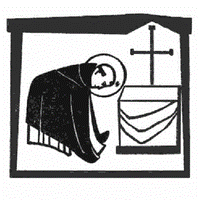
The First Way - Inclinations (Bowing): Standing upright in your prayer space, bow your head humbly, considering Christ's own humiliation on the cross. There are three traditional forms: a simple nod of the head, a bow from the shoulders, and a profound bow from the waist. These movements cultivate humility and reverence, acknowledging our lowliness before God's greatness.
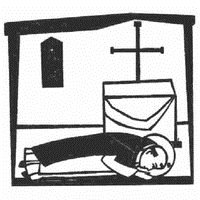
The Second Way - Prostrations (Lying Face Down): Lying completely prostrate on the ground in the shape of a cross, face down before God. This posture expresses deep repentance and complete surrender to God's mercy. St. Dominic would remain in this position while praying verses like "God, be merciful to me, a sinner" (Luke 18:13).
- Reflection Questions: Did your body's position affect your sense of humility and reverence during the bowing practice? What emotions or insights arose when you placed yourself completely prostrate before God?
Practice 2
- Psalm 51:1-2: Have mercy on me, O God, according to your unfailing love; according to your great compassion blot out my transgressions. Wash away all my iniquity and cleanse me from my sin.
- Psalm 130:1-2: Out of the depths I cry to you, Lord; Lord, hear my voice. Let your ears be attentive to my cry for mercy.
- Prayer: A prayer attributed to St. Dominic
May God the Father who made us bless us.
May God the Son send His healing among us.
May God the Holy Spirit move within us ...
May we walk and preach the word of God to all.
Amen
- Practice: Try the Third and Fourth Ways

The Third Way - Discipline of the Body (Penance): This way involves some form of bodily penance to remind yourself of the seriousness of sin and your need for God's mercy. Historically, St. Dominic used physical discipline, but the deeper principle is engaging in acts of self-denial that turn your heart toward repentance and away from sin. How might you engage your body in this kind of prayer?
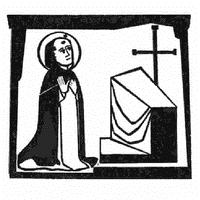
The Fourth Way - Genuflections (Repeated Kneeling): Repeatedly rise and kneel on one knee before Christ. St. Dominic would sometimes continue this from after evening prayer until midnight. This rhythmic movement expresses both humility and hopeful expectation of God's grace.
- Reflection Questions: What forms of appropriate penance or self-discipline might help you take sin seriously without causing bodily or mental harm? How might these actions of self-denial be counter-cultural? How did the repetitive kneeling and rising affect your sense of God's mercy and your confidence in approaching Him?
Practice 3
- Psalm 88:9: I call to you, LORD, every day; I spread out my hands to you.
- Psalm 143:6: I spread out my hands to you; I thirst for you like a parched land.
- Prayer: A prayer attributed to St. Dominic
May God the Father who made us bless us.
May God the Son send His healing among us.
May God the Holy Spirit move within us ...
May we walk and preach the word of God to all.
Amen
- Practice: Try the Fifth and Sixth Ways
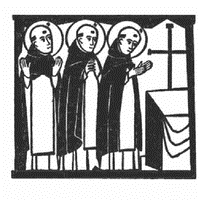
The Fifth Way - Standing in Contemplation: Stand upright before God without leaning or supporting yourself. Your hands may be extended before your chest like an open book, or joined together, or raised to shoulder level as if listening carefully. This posture expresses attentive meditation on God's Word and reverent listening for His voice.
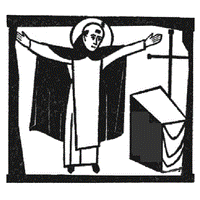
The Sixth Way - Standing in the Shape of a Cross: Stand with arms outstretched horizontally, forming a cross with your body. St. Dominic used this posture when praying for miracles or in times of desperate intercession. This position unites you with Christ's suffering and expresses earnest supplication for God's intervention.
- Reflection Questions: How did standing in contemplative stillness without external support affect your ability to focus on God's presence? What did you experience when you stood in the shape of a cross?
Practice 4
- Psalm 28:1-2: To you, Lord, I call; you are my Rock, do not turn a deaf ear to me. For if you remain silent, I will be like those who go down to the pit. Hear my cry for mercy as I call to you for help, as I lift up my hands toward your Most Holy Place.
- Prayer: A prayer attributed to St. Dominic
May God the Father who made us bless us.
May God the Son send His healing among us.
May God the Holy Spirit move within us ...
May we walk and preach the word of God to all.
Amen
- Practice: Try the Seventh and Eighth Ways
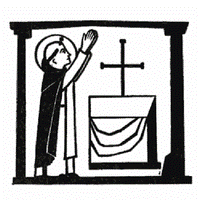
The Seventh Way - Standing with Arms Raised (Supplication): Stand with both arms raised straight up toward heaven, hands either joined together or slightly parted as if receiving something from God. This posture acknowledges that all good gifts come from above and expresses earnest supplication for God's joy and mercy, particularly for others.
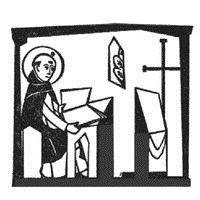
The Eighth Way - Contemplative Reading: Sit quietly with Scripture or a spiritual book. Read slowly and meditatively, pausing to let God speak through the text. Move naturally between reading, meditation, prayer, and contemplation as the Holy Spirit leads.
- Reflection Questions: What sensations or insights arose when you raised your hands toward heaven? How did combining physical stillness with spiritual reading affect the quality of your attention to God's voice? Which of these two contrasting approaches—the active reaching upward or the receptive sitting—better matched your spiritual needs today?
Practice 5
- Luke 24:32: They asked each other, "Were not our hearts burning within us while he talked with us on the road and opened the Scriptures to us?"
- Prayer: A prayer attributed to St. Dominic
May God the Father who made us bless us.
May God the Son send His healing among us.
May God the Holy Spirit move within us ...
May we walk and preach the word of God to all.
Amen
- Practice: Try the Ninth Way
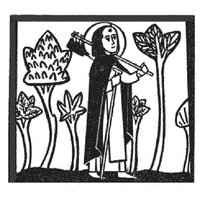
The Ninth Way - Walking Prayer (Prayer on a Journey): Engage in prayer while walking. Be aware of God's creation around you—sounds, smells, sights, the feeling of ground beneath your feet, your breath, your heartbeat. You may recall Scripture for contemplation or simply rest in God's presence as you move. St. Dominic often prayed the Divine Office while traveling and found God in the beauty of His creation along the journey.
- Reflection Questions: How did combining physical movement with prayer affect your sense of God's presence in creation? What differences did you notice between stationary prayer and prayer while walking?
- Integration Questions: As you finish this week of embodied prayer, how has using your body intentionally in prayer changed your understanding of the connection between physical posture and your inner spiritual state? In what ways might you continue to engage your whole being—body, mind, and spirit—in your ongoing relationship with God?
Week 7: The Jesus Prayer
Learn
Opening Reflection Questions
When you think about "praying without ceasing" (1 Thessalonians 5:17), what emotions arise? Does it sound like an impossible burden, a beautiful invitation, or something else entirely? What would it look like for prayer to become as steady as a heartbeat?
Drawn into the Pilgrim's Prayer
I am not much of a reader. When I pick up a new book, it's often with anxiety. I fear that I'll get bored yet feel compelled to finish it anyway. Even with books I ultimately enjoy, there's usually substantial inertia. I need time to adjust to an author's style and convince myself it's worth the effort. On rare occasions, I'm convinced within a few pages. Once, I was sold by the very first sentence:
"By the grace of God I am a Christian, by my deeds a great sinner, and by my calling a homeless wanderer of humblest origin, roaming from place to place." -- The Way of a Pilgrim, translated by Helen Bacovin, p. 13
Then the author continued:
"My possessions consist of a knapsack with dry crusts of bread on my back and in my bosom the Holy Bible. This is all!
On the twenty-fourth Sunday after Pentecost I came to church to attend the Liturgy and entered just as the epistle was being read. The reading was from Paul's First Letter to the Thessalonians, which says in part, 'Pray constantly.' These words made a deep impression on me and I started thinking of how it could be possible for a man to pray without ceasing when the practical necessities of life demand so much attention. I checked my Bible and saw with my own eyes exactly what I had heard, that it is necessary to pray continuously."
So began 80 pages of pure joy as I shared in the Pilgrim's quest to learn how to pray without ceasing. Through him, or perhaps with him, I discovered that
"The ceaseless Jesus Prayer is a continuous, uninterrupted call on the holy name of Jesus Christ with the lips, mind, and heart; and in the awareness of his abiding presence it is a plea for blessing in all undertakings, in all places, at all times, even in sleep. The words of the Prayer are: 'Lord Jesus Christ, have mercy on me!'" -- The Way of a Pilgrim, p. 18
The Philokalia
The Jesus Prayer finds its most comprehensive treatment in a collection called the Philokalia (literally "love of the beautiful"). Compiled in the 18th century by two Greek monks, this multi-volume work gathers the spiritual wisdom of the Eastern Christian desert fathers, monks, and mystics from the 4th to 15th centuries.
The Philokalia was intended to provide practical guidance for those seriously pursuing union with God. Its pages contain detailed instructions on prayer, contemplation, and the inner life, written by those who had walked these paths. For Orthodox Christianity, it represents the heart of hesychast spirituality—the tradition of "inner stillness" that seeks direct experience of God's presence.
While the Philokalia covers many aspects of the spiritual life, a significant portion addresses what the tradition calls "the Prayer of the Heart"—the Jesus Prayer as practiced by those seeking unceasing communion with God.
The Prayer of the Heart
The Jesus Prayer emerges from the early church's meditation on Paul's command to "pray without ceasing" (1 Thessalonians 5:17). The Eastern Church discovered that by repeatedly calling upon the name of Jesus—"Lord Jesus Christ, have mercy on me"—prayer could become an unbroken thread woven through every waking and sleeping moment.
The prayer's genius lies in its simplicity. It is said to contain the essence of the Gospel: acknowledgment of Jesus as Lord and Christ, recognition of our need for mercy, and the fundamental posture of humility before God. As a quote commonly attributed to St. John Chrysostom states, "The name of Jesus, invoked continuously in the heart, puts to flight all evils, purifies the soul, and sanctifies it."
Within Orthodox tradition, the Jesus Prayer is carefully transmitted from spiritual parent to spiritual child. It requires sincere commitment and proper guidance. Beyond mere repetition, the goal is for it to become so integrated into one's being that it continues even during sleep.
Today, the Jesus Prayer continues to resonate across Christian traditions. Whether among Orthodox monks, Catholic contemplatives, or Protestant seekers, its ancient rhythm—"Lord Jesus Christ, have mercy on me"—offers a way to quiet the noise, center the heart, and return to the simplicity of God's presence.
An Invitation
This week, you're invited to begin a gentle experiment: what if prayer could become as constant as breathing? Whether you're walking, washing dishes, or waiting in traffic, try quietly repeating the Jesus Prayer. Let it become a rhythm that anchors you in God's mercy throughout the day.
Daily Practices
Practice 1
- 1 Thessalonians 5:16-18: Rejoice always, pray continually, give thanks in all circumstances; for this is God's will for you in Christ Jesus.
- Prayer: Lord Jesus Christ, have mercy on me
- Practice: Learning the Posture
"'Now if you will listen, I will read how you can learn ceaseless interior prayer.' The elder opened the Philokalia to the account of St. Simeon the New Theologian and began reading: 'Sit alone and in silence; bow your head and close your eyes; relax your breathing and with your imagination look into your heart; direct your thoughts from your head to your heart. And while inhaling say, 'Lord Jesus Christ, have mercy on me,' either softly with your lips or in your mind. Endeavor to fight distractions but be patient and peaceful and repeat this process frequently.'" -- The Way of a Pilgrim, p. 18
Begin with 10-15 minutes of focused practice following these instructions. Don't worry about counting repetitions initially—focus on establishing a gentle rhythm. When your mind wanders, gently return to the prayer. After your focused time, try carrying the prayer with you for the next hour as you go about your activities.
- Reflection Questions: How did following these specific instructions feel? What did you notice about your ability to focus during this structured approach to the Jesus Prayer?
Practice 2
- 1 Thessalonians 5:16-18: Rejoice always, pray continually, give thanks in all circumstances; for this is God's will for you in Christ Jesus.
- Colossians 4:2: Devote yourselves to prayer, being watchful and thankful.
- Prayer: Lord Jesus Christ, have mercy on me
- Practice: When Prayer Feels Dry
"For a week I followed the instructions of the elder and studied ceaseless prayer alone in the vegetable garden, and for a while I managed. Then a great burden came upon me. Laziness, boredom, drowsiness and a cloud of disturbing thoughts seemed to overwhelm me. In my sorrow I went to see the elder and explained my situation to him. He welcomed me lovingly and said, 'Dearly beloved brother, a war has been declared against you by the world of darkness'... And so the elder found the instruction of the Venerable Nicephorus the Solitary and began: "'If, in spite of all effort, you cannot enter the interior of the heart in the way which was explained to you, then do what I will tell you and with God's help you will reach your goal. Man's vocal cords enable him to speak, to vocalize words. Use this ability then and, while fighting distractions, diligently and continuously say, "Lord Jesus Christ, have mercy on me!" If you will persevere for some time then, without any doubt, the path to the heart will be opened to you. This has been verified through experience.'" -- The Way of a Pilgrim, pp. 20-21
Spend time today experimenting with both vocalizing the prayer and praying it silently. When you notice your mind wandering or the prayer feeling burdensome, try speaking it aloud. Notice which approach helps your concentration.
- Reflection Questions: Have you experienced any "laziness, boredom, drowsiness" or distracting thoughts while practicing the Jesus Prayer? How did vocalizing the prayer affect your concentration compared to silent repetition?
Practice 3
- 1 Thessalonians 5:16-18: Rejoice always, pray continually, give thanks in all circumstances; for this is God's will for you in Christ Jesus.
- Romans 12:12: Be joyful in hope, patient in affliction, faithful in prayer.
- Prayer: Lord Jesus Christ, have mercy on me
- Practice: The Prayer Takes Root
"For a whole week I stayed alone in my hut and recited the Jesus Prayer six thousand times every day, neither worrying about anything nor paying attention to the distracting thoughts, no matter how severe they became. My main concern was to carry out the advice of my director as accurately as possible. And do you know what happened? I became so accustomed to the Prayer that if for a short while I stopped reciting it I felt as if I were missing something, as though I had lost something. When I would begin reciting the Prayer again, I would immediately feel great joy and delight. If I happened to meet someone then, I did not feel like talking. My only desire was to be alone and to recite the Prayer. I had become so accustomed to it in a week." -- The Way of a Pilgrim, p. 21
Today, in addition to 10-15 minutes of focused repetition, try extending the Jesus Prayer throughout your daily activities. While walking, washing dishes, folding laundry, etc. keep repeating the prayer in your mind and heart if you cannot do so on your lips.
- Reflection Questions: Can you imagine prayer ever feeling so natural that its absence would feel like something missing? How might constant communion with God come to feel necessary rather than burdensome?
Practice 4
- 1 Thessalonians 5:16-18: Rejoice always, pray continually, give thanks in all circumstances; for this is God's will for you in Christ Jesus.
- Acts 17:28: For in him we live and move and have our being.
- Prayer: Lord Jesus Christ, have mercy on me
- Practice: Breathing with Jesus
"I spent the rest of the summer reciting the name of Jesus vocally and I enjoyed great peace. During my sleep I often dreamed that I was praying. And if I happened to meet people during the day they all seemed as close to me as if they were my kinsmen, even though I did not know them. My thoughts had quieted down completely; I thought only of the Prayer, to which my mind now began to listen, and my heart produced certain warmth and gladness." -- The Way of a Pilgrim, p. 23
Today, experiment with coordinating the Jesus Prayer with your breathing: "Lord Jesus Christ" on the inhale, "have mercy on me" on the exhale. Don't force your breathing. Let it find a natural rhythm with the prayer.
- Reflection Questions: How do you think deep, constant communion with God might affect your view of strangers or difficult people? Can you envision a time when prayer for mercy might naturally extend from yourself to strangers, seeing them as "kinsmen"?
Practice 5
- 1 Thessalonians 5:16-18: Rejoice always, pray continually, give thanks in all circumstances; for this is God's will for you in Christ Jesus.
- Philippians 4:6-7: Do not be anxious about anything, but in every situation, by prayer and petition, with thanksgiving, present your requests to God. And the peace of God, which transcends all understanding, will guard your hearts and your minds in Christ Jesus.
- Prayer: Lord Jesus Christ, have mercy on me
- Practice: The Prayer of the Heart
"So now I walk and say the Jesus Prayer without ceasing and it is more precious and sweet to me than anything else in the world. Sometimes I walk seventy or more versts in a day and I do not get tired; I am only conscious of praying. When the cold air chills me, I begin saying the Prayer with greater intensity and I warm up. When hunger begins to overcome me, I begin saying the name of Jesus Christ more frequently and I forget that I wanted to eat. When I become sick and feel rheumatic pain in my back and legs, I pay greater attention to the Prayer and I do not feel the pain. When someone offends me, I remember how sweet the Jesus Prayer is and the offense and anger disappear and I forget everything." -- The Way of a Pilgrim, p. 24
Today, experiment with turning to the Jesus Prayer during any moments of physical discomfort, fatigue, stress, or emotional difficulty. Let the prayer become a gentle background presence throughout your day.
- Reflection Questions: Can you imagine constant prayer and meditation on the person of Jesus bringing relief during discomfort, stress, or sorrow? How might anchoring yourself in God's mercy transform your response to life's difficulties?
- Integration Questions: How has a week of practicing the Jesus Prayer affected your understanding of praying without ceasing? What, if anything, surprised you about this practice? In what ways might you continue exploring the Jesus Prayer beyond this week?
Whether this week felt fruitful, frustrating, or somewhere in between, give yourself grace and allow yourself to savor the journey.
Week 8: The Daily Office
Learn
Opening Reflection Questions
When do you typically pray during the day? Is it at consistent times or whenever the moment arises? Have you ever felt at a loss for words in prayer, or wished for language that could express what you're feeling before God? Is there a part of you that longs to feel connected to other believers in prayer, or do you prefer the intimacy of praying alone?
Understanding the Terms
The Daily Office, the Liturgy of the Hours, and the Divine Office all refer to closely related practices of praying at fixed times throughout the day using written liturgical prayers. Daily Office is the term used in Anglican and Lutheran traditions, Liturgy of the Hours is the modern Catholic term, and Divine Office is the traditional Catholic name. Eastern Orthodox churches refer to their corresponding services as the Divine Services or Canonical Hours. While there are variations in structure and content across these traditions, the heart of these practices is the same: marking specific hours of each day with prayer, primarily drawn from the psalms and other Scripture, that sanctifies time and connects us to a rhythm that has sustained the Church for centuries.
Early Christian & Monastic Development
By the second and third centuries, Church Fathers such as Clement of Alexandria, Origen, and Tertullian wrote of the practice of Morning and Evening Prayer, and of the prayers at terce (~9 AM), sext (~noon), and none (~3 PM). Later, the Desert Fathers began to live out Paul's command to "pray without ceasing" (1 Thessalonians 5:17) by having one group of monks pray the psalms at one fixed hour, followed by another group at the next. These early monks in the Egyptian desert discerned that the call to unceasing prayer meant arranging their communities so that prayer, specifically the praying of Scripture together, never stopped.
What began as individual hermits seeking God in solitude eventually became communities where this cycle of fixed-hour prayer, centered on the psalms, became the organizing rhythm of daily life in monasteries.
St. Benedict's Lasting Contribution
St. Benedict's lasting contribution was organizing the day around eight times of prayer: Matins (in the deep night), Lauds (at dawn), Prime (early morning), Terce (mid-morning), Sext (midday), None (mid-afternoon), Vespers (at sunset), and Compline (before bed). His insight was integration through ora et labora (pray and work), interspersing the monastery's labor with prayer so that the mind wouldn't become absorbed by work alone.
This rhythm follows both the natural day and the liturgical significance of different times: Lauds celebrates Christ's resurrection with the dawn, Terce commemorates the coming of the Holy Spirit, None recalls Christ's death at 3 PM, while Vespers commemorates the taking down of Christ's body from the cross. At each of these hours, the community gathered to pray the psalms and hear Scripture readings together, with all 150 psalms cycling through the prayer schedule each week. The genius was in how the two elements reinforced each other: the fixed times created the structure, while the written liturgical prayers, especially the psalms, provided the content that shaped the community's life with God.
The Heart of the Practice
What makes the Daily Office distinctive is how its two core elements work together. The fixed times create a framework that structures our days around prayer rather than letting prayer fit into whatever time remains. The written liturgical prayers, primarily the psalms, provide words when our own words fail and connect us to the full emotional and spiritual range of human experience before God.
But there's something more: this is not merely personal prayer but the prayer of the whole Church. Each time we pray the Daily Office, we join a great choir that is praising God every hour of every day throughout the world. When you pray Morning Prayer, you're joining countless others around the globe in the same psalms, the same Scripture readings, the same prayers … creating a continuous offering of prayer that spans time zones and continents.
Today, many Christians outside monastic communities have adapted this rhythm, cycling through the psalms monthly rather than weekly and focusing primarily on morning and evening prayer rather than the full eight prayer times of the monastic tradition.
An Invitation
This week, we'll explore how the wisdom of over 1,500 years of structured daily prayer might deepen our own relationship with God. We'll experiment with morning and evening prayer using the Anglican Daily Office, discovering how fixed times and written prayers work together to create a sustainable rhythm. We'll learn what it means to pray the psalms as the Church has prayed them for centuries, and we'll experience what it's like to join the global Christian community in this daily unified prayer. Whether you've tried and abandoned daily prayer patterns before, or you're completely new to the idea, this week offers fresh grace and gentle entry points into one of Christianity's most enduring spiritual practices.
Daily Practices
Resources for This Week's Practices
Daily Office for All
- What is it? Daily Office prayers from the Anglican Book of Common Prayer 2019 in a simplified online format. It is updated daily and follows the church calendar.
- How much time should I block out? Each morning and evening prayer should take ~ 25 minutes.
- Website: https://dailyofficeforall.com/
- What to do: Click on the link for the relevant 'Daily Office' time and pray through it. If you are pressed for time, try the abrreviated versions under 'Family Prayer'.
Bonus Option: Local Community Prayer
If Sunday falls during your practice week, consider participating in St. Mark's Episcopal Cathedral Compline (9:30 PM) for the full communal experience. Stream live at https://complinechoir.org/ or attend in person at 1245 Tenth Avenue East, Seattle.
Practice 1
- Scripture: Integrated into the Liturgy of the Hours
- Prayer: Integrated into the Liturgy of the Hours
- Practice:
Note! For some of us, this may feel very different from our typical prayer. Remember, you're not just reading or listening—you're joining your voice (silently or aloud) with Christians from around the world in prayer and worship.
Morning: Choose one of the morning prayer options above and participate fully.
Evening: Choose one of the evening prayer options (Evening Prayer/Compline) and participate fully.
- Reflection Questions: What was it like to pray using written liturgical prayers instead of spontaneous prayer? What felt comfortable or uncomfortable about this experience? How did the structure and rhythm of morning and evening prayer affect your sense of the day's beginning and ending?
Practice 2
- Scripture: Integrated into the Liturgy of the Hours
- Prayer: Integrated into the Liturgy of the Hours
- Practice:
Continue with your chosen morning and evening prayer from yesterday's options. Today, pay particular attention to how these two prayer times create bookends for your day.
Morning: Engage in morning prayer using your chosen resource.
Evening: Engage in evening prayer (Evening Prayer/Compline) using your chosen resource.
- Reflection Questions: How did having structured prayer times at the beginning and end of your day affect your awareness of God's presence during your regular activities? How does this rhythm of morning and evening prayer compare to your usual patterns of connecting with God throughout the day?
Practice 3
- Scripture: Integrated into the Liturgy of the Hours
- Prayer: Integrated into the Liturgy of the Hours
- Practice:
Today, try the alternative option to compare different approaches to liturgical prayer.
If you've been using the full length Daily Office, try the Family Prayer for both morning and evening.
If you've been using Family Prayer, try using the full length Daily Office for both morning and evening.
- Reflection Questions: What differences did you notice between today's prayer format and what you used yesterday? Which elements felt more or less helpful for your connection with God? What insights are you gaining about your own preferences for structured prayer?
Practice 4
- Scripture: Integrated into the Liturgy of the Hours
- Prayer: Integrated into the Liturgy of the Hours
- Practice:
Select your preferred morning and evening prayer format from the previous days. Today, focus especially on the communal nature of this practice.
Morning: Engage in morning prayer, being mindful that you're joining Christians around the world in similar prayers.
Evening: Engage in evening prayer (Evening Prayer/Compline), again being mindful that you are praying with the global church.
- Reflection Questions: How does knowing that Christians worldwide are praying similar prayers affect your experience of the liturgy? Does it change how alone or connected you feel during prayer?
Practice 5
- Scripture: Integrated into the Liturgy of the Hours
- Prayer: Integrated into the Liturgy of the Hours
- Practice:
Complete your week with morning and evening prayer using your preferred format from this week's experiments.
Morning: Engage in morning prayer, reflecting on how this practice has developed over the five days.
Evening: Engage in evening prayer (Evening Prayer/Compline).
- Reflection Questions: Has your comfort level with liturgical prayer changed from Day 1 to today? If so, how? Have any aspects of the practice become more natural or meaningful? Are there elements from this week that you might want to incorporate into your ongoing prayer life?
- Integration Questions: How does the rhythm of morning and evening prayer compare to other spiritual practices you've explored in previous weeks? What unique gifts does liturgical prayer offer? In what ways has joining the global rhythm of Christian prayer affected your sense of connection to the broader Church?
Week 9: The Prayer of Examen
Learn
Opening Reflection Questions
Think back on the past week: how often did you pause to reflect on where you encountered God's presence or felt His absence? When you experienced moments of peace, joy, or spiritual intensity, did you take time to notice what preceded them? Conversely, when you felt spiritually dry, anxious, or disconnected, did you examine what might have contributed to those feelings?
The Context of St. Ignatius of Loyola
Ignatius of Loyola (1491-1556) lived during one of the most turbulent periods in Christian history. Born into Spanish nobility as Íñigo López de Loyola, he initially pursued a career as a soldier and courtier. In 1521, a cannonball shattered Ignatius's leg and ended his military career. During his long recovery, the only books available to him were a life of Christ and stories of the saints. As Ignatius read, he began to notice a pattern: when he imagined worldly success, he felt empty afterward. But when he imagined following Christ, he felt peace and joy. That simple observation became the seed of his lifelong focus: learning to discern the inner movements that draw us toward or away from God.
After his recovery, Ignatius spent nearly a year in solitude at Manresa, living in a cave and devoting himself to prayer, fasting, and spiritual exercises. During this time, he experienced both profound mystical encounters and severe spiritual desolation. Through careful attention to these inner movements, he began developing what would become the Spiritual Exercises—a systematic approach to encountering God through prayer, meditation, and discernment.
In 1540, Ignatius founded the Society of Jesus (the Jesuits), which became one of the most influential religious orders in church history. The Jesuits combined deep spiritual formation with intellectual rigor and missionary zeal, establishing schools, universities, and missions around the world. Central to their spirituality was the practice of daily examen, a brief prayer of reflection.
Understanding the Prayer of Examen
The prayer of examen is fundamentally about paying attention to God's presence in daily life. Unlike other forms of prayer that focus primarily on petition or praise, the examen is a reflective practice that seeks to discern how God has been present throughout the day and how we have responded to that presence.
Ignatius identified two basic movements within us: consolation and desolation. Consolation refers to any interior movement that draws us closer to God—experiences of peace, hope, joy, courage, strength, or love that seem to arise from divine grace. Desolation describes movements that pull us away from God—feelings of anxiety, despair, temptation, or spiritual dryness that leave us feeling separated from divine love.
The genius of the examen isn't in avoiding spiritual lows or chasing highs, but in noticing them. When did I feel most alive today? When did I feel drained or distant from God? By being attentive to these interior movements, we begin to recognize what draws us closer to God—and what doesn't.
The Daily Examen in Practice
Ignatius recommended a simple five-step process for daily reflection, traditionally practiced before sleep. While the basic structure remains consistent, different Ignatian sources emphasize various aspects of this practice. The version outlined here represents one traditional approach, though this week's practices will introduce more contemporary adaptations.
1. Presence: Recognize that you are in God's presence and ask for grace to see your day clearly.
2. Gratitude: Review the day for moments of gift, beauty, or grace, however small, and give thanks.
3. Review: Examine the day's events, paying attention to feelings, interactions, and spiritual movements.
4. Recognition: Acknowledge moments when you felt most and least connected to God, love, or life.
5. Resolution: Ask for forgiveness where needed and grace for tomorrow's challenges.
This isn't meant to be a thorough moral inventory or a time for harsh self-judgment. Rather, it's a gentle, honest conversation with God about the reality of your inner life and God's presence within it.
An Invitation to Attention
This week, you're invited to engage in a simple practice of ending each day with a conversation with God about where you encountered His presence. Whether you use Ignatius's five-step structure or simply pause to ask, "Where was God today?", may this practice become a rhythm that trains your heart to notice His presence in the everyday.
Daily Practices
This week's practices are adapted from the Examen Prayer series by Pray as you Go (prayasyougo.org), a ministry of the British Jesuits. Accessed July 2025.
If any of the links below are unavailable, backup audio files are available on our Downloads page.
Practice 1
- Psalm 139:23: Search me, God, and know my heart; test me and know my anxious thoughts.
- Prayer: A prayer from St. Ignatius's Spiritual Exercises
Direct O Lord and guide and influence all that is happening in my mind and heart during this time of prayer: all my moods and feelings, my memories and imaginings; my hopes and desires; may all be directed and influenced to your greater glory, praise and service and to my growth in your Spirit.
Amen
- Practice: Basic Daily Review (~8 minutes)
Today we begin with the foundational practice of daily review. You can follow along with this guided examen prayer at https://prayasyougo.org/prayer/examen-prayer-1-19 or practice on your own using the framework below:
- Prepare: Take a moment to stop, become still and focused. Let your breathing help you relax. Ask for God to be with you and guide your thoughts so you might see God's presence in your life.
- Review the Day: Begin to recall your day from morning through evening. How were you feeling at different times? Notice both the events and your interior responses.
- Notice Life and Light: Where do you notice times of life, light, or energy? What gifts have you received today? Take a moment to relish these and give thanks.
- Notice Difficulties: Notice difficult times too, taking them to God for his light and warmth.
- Look Forward: As this day ends and you look forward, is there anything you want to ask of God for the coming days?
- Reflection Questions: How did this simple practice of reviewing your day feel? What did you notice about God's presence that you might have otherwise missed? What made this different from just thinking about your day?
- Closing Prayer: The Suscipe of St. Ignatius
Take, Lord, and receive all my liberty,
my memory, my understanding,
and my entire will,
All I have and call my own.
You have given all to me.
To you, Lord, I return it.
Everything is yours; do with it what you will.
Give me only your love and your grace,
that is enough for me.
Practice 2
- Lamentations 3:40: Let us examine our ways and test them, and let us return to the Lord.
- Prayer: A prayer from St. Ignatius's Spiritual Exercises
Direct O Lord and guide and influence all that is happening in my mind and heart during this time of prayer: all my moods and feelings, my memories and imaginings; my hopes and desires; may all be directed and influenced to your greater glory, praise and service and to my growth in your Spirit.
Amen
- Practice: Seeking the Spirit's Guidance (~11 minutes)
You can follow this guided prayer at https://prayasyougo.org/prayer/examen-ii-43 or practice using the approach below:
The focus today is on asking the Holy Spirit to guide your memory and help you see God's movement in your day. Begin by relaxing and knowing you are in God's presence. Ask God's Spirit to guide your memory as you look back over the day, trusting that the Holy Spirit will help you see what the Father wants to show you.
- Look for the Spirit's Gifts: Look for moments when there has been energy, light, life—when you experienced love, joy, peace, patience, kindness, goodness, trust, gentleness, or self-control.
- Cooperation with God: Ask yourself: when did you most fully cooperate with God? When did you feel most alive?
- Times Out of Tune: Become aware of times when you felt out of tune with God. When did you feel least alive? Try not to be judgmental, but simply notice.
- Ask for What You Need: What do you want to ask forgiveness for? What do you need to strengthen so as to follow the way you are being drawn by the Spirit?
- Reflection Questions: How did actively asking for the Spirit's guidance change your perspective on the day's events? Did you sense the Holy Spirit directing you or giving you insight?
- Closing Prayer: The Suscipe of St. Ignatius
Take, Lord, and receive all my liberty,
my memory, my understanding,
and my entire will,
All I have and call my own.
You have given all to me.
To you, Lord, I return it.
Everything is yours; do with it what you will.
Give me only your love and your grace,
that is enough for me.
Practice 3
- Proverbs 27:19: As water reflects the face, so one's life reflects the heart.
- Prayer: A prayer from St. Ignatius's Spiritual Exercises
Direct O Lord and guide and influence all that is happening in my mind and heart during this time of prayer: all my moods and feelings, my memories and imaginings; my hopes and desires; may all be directed and influenced to your greater glory, praise and service and to my growth in your Spirit.
Amen
- Practice: Noticing God's Movement (~12 minutes)
Follow the guided prayer at https://prayasyougo.org/prayer/examen-iii-25 or use this framework:
This prayer focuses on seeing where God has been moving through your moods and feelings. Remember that God guides us through our interior movements—normally God's way brings deep peace and consolation.
- Stop and Acknowledge God's Presence: No matter what's on your mind, stop. God is with you—quiet, perhaps, but present nonetheless.
- Give Thanks: Remember that everything you have is a gift from God. What would you especially like to give thanks for today?
- Ask for Light: Ask God to shine his light into your heart so you can see God working in the day's events.
- Review with Attention to Feelings: As you remember through the day, pay attention to how you felt at different times. Was it joyful, sad, angry, or frightened? What was the cause of those feelings? Did your mood change during the day?
- Examine and Ask for Grace: What can you be proud of today? Give thanks for it. Also, did you turn away from God? Ask forgiveness and especially for the graces of healing and strength.
- Look to Tomorrow: What are you expecting tomorrow? Where might you most need God's help?
- Reflection Questions: How did paying attention to your moods and feelings help you notice God's guidance? Where did you sense God inviting you toward life today? What patterns do you notice in what brings you peace versus what disturbs your spirit?
- Closing Prayer: The Suscipe of St. Ignatius
Take, Lord, and receive all my liberty,
my memory, my understanding,
and my entire will,
All I have and call my own.
You have given all to me.
To you, Lord, I return it.
Everything is yours; do with it what you will.
Give me only your love and your grace,
that is enough for me.
Practice 4
- Luke 24:31: Then their eyes were opened and they recognized Him
- Prayer: A prayer from St. Ignatius's Spiritual Exercises
Direct O Lord and guide and influence all that is happening in my mind and heart during this time of prayer: all my moods and feelings, my memories and imaginings; my hopes and desires; may all be directed and influenced to your greater glory, praise and service and to my growth in your Spirit.
Amen
- Practice: Finding God in All Things (~12 minutes)
Use the guided prayer at https://prayasyougo.org/prayer/examen-iv-27 or follow this approach:
Today's practice emphasizes finding God in the ordinary moments and recognizing divine opportunities throughout your day.
- Enter God's Presence: Find a comfortable place, breathe deeply, and become conscious of placing yourself before God, who is waiting for you, looking at you and smiling.
- Ask for Grace: Ask God to reveal the day as God sees it. Ask for a spirit of gratitude for whatever was given in the day, even if you're not immediately aware of having received much.
- Review as God Shows You: Let your day play back to you, trusting that God is showing you the day. Notice the "warm spots and cold spots." Give it all to God to bless.
- Focus on Delight: Bring to mind one or two points that have delighted you today—events, encounters, or moments that brought joy, satisfaction, or made something deep inside you say "yes."
- Acknowledge the Negative: Also bring to mind anything negative that surfaces—words, thoughts, or reactions that left you saddened, annoyed, or angry. Acknowledge and own it, then give it to God to heal.
- Bless Tomorrow: Looking forward, imagine your journey away from this moment. Can you see tonight, tomorrow morning? You are blessing the day ahead because God has been with you throughout this reflection.
- Reflection Questions: What did it feel like to trust that God was showing you your day rather than just remembering it yourself? Which moments made your soul say "yes" today? How might this practice change the way you approach tomorrow?
- Closing Prayer: The Suscipe of St. Ignatius
Take, Lord, and receive all my liberty,
my memory, my understanding,
and my entire will,
All I have and call my own.
You have given all to me.
To you, Lord, I return it.
Everything is yours; do with it what you will.
Give me only your love and your grace,
that is enough for me.
Practice 5
- 2 Corinthians 13:5: Examine yourselves to see whether you are in the faith; test yourselves.
- Prayer: A prayer from St. Ignatius's Spiritual Exercises
Direct O Lord and guide and influence all that is happening in my mind and heart during this time of prayer: all my moods and feelings, my memories and imaginings; my hopes and desires; may all be directed and influenced to your greater glory, praise and service and to my growth in your Spirit.
Amen
- Practice: Comprehensive Examen (~22 minutes)
Today's extended practice at https://prayasyougo.org/prayer/examen-v-9 offers the fullest version of the examen, or you can follow this expanded framework:
- Recall God's Presence: You are a creature in the midst of creation. God is present within you, in the creation that surrounds you, in your body, and in those around you.
- Ask for Awareness: Ask the Holy Spirit to make you aware of your unique giftedness and help you look on all you see with love.
- Concrete Gratitude: Look over your day with gratitude for specific gifts. Be concrete. Recall the smell of morning coffee, taste of good food, a child's laugh, a flower's fragrance. Take stock of what you received and what you gave.
- Notice Permanent Gifts: Also look at your permanent gifts that allow your participation in this day—your particular strengths, ability to hope, sense of humor, faith, intelligence, health, family, and friends.
- Ask for the Spirit of Truth: Ask God to send the Holy Spirit to help you look at your actions, attitudes, and motives with honesty and patience. The Spirit gives freedom to look upon yourself without condemnation and without complacency.
- Extended Review: This is the longest step. Recall events, explore the context of your actions, search for internal movements of your heart. Review your hopes and hesitations. Many situations will show your heart was divided—wavering between helping and disregarding, listening and ignoring.
- Heart to Heart with Jesus: Speak with Jesus about your day. Share your thoughts on your actions, attitudes, feelings, and interactions. Ask for direction, share concerns, seek forgiveness, express gratitude.
- Look Forward with Compassion: Having reviewed this day, look upon yourself with compassion and see your need for God. Express sorrow for opportunities missed and ask forgiveness. Give thanks for grace and especially praise God for times you responded in ways that allowed you to better see God's life around you.
- Reflection Questions: How did this extended time of reflection deepen your awareness of God's presence? In what ways did speaking directly with Jesus about your day feel different from simply thinking about it?
- Integration Question: As you conclude this week of practicing the examen, has daily conversation with God about your day affected your awareness of His presence in ordinary moments?
- Closing Prayer: The Suscipe of St. Ignatius
Take, Lord, and receive all my liberty,
my memory, my understanding,
and my entire will,
All I have and call my own.
You have given all to me.
To you, Lord, I return it.
Everything is yours; do with it what you will.
Give me only your love and your grace,
that is enough for me.
Week 10: Imaginative Prayer
Learn
Opening Reflection Questions
When you read the stories of Jesus in the Gospels, do you ever find yourself imagining what it would have been like to be there? What would you have seen, heard, or felt if you had been present when Jesus calmed the storm, healed the blind man, or called the disciples? How comfortable are you with using your imagination as a pathway to encounter God?
Finding Rest in God's Presence
When I wake up in the middle of the night and can't fall back asleep, I get up to pray. My final prayer is often, "Please Lord, give sweet rest to your servant." Then I climb into bed and imagine myself like Samuel, sleeping on a small rug in the tent of God. In my mind's eye, I simply lie there in the darkness and in peace, knowing I am in the presence of God. Other times I imagine myself by a campfire with Jesus and some unknown disciples—not in conversation, but simply enjoying his presence, watching the flames. These aren't formal prayer techniques I learned from others, but they've become some of my most treasured times with God.
The Ignatian Tradition of Imaginative Prayer
What I practice instinctively has deep roots in a more formal tradition. Imaginative prayer, as we understand it today, was most fully developed by St. Ignatius of Loyola in his Spiritual Exercises (we explored Ignatius's life and context in Week 9 with the Prayer of Examen). While earlier Christian mystics like St. Bonaventure had used meditation on Gospel scenes, Ignatius systematized this approach into a comprehensive method of prayer that engages the whole person—mind, heart, and imagination—in encountering Christ.
The practice typically begins with selecting a Gospel scene—perhaps Jesus calling the disciples by the Sea of Galilee, the woman touching his cloak in the crowd, or Jesus washing the disciples' feet. After settling into prayer and asking for the Holy Spirit's guidance, you read the passage slowly, then close your eyes and step imaginatively into the scene.
The key is engaging all your senses. What does the marketplace smell like when Jesus encounters Zacchaeus? How does the sand feel beneath your feet as you walk with the disciples? What expression do you see on Jesus' face when he looks at you? What sounds fill the air—waves lapping, crowds murmuring, children playing? Ignatius believed that God speaks through these imaginative details just as truly as through theological insights.
You might place yourself as one of the characters already in the story—perhaps you're the woman at the well or one of the disciples in the boat during the storm. Or you might simply be an observer, watching from the edge of the crowd as Jesus teaches or heals. Sometimes practitioners find themselves having conversations with Jesus within the scene, sharing their own struggles or questions.
The Fruit of Contemplative Encounter
Some people worry that imaginative prayer might lead them away from the real Jesus into a Jesus of their own making. Ignatian wisdom addresses this concern by keeping the practice anchored in actual Gospel texts and encouraging practitioners to notice patterns over time. Does your prayer lead to a life increasingly in alignment with the fruit of the Spirit? Does it draw you toward greater love of God and neighbor? These are the measures of authentic encounter with God.
Those who practice imaginative prayer often report that Gospel stories come alive in new ways. Scripture moves from being something they think about to something they experience. They discover that Jesus isn't just a historical figure but the living Son of God who meets them in their current circumstances. The stories become less like ancient reports and more like invitations into ongoing relationship.
This practice can be particularly powerful during difficult seasons. When facing grief, anxiety, or confusion, stepping imaginatively into scenes of Jesus' compassion—watching him weep with Mary and Martha, seeing his response to the woman caught in adultery, or witnessing his patient teaching of confused disciples—can provide comfort and perspective that goes beyond purely intellectual understanding.
An Invitation
This week, you're invited to offer your imagination to God in prayer. Whether you follow traditional Ignatian methods or follow your own Spirit-led path, the purpose is to meet the risen Jesus in the here and now. Let yourself see, hear, and encounter the Christ who still walks among us, speaks words of life, and invites you to come and see.
Daily Practices
Practice 1
- Mark 10:46-52: Jesus Heals Blind Bartimaeus
- Prayer: A prayer based on Luke 24:32
Lord Jesus, as the hearts of your disciples burned within them on the road to Emmaus, so might I encounter you in this time of prayer.
Amen.
- Practice: Ignatian Gospel Contemplation
Find a quiet place where you can sit comfortably without distraction. Begin by settling into God's presence and offering the prayer above.
Read Mark 10:46-52 slowly twice, allowing the scene to take shape in your mind. Then close your Bible and follow these steps:
Preparation: Ask the Holy Spirit to guide your imagination and help you encounter Jesus in this Gospel scene. What grace do you desire from this time of prayer? Perhaps to know Jesus more deeply, to experience his compassion, or to understand his heart for those who cry out to him.
Setting the Scene: In your imagination, place yourself in Jericho as Jesus is leaving the city. What does the road look like? What sounds do you hear—the crowd's conversations, footsteps on dusty paths, perhaps vendors hawking their goods? What does the air smell like? How does the sun feel on your skin?
Enter the Story: Notice Bartimaeus sitting by the roadside. What do you see in his posture, his clothing, his face? When he begins shouting, "Jesus, Son of David, have mercy on me!" what do you hear in his voice? How does the crowd react? Where are you in the scene? Are you part of the crowd trying to quiet him? Are you watching from a distance?
Encounter Jesus: Watch Jesus stop and call for Bartimaeus. What expression do you see on Jesus' face? How does he move? What tone does he use when he asks, "What do you want me to do for you?" Pay attention to Jesus' posture, his hands, his entire presence as he interacts with Bartimaeus.
The Healing: Witness the moment of healing. What do you see happening to Bartimaeus? What is his reaction? How does Jesus respond? If you could speak with Jesus in this moment, what would you say? How might he look at you?
Conclusion: End by having a conversation with Jesus about what you've experienced (called a "colloquy" in the Ignatian tradition). Share your thoughts, feelings, questions, or gratitude. Ask for whatever grace you need. If something particularly moved you, consider returning to this scene in prayer another day, paying attention to where God might be drawing your heart.
- Reflection Questions: What struck you most about Jesus in this scene? How did he appear to you—his demeanor, his words, his actions? What, if anything, surprised you about your experience of this Gospel story? How did being present in the scene differ from simply reading the passage?
Practice 2
- Mark 2:1-12: Jesus Heals the Paralytic
- Prayer: A prayer based on Luke 24:32
Lord Jesus, as the hearts of your disciples burned within them on the road to Emmaus, so might I encounter you in this time of prayer.
Amen.
- Practice: Gospel Contemplation
Read Mark 2:1-12 slowly, then enter the scene using your imagination. Place yourself in the crowded house in Capernaum—you might be part of the crowd, one of the four friends carrying the paralytic, or simply an observer. Use all your senses: What does the packed house smell like? What sounds fill the air? How does Jesus respond when the roof opens above him and the man is lowered down? Pay attention to Jesus' face, his voice, his movements. Notice both his words of forgiveness and his command to walk. End in conversation with Jesus about what you've witnessed.
- Reflection Questions: What did you notice about Jesus' response to the faith of the four friends? How did his presence affect the atmosphere in that crowded room? What did you sense about his authority—both to forgive and to heal?
Practice 3
- Luke 5:1-11: Jesus Calls His First Disciples
- Prayer: A prayer based on Luke 24:32
Lord Jesus, as the hearts of your disciples burned within them on the road to Emmaus, so might I encounter you in this time of prayer.
Amen.
- Practice: Gospel Contemplation
Read Luke 5:1-11, then imaginatively place yourself by the Sea of Galilee. If you've been observing from the edges of previous scenes, consider placing yourself as one of the fishermen this time. Or if you've been participating, try watching from the shore. What does the morning air feel like by the water? How do the fishermen look after a long night of unsuccessful fishing? Watch Jesus teach from Simon's boat, then witness the miraculous catch. Pay special attention to the disciples' faces and Jesus' call to follow him. What do you see in Peter's eyes when he says, "Go away from me, Lord; I am a sinful man"? How does Jesus respond?
- Reflection Questions: If Jesus looked directly at you in this scene, what expression did you see? How did his call to "follow me" land on your heart? What did you notice about the transition from ordinary fishing to life-changing encounter?
Practice 4
- Luke 7:11-17: Jesus Raises the Widow's Son
- Prayer: A prayer based on Luke 24:32
Lord Jesus, as the hearts of your disciples burned within them on the road to Emmaus, so might I encounter you in this time of prayer.
Amen.
- Practice: Gospel Contemplation
Read Luke 7:11-17, then enter this scene of profound loss and extraordinary restoration. Place yourself among the crowd following Jesus as you approach the town gate of Nain. What do you see when the funeral procession meets Jesus' group? Notice the widow's face, the mourners around her. Watch Jesus closely—what moves across his features when he sees her? Pay attention to his words: "Don't cry." How does he say this? What happens when he touches the stretcher and speaks to the dead man? Witness the son sitting up and speaking, and Jesus giving him back to his mother.
- Reflection Questions: What did you observe about Jesus' compassion for the widow? How did his presence change the atmosphere of grief? What did this scene reveal to you about Jesus' heart toward human suffering?
Practice 5
- Luke 19:2-10: Jesus and Zacchaeus
- Prayer: A prayer based on Luke 24:32
Lord Jesus, as the hearts of your disciples burned within them on the road to Emmaus, so might I encounter you in this time of prayer.
Amen.
- Practice: Gospel Contemplation
Read Luke 19:2-10, then place yourself in the crowded streets of Jericho. Are you part of the crowd straining to see Jesus, or do you notice Zacchaeus climbing the sycamore tree? What do you observe about this wealthy but despised tax collector? When Jesus stops under the tree and looks up, what do you see pass between them? Follow them to Zacchaeus's house—what changes do you notice in both men during their meal together? Pay attention to Zacchaeus's declaration about giving to the poor and making restitution. How does Jesus receive this transformation?
- Reflection Questions: What stands out to you about the way Jesus saw Zacchaeus compared to the crowd? How did Jesus' acceptance affect this encounter?
- Integration Questions: As you conclude this week of imaginative prayer, how has "entering" Gospel scenes changed your relationship with these familiar stories? In what ways might this practice of meeting Jesus in Scripture affect how you approach the Gospels going forward?
Week 11: Waiting on the Holy Spirit
Learn
Opening Reflection Questions
Have you ever experienced seasons when you felt spiritually dry or powerless, longing for God to move in fresh ways? What would it look like for you to actively wait through prayer, fasting, and crying out for the Holy Spirit's empowerment in your life and ministry?
Three Dimensions of Waiting
Waiting on the Holy Spirit means different things to different people. While contemplative traditions emphasize quiet waiting in silence, this week we focus on the more active waiting found throughout Scripture and lived out in Pentecostal and charismatic movements worldwide. We'll explore three particular dimensions of this practice. First, personally seeking to be filled with the Holy Spirit daily for holy living and effective ministry. Second, crying out for the Holy Spirit's outpouring to awaken and empower the Church. Third, waiting attentively for the Spirit's guidance, wisdom, and prophetic insight.
Old Testament Foundation: The Pattern of Crying Out
God often moves in response to His people's desperate crying out. In Exodus 33, after the golden calf incident, Moses declares to God: "If your Presence does not go with us, do not send us up from here" (v. 15). God responds, "I will do the very thing you have asked." This refusal to continue without God shows that Moses understood that without God's manifest presence and power, all our efforts are futile.
The Psalms capture this same heart cry. Psalm 85:6 voices the community's desperate longing: "Will you not revive us again, that your people may rejoice in you?" This is an urgent plea for God to move powerfully among His people.
The book of Judges shows a repeated pattern of crying out in desperation following a period of falling away and God responding by sending His Spirit upon leaders to deliver them. As we see with Othniel, "the Israelites cried out to the Lord, and he raised up for them a deliverer... The Spirit of the Lord came on him" (Judges 3:9-10). God's Spirit comes in response to His people's active, urgent intercession. This pattern of God's Spirit responding to His people's desperate intercession continues and intensifies in the New Testament, beginning with Jesus himself.
Jesus and the Spirit: The Model of Dependence
Shockingly, even Jesus needed to receive the Holy Spirit for ministry. At his baptism, "heaven was opened and the Holy Spirit descended on him in bodily form like a dove" (Luke 3:21-22). The Son of God, fully divine yet fully human, required the Spirit's empowerment before beginning his public ministry. This truth should both humble and encourage us: if Jesus needed the Spirit's power, how much more do we?
Later, when the time came to commission his disciples, Jesus made the connection explicit. "As the Father has sent me, I am sending you," he told them. And immediately, "he breathed on them and said, 'Receive the Holy Spirit'" (John 20:21-22). Then, before his ascension, Jesus commanded his disciples to wait: "Do not leave Jerusalem, but wait for the gift my Father promised" (Acts 1:4). Despite having been with Jesus for three years, witnessing his resurrection, and receiving his commission, they were still not ready. They needed the empowerment of the Holy Spirit. Ministry and Spirit empowerment are inseparable.
New Testament Fulfillment: Active Waiting Rewarded
Famously, the disciples were in constant prayer (Acts 1:14) for ten days waiting for the Holy Spirit until Joel 2:28 was fulfilled and the Spirit was poured out at Pentecost. Acts 4 makes it clear that this was not a one-time occurrence. After being threatened by the religious leaders, the church 'raised their voices together in prayer' and asked for God to enable them to speak boldly and perform signs and wonders through the name of Jesus. In response, "the place where they were meeting was shaken. And they were all filled with the Holy Spirit and spoke the word of God boldly" (v. 31).
Paul also taught that this was not a one-time experience. His command in Ephesians 5:18 uses the present tense, passive voice, imperative, which awkwardly but correctly translates to something like "keep being filled with the Spirit." Why do we need a continual filling? Because, as DL Moody supposedly said, we leak!
Global Testimony: Active Waiting Today
Around the world today, believers are discovering the power of actively waiting on the Holy Spirit. In South Korea, Pastor David Yonggi Cho planted one of the world's largest churches on a foundation of early morning prayer, fasting, and all-night gatherings where people cried out for healing and breakthrough. He believed the ministry would collapse without daily, sustained pursuit of God's presence. As Pastor Cho put it, "Everyone who is willing to wait upon the Lord can be qualified to carry out the great task before them." This understanding, that waiting on God empowers believers for ministry, has sparked Spirit-led movements around the world.
An Invitation to Active Waiting
This week is an invitation to move from thinking about the Holy Spirit to actively seeking His presence and blessing. Whether asking for daily strength to live faithfully, crying out for revival, or waiting for His guidance, the truth remains: we can't do God's work without God's Spirit. As Jesus said, "Apart from me you can do nothing" (John 15:5). God's promises haven't changed, but like the early disciples, we must be willing to wait expectantly.
Daily Practices
Practice 1
- Romans 8:14-16: For those who are led by the Spirit of God are the children of God. The Spirit you received does not make you slaves, so that you live in fear again; rather, the Spirit you received brought about your adoption as his children. And by him we cry out, "Abba, Father." The Spirit himself testifies with our spirit that we are God's children.
- Prayer: A prayer of Lonnie Frisbee
Come, Holy Spirit
- Practice: The Spirit's Quiet Assurance
Paul reminds us that the Spirit doesn't just empower us for ministry—He also bears witness to our deepest identity as God's beloved children. The same Spirit who enables bold witness also whispers intimate truths to our hearts.
Find a quiet place where you can sit comfortably. Begin by slowly reading Romans 8:14-16 several times, allowing the words to settle into your heart. Notice the profound shift from slavery and fear to adoption and intimacy. The Spirit transforms us from fearful servants into beloved children who can cry "Abba, Father."
Spend time in silent waiting, asking the Holy Spirit to testify to your spirit that you are God's child. This isn't about dramatic manifestations but about deep, quiet assurance. Ask the Spirit to impress God's love upon your heart, to burn the truth of your righteousness in Christ into your very being. His blood was enough. You are not just forgiven, you are adopted, beloved, secure.
As you wait, pay attention to gentle impressions, quiet peace, or growing confidence in God's love. Sometimes the Spirit's greatest work is not in spectacular gifts but in settling our hearts with unshakeable assurance of our identity in Christ.
If thoughts of unworthiness or condemnation arise, return to verse 15: "The Spirit you received does not make you slaves, so that you live in fear again." Let the Spirit speak louder than your doubts.
- Reflection Questions: How might beginning this week by focusing on your identity as God's child affect your approach to the rest of the week's practices? In what ways might the Spirit's quiet testimony of your belovedness be foundational to His more dramatic manifestations of power?
Practice 2
- Acts 19:1-6: While Apollos was at Corinth, Paul took the road through the interior and arrived at Ephesus. There he found some disciples and asked them, "Did you receive the Holy Spirit when you believed?" They answered, "No, we have not even heard that there is a Holy Spirit." So Paul asked, "Then what baptism did you receive?" "John's baptism," they replied. Paul said, "John's baptism was a baptism of repentance. He told the people to believe in the one coming after him, that is, in Jesus." On hearing this, they were baptized in the name of the Lord Jesus. When Paul placed his hands on them, the Holy Spirit came on them, and they spoke in tongues and prophesied.
- Prayer: A prayer of Lonnie Frisbee
Come, Holy Spirit
- Practice: Crying Out for the Spirit's Empowerment
In Acts 19 we see that it's possible to be a follower of Jesus yet never have received the Holy Spirit's empowerment. These Ephesian disciples believed in Jesus but had never experienced the Spirit's filling that Jesus promised. Like them, we need to actively seek and receive the Holy Spirit's power for ministry and holy living.
Find a place where you can pray aloud without distraction. Begin by reading Acts 19:1-6 again slowly. Notice that Paul didn't assume these disciples had received the Spirit's empowerment simply because they believed. He asked directly. Today, ask yourself the same question: "Have I received the Holy Spirit's empowerment?"
Spend time crying out to God as the early church did. Don't be satisfied with quiet, polite prayer. Follow the pattern of Acts 4:24: "they raised their voices together in prayer." Ask the Holy Spirit to come upon you with power. Pray for the gifts of the Spirit. Ask to be filled to overflowing with His presence. Expect Him to move.
Be open to however the Spirit might manifest His presence. Some experience deep peace, others overwhelming joy, still others are moved to prophecy or pray in tongues as the Ephesian disciples did. Don't manufacture anything, but don't limit God either. Simply position yourself before Him with open hands and an expectant heart.
End by thanking God for whatever He has done and asking Him to continue filling you throughout the day.
- Reflection Questions: Did your assurance of being loved by God affect your boldness in asking for power? How did it feel to "cry out" rather than simply pray quietly? How might regular times of earnestly seeking the Spirit's filling change your daily walk with God?
Practice 3
- 2 Chronicles 7:14: If my people, who are called by my name, will humble themselves and pray and seek my face and turn from their wicked ways, then I will hear from heaven, and I will forgive their sin and will heal their land.
- Prayer: A prayer of Lonnie Frisbee
Come, Holy Spirit
- Practice: Crying Out for Church Awakening
The first two days focused on personal filling. Today we turn our hearts toward the broader church, crying out for the Holy Spirit to awaken and revive God's people. God's promise in 2 Chronicles is clear: when His people humble themselves, pray, seek His face, and turn from sin, He will respond with healing and restoration.
Begin by confessing that the church, including you and me, needs awakening. We have grown comfortable with the status quo, complacent, and perhaps even cold toward God himself. Acknowledge before God that we cannot revive ourselves; only the Holy Spirit can breathe life into dry bones.
Pray specifically for your local church. Ask the Holy Spirit to stir hearts, convict of sin, and ignite passion for Jesus. Pray for your pastor and church leaders, that they would be filled with the Spirit's power and boldness. Ask God to remove anything that hinders His presence and work.
Expand your prayers to the church in your city. Name other congregations and denominations, asking the Spirit to move across cultural and theological boundaries. Pray for unity among believers and for the church to become a powerful witness in your community.
Finally, pray for the church in your county and region. Ask the Holy Spirit to pour out revival that spreads from church to church, community to community. Cry out for an awakening that cannot be contained or controlled by human effort—only the sovereign work of God's Spirit. Pray that Christ's bride would have eyes only for Him.
Don't pray timidly. Follow the pattern of Acts 4:24 and "raise your voice" in prayer. The church desperately needs the Spirit's power, and desperate times call for desperate prayer.
- Reflection Questions: How did praying for the broader church differ from praying for personal filling? What specific areas of complacency or coldness in the church did the Spirit bring to mind? How might persistent corporate prayer for revival change your local church community?
Practice 4
- Acts 1:8: But you will receive power when the Holy Spirit comes on you; and you will be my witnesses in Jerusalem, and in all Judea and Samaria, and to the ends of the earth.
- Prayer: A prayer of Lonnie Frisbee
Come, Holy Spirit
- Practice: Empowered Church, Transformed Society
Yesterday we prayed for the church to be awakened. Today we cry out for that awakened church to be empowered to transform society. Jesus promised the Holy Spirit's power specifically for witness—not just personal blessing, but powerful engagement with the world around us.
Begin by thanking God for His heart for the lost and broken. Acknowledge that an awakened church filled with the Spirit naturally overflows into society with the love and power of Christ. The Spirit empowers us not to retreat from the world but to engage it boldly.
Pray for the church to be filled with the Spirit's power for evangelism. Ask God to give believers supernatural boldness to share the gospel, divine appointments with the lost, and signs and wonders that authenticate the message. Cry out for the church to move beyond comfortable walls into the streets, workplaces, and neighborhoods.
Pray for the church to be empowered for justice and mercy. Ask the Holy Spirit to burden believers' hearts for the poor, oppressed, and marginalized. Pray for divine wisdom and resources to address homelessness, addiction of every kind, injustice, and broken families in your community. Ask for the Spirit's power to heal both souls and society.
Pray for the church to demonstrate the kingdom of God through supernatural unity, love, and holiness that catches the world's attention. Ask the Spirit to make the church so distinctly different that society takes notice and asks, "What do these people have that we don't?"
End by asking the Holy Spirit to use your own church as a catalyst for transformation in your community. Pray that your congregation would be known not just for what you believe, but for how powerfully you love and serve.
- Reflection Questions: How did praying for the church's impact on society expand your vision of the Spirit's work? What specific needs in your community did the Spirit bring to mind? How might an empowered church actually transform the culture around it?
Practice 5
- 1 Corinthians 12:31 & 14:1: Now eagerly desire the greater gifts... Follow the way of love and eagerly desire gifts of the Spirit, especially prophecy.
- Prayer: A prayer of Lonnie Frisbee
Come, Holy Spirit
- Practice: Waiting for Wisdom and Prophetic Insight
We wrap up this week by actively seeking the Holy Spirit's guidance, wisdom, and prophetic insight. Paul commands us to "eagerly desire" spiritual gifts, especially prophecy, which is God's specific communication to His people. Today we position ourselves to receive whatever the Spirit wants to reveal.
Before you begin praying, identify a specific area where you need the Holy Spirit's wisdom or guidance. This might be a major life decision, a relationship challenge, direction for ministry, insight about someone you're concerned for, or clarity about God's calling on your life. Write it down, and if you feel comfortable, please consider bringing it back to the group next week for continued prayer. If you can't think of a specific need, follow Paul's instruction to eagerly desire the greater gifts, particularly prophecy.
Ask the Holy Spirit to speak in whatever way He wants about whatever He wants. Begin with extended worship and thanksgiving, positioning your heart to receive from God. Then present your specific request or ask for prophetic insight. Wait expectantly—not just for a still, small voice, but be open to visions, dreams, strong impressions, or scripture that comes alive with new meaning.
Spend significant time in silence, listening with your heart. Don't rush or manufacture anything. Sometimes the Spirit speaks immediately; sometimes He requires patient waiting. Be alert to gentle nudges, specific thoughts that seem to come from outside yourself, or sudden clarity about your situation.
Write down whatever comes to mind, even if it seems unclear initially. Test everything against Scripture and godly counsel, but don't dismiss impressions too quickly. The Spirit often speaks in ways we don't expect.
- Reflection Questions: What did you sense during this time of waiting for the Spirit's guidance? How was this different from regular prayer or decision-making? What will you bring back to the group for continued prayer and discernment?
- Integration Question: As you wrap up this week of actively waiting on the Holy Spirit, how has your understanding of the Spirit's empowerment in daily life changed? Are there any practices that might you continue beyond this week?
Week 12: Intercession
Learn
Opening Reflection Questions
Have you ever experienced the kind of persistent, wrestling prayer that refuses to let go until God moves? What might your life look like if you truly believed that intercessory prayer was essential for the advancement of God's Kingdom?
Old Testament Foundation: The Pattern of Contending
From the beginning, Scripture shows that God responds to bold, persistent intercession. The salvation of people and the advancement of God's Kingdom often begin not with action but with prayer.
In Genesis 18, Abraham intercedes for Sodom. "What if there are fifty righteous people?" he asks God. Then forty-five. Then forty. He keeps going until he reaches ten. At every turn, God listens... and agrees. Abraham's prayer is a bold negotiation rooted in trust, revealing that God welcomes those who contend with Him for mercy.
Moses goes even further. After the golden calf incident, God threatens to destroy the Israelites. But Moses stands in the gap: "Turn from your fierce anger; relent and do not bring disaster on your people" (Exodus 32:12). And Scripture says, "The Lord relented and did not bring on his people the disaster he had threatened" (v. 14). Moses' intercession actually shifts the course of history. Moses doesn't simply pray about the situation—he steps into it as a mediator, embodying the heart of God for mercy.
Later, through the prophet Ezekiel, God reveals what He longs for: "I looked for someone among them who would build up the wall and stand before me in the gap on behalf of the land so I would not have to destroy it, but I found no one" (Ezekiel 22:30). God is not reluctant to show mercy. Rather, He is searching for someone who will boldly ask for it.
Jesus: The Model and Commander of Intercession
That same heart is fully revealed in Jesus. On the night of His betrayal, Jesus tells Peter, "Simon, Simon, Satan has asked to sift all of you as wheat. But I have prayed for you... that your faith may not fail" (Luke 22:31-32). Though Peter denied him, Jesus' intercession ensured his restoration. Jesus' prayers carry Peter through his failures and into his future role of church leader.
Moreover, Jesus doesn't just practice intercession, he commands it. "Ask the Lord of the harvest... to send out workers into his harvest field" (Matthew 9:38). Jesus could send workers Himself. Instead, He makes the harvest contingent upon prayer. That God has sovereignly chosen to release His blessings in response to intercession should humble and awaken us.
New Testament Practice: Intercession as Authority
The early church understood this. When Herod imprisoned Peter, Acts tells us, "but the church was earnestly praying to God for him" (Acts 12:5). In response, an angel breaks Peter out of prison—while the church is still in prayer!
Later, Paul gives us a peek behind the curtain when he writes, "Our struggle is not against flesh and blood, but against... the spiritual forces of evil in the heavenly realms" (Ephesians 6:12). Intercession isn't just communication, it's combat. It's the way we participate in God's victorious warfare against evil.
James adds: "The prayer of a righteous person is powerful and effective" (James 5:16). He then reminds us of Elijah, who "prayed earnestly that it would not rain, and it did not... for three and a half years. Again he prayed, and the heavens gave rain" (vv. 17-18). Elijah was not superhuman, rather "he was a human being, even as we are." The implication is clear: your prayers can carry the same weight if you're willing.
Contemporary Testimony: The Redeemed Christian Church of God
This kind of powerful intercessory prayer wasn't just reserved for Biblical times—it's still happening today.
In many churches today, growth is often linked to strategy—vision statements, leadership pipelines, and organizational plans. But in Nigeria, the Redeemed Christian Church of God has built their global movement upon a different foundation: intercession. Pastor E.A. Adeboye is known to say, "Prayer is the master key that opens all doors" and his church backs this up with practice. Every month, believers gather for their Holy Ghost Service—an all-night vigil of what they call 'violent prayer.' This is desperate, sustained pleading with God for healing, deliverance, revival, and transformation.
Testimonies from these gatherings include restored families, miraculous healings, and spiritual renewal that ripples through entire communities. The church now plants a new congregation nearly every day, in countries around the world. Their story echoes the early church's experience: when God's people pray with desperation, God moves with power.
An Invitation to Contend
Just as God has chosen to bring salvation through people who share the gospel, He has also chosen to release blessing through those who intercede. He delights to work in partnership with His people—and intercession is where that partnership begins.
This week, you're invited to step into this rich legacy. Like Abraham, plead with God for the lost. Like Moses, stand between rebellion and judgement. Like the early church, pray with conviction for captives to be set free. And like Jesus, intercede for others in the quiet places where no one sees you except God and cry out: "Your kingdom come, Your will be done, on earth as it is in heaven."
Daily Practices
Practice 1
- 1 Peter 1:15-16: But just as he who called you is holy, so be holy in all you do; for it is written: "Be holy, because I am holy."
- Prayer: What Jesus taught us to pray
Your kingdom come, Your will be done, on earth as it is in heaven
- Practice: Contending for the Church's Sanctification
A.W. Tozer once observed: "Why do we see so little of God's ability to do hard and difficult things? Because we are accustomed to living in our leprosy. We have closed minds; even though we are orthodox, we are unbelievers... Believing in the God of yesterday makes us orthodox. Believing in the God of today releases God's power into our midst."
Today we begin by wrestling with God for the church's holiness. Like Moses, who wouldn't let God destroy His people, we stand in the gap for a church that has grown comfortable with spiritual mediocrity.
Start by confessing the church's lukewarmness—including your own. Acknowledge that we often treat God as merely historical rather than powerfully present. We believe the Bible but struggle to believe God will do anything new. Many of us believe the cross was enough to forgive our sins, but not enough to keep us holy. We've grown accustomed to prayerlessness, small visions of God, and faithlessness disguised as humility.
Cry out for the Holy Spirit's conviction to fall upon the church—conviction of sin, righteousness, and judgment (John 16:8). Pray for a purifying fire to burn away double-mindedness, religious unbelief, and the spirit of compromise. Wrestle with God like Jacob, refusing to let go until He blesses His church with the Holy Spirit and power so that how we live matches who we are in Christ.
Pray specifically for yourself, your family, your church community, and your church leaders. Ask God for a deeper revelation of His holiness that will cast disinfecting light on the darkness of our souls. Pray for a holy dissatisfaction with comfortable, culture-shaped Christianity.
- Reflection Questions: What specific areas of spiritual complacency in your life or church did the Spirit bring to mind? How did it feel to contend for the church's holiness rather than simply accepting current spiritual temperatures? What would your congregation look like if God answered this prayer for purifying fire?
Practice 2
- Matthew 9:35-38: Jesus went through all the towns and villages, teaching in their synagogues, proclaiming the good news of the kingdom and healing every disease and sickness. When he saw the crowds, he had compassion on them, because they were harassed and helpless, like sheep without a shepherd. Then he said to his disciples, "The harvest is plentiful but the workers are few. Ask the Lord of the harvest, therefore, to send out workers into his harvest field."
- Prayer: What Jesus taught us to pray
Your kingdom come, Your will be done, on earth as it is in heaven
- Practice: Wrestling for Harvest Workers
In response to the overwhelming needs of the crowds, Jesus commands his followers to pray for more workers. For reasons only known to God, in His sovereignty He has chosen to call forth more laborers only in response to our intercession. Today we obey this direct command by pleading for a massive multiplication of harvest workers worldwide.
Begin by thanking God that He "wants all people to be saved and to come to a knowledge of the truth" (1 Timothy 2:4). This is clearly God's will, which means there's zero need to doubt or hedge when praying for global evangelization. You're praying for something God desperately desires, so pray with confidence and authority.
Cry out for workers to be sent to the unreached people groups who have never heard the gospel. Pray for the completion of the Great Commission in this generation. Ask God to raise up missionaries, church planters, translators, and evangelists from every nation to reach every nation.
Pray specifically for your local harvest field. Wrestle with God for bold evangelists in your workplace, neighborhood, and city. Ask Him to burden believers' hearts for the lost around them and give them courage, boldness, and supernatural opportunities to share the gospel.
Intercede for perseverance among current missionaries and church planters. Many are discouraged, underfunded, or facing spiritual warfare. Stand in the gap for those already laboring in difficult fields.
Also pray for the financial provision needed to send workers. Ask God to stir the hearts of givers and open unexpected sources of funding for global missions.
End by asking God if He's calling you to be part of the answer to your own prayers—either going or sending others with unprecedented generosity.
- Reflection Questions: How did obeying Jesus' direct command to pray for workers feel different from general praying for missions? What specific unreached people groups or local areas did the Spirit burden you to intercede for? In what ways might God be calling you to participate in answering your own prayers?
Practice 3
- Hebrews 13:3: Continue to remember those in prison as if you were together with them in prison, and those who are mistreated as if you yourselves were suffering.
- Prayer: What Jesus taught us to pray
Your kingdom come, Your will be done, on earth as it is in heaven
- Practice: Standing in the Gap for the Persecuted
The writer of Hebrews commands us to remember imprisoned and mistreated believers "as if" we were suffering with them. Today we enter their pain through intercession, contending with God for their protection, strength, and vindication.
Start by acknowledging this sobering truth: "everyone who wants to live a godly life in Christ Jesus will be persecuted" (2 Timothy 3:12). Our brothers and sisters around the world are suffering for the same faith we hold, often paying prices we cannot imagine.
Cry out for believers in hostile nations where following Jesus means risking everything. Pray for Christians especially in North Korea, China, Afghanistan, Somalia, Libya, and other countries where faith is costly. Ask God to sustain their hope, provide for their families, and grant them supernatural peace in the midst of suffering.
Intercede for pastors and church leaders who face imprisonment, torture, or death for preaching the gospel. Like the early church prayed earnestly for Peter (Acts 12:5), wrestle with God for divine protection and miraculous deliverances.
Pray for the persecutors themselves. Be encouraged by Paul and Silas' jailer who "fell trembling before Paul and Silas" and asked, "Sirs, what must I do to be saved?" (Acts 16:29-30). Ask God for incomprehensible miracles like that of Paul, that they might go from persecutors to proclaimers of truth.
Don't forget believers facing subtler forms of persecution like social isolation, job discrimination, or family rejection. Pray for courage and wisdom as they navigate these challenges.
Ask God to redeem persecution for His purposes, using it to strengthen and purify His church. Throughout history, the blood of martyrs has been the seed of the church. Pray that current persecution would result in explosive church growth.
Wrestle with God until you sense His heart breaking for His suffering children, then intercede from that place of Christlike compassion.
- Reflection Questions: What specific countries or situations did the Spirit burden you to intercede for? How might regular intercession for the persecuted church change your perspective on your own spiritual challenges?
Practice 4
- 1 Timothy 2:1-4: I urge, then, first of all, that petitions, prayers, intercession and thanksgiving be made for all people—for kings and all those in authority, that we may live peaceful and quiet lives in all godliness and holiness. This is good, and pleases God our Savior, who wants all people to be saved and to come to a knowledge of the truth.
- Prayer: What Jesus taught us to pray
Your kingdom come, Your will be done, on earth as it is in heaven
- Practice: Contending for Transformed Leadership
Paul places prayer for governing authorities "first of all" because transformed leadership affects everything else—evangelism, justice, religious freedom, and societal flourishing. Today we contend with God for leaders who will create conditions where the gospel can advance and people can live in peace.
Begin by praying for your national leaders including, but not limited to, the president, congress, and supreme court. Don't pray based on political preferences but on God's desire for leaders who fear Him and serve justly. Ask God to grant them wisdom, surround them with godly counselors, and convict them of their need for His guidance.
Pray for local authorities—governors, mayors, city councils, school boards, police chiefs, and judges. These leaders directly impact your community's spiritual climate. Wrestle with God for their salvation and for policies that reflect biblical values.
Intercede for leaders in nations where Christianity is restricted or outlawed. Like King Cyrus being stirred to rebuild the temple and restore His people to their land, cry out for God to soften the hearts of hostile rulers toward His people.
Pray for leaders facing spiritual warfare. Those in authority may be prime targets for demonic influence. Ask God to break any demonic spiritual influences over leaders and to raise up intercessors who will pray consistently for them.
Remember that God "deposes kings and raises up others" (Daniel 2:21). Pray for upcoming elections and appointments, asking God to position leaders according to His purposes rather than human political calculations.
- Reflection Questions: How did praying for leaders you disagree with politically challenge or stretch you? For which specific leaders did the Spirit burden you to intercede? How might consistent prayer for authorities change your relationship with government and civic engagement?
Practice 5
- Luke 4:18-19: The Spirit of the Lord is on me, because he has anointed me to proclaim good news to the poor. He has sent me to proclaim freedom for the prisoners and recovery of sight for the blind, to set the oppressed free, to proclaim the year of the Lord's favor.
- Prayer: What Jesus taught us to pray
Your kingdom come, Your will be done, on earth as it is in heaven
- Practice: Wrestling for the Liberation of the Oppressed
Jesus launched His ministry by declaring His mission to liberate the oppressed. Today we join Him in this work through intercession, contending with God for freedom from every form of captivity—physical, spiritual, economic, and social.
Begin by crying out for those trapped in modern slavery, which is estimated to directly impact 50 million people worldwide. Pray for victims of human trafficking, forced labor, and sexual exploitation. Ask God to expose trafficking networks, protect the vulnerable, and raise up modern abolitionists to fight for freedom.
Wrestle with God for those living in grinding poverty, especially children who lack basic necessities. Pray for divine provision, economic opportunities, and systemic changes that break cycles of generational poverty. Ask God to burden the hearts of those with resources to give generously and those with power to use it for just reforms.
Intercede for those bound by addiction—alcohol, drugs, gambling, pornography, and other compulsions that destroy lives and families. Ask God to break demonic strongholds, provide treatment and recovery resources, and surround addicts with communities of healing and accountability.
Pray for those living under oppressive regimes or in war-torn regions where violence and terror dominate daily life. Cry out for protection, peace, and just resolution of conflicts.
Pray for those oppressed by mental illness, depression, and despair. Ask God to bring healing, hope, and skilled caregivers to those struggling in darkness.
Intercede for those bound by demons. Like the man from the Gerasenes who was found "sitting at Jesus' feet" after Jesus cast out Legion (Luke 8:35), cry out for supernatural deliverance from evil spirits. Ask God to manifest His power through the name of Jesus, so that their freedom becomes a sign and wonder that draws many to faith.
Pray for divine justice in corrupt systems that oppress the poor while enriching the powerful. Like the persistent widow in Jesus' parable (Luke 18), refuse to give up until God brings justice.
End by asking God to use His church as agents of liberation—unifying intercession and Spirit-led action to secure freedom for the oppressed.
- Reflection Questions: Which forms of oppression did the Spirit most burden your heart to intercede for? How did contending for others' liberation connect to your understanding of the gospel? In what ways might God be calling you to move from intercession to action on behalf of the oppressed?
- Integration Question: As you conclude this week of intercession, how has standing in the gap for others changed your understanding of prayer's power and purpose? What patterns of intercession do you sense God calling you to continue beyond this week?
Rhythms of Formation
Week 13: Sabbath & Rest
Learn
Opening Reflection Questions
Consider the rhythms of your week: where do you find true restoration, and what, if anything, makes rest feel difficult or elusive?
Biblical Origins
The opening chapters of Genesis introduce the concept of rest. After six days of creation, "God rested from all his work" and blessed the seventh day and made it holy (Genesis 2:2-3). Long before the law and the prophets, the sacred pattern of work and rest was built into the created order.
Later, in the Ten Commandments, this rhythm becomes a covenant command. Israel is told, "Remember the Sabbath day by keeping it holy... on it you shall not do any work" (Exodus 20:8-10). The Hebrew word shabbat means "to cease" or "to rest," emphasizing the complete stopping of ordinary work. The command is rooted in creation, but when the law is repeated in Deuteronomy, a second reason is given: "Remember that you were slaves in Egypt and that the Lord your God brought you out" (Deuteronomy 5:15). So Sabbath becomes both a remembrance of creation and a celebration of liberation. In other words, Sabbath is not just a break; it's a protest against every Pharaoh that demands endless production. It's a weekly prophetic action stating that we are not defined by what we do, but by who we are in relation to God.
Sabbath in Israel's History
Despite its central place in the covenant, Israel struggled to observe the Sabbath faithfully. Prophets like Jeremiah warned that neglecting Sabbath would lead to exile (Jeremiah 17:21-27), while Ezekiel, writing from exile, explained that desecration of the Sabbath was one of the reasons for their judgment (Ezekiel 20:12-24). It wasn't until after the return from exile that Sabbath-keeping was enforced and became a pillar of Jewish identity (Nehemiah 13:15-22).
Jesus is Lord even of the Sabbath
By the time of Jesus, Sabbath observance had acquired a legalistic framework for many Jews. The Pharisees, likely reacting to Israel's pre-exilic failures, added layers of tradition to the words of Scripture. These traditions eventually developed into 39 categories of prohibited work, which help explain why the religious leaders considered it unlawful for Jesus' disciples to pick grain on the Sabbath (Mark 2:24). Jesus confronted the Pharisees directly by declaring, "The Sabbath was made for man, not man for the Sabbath. So the Son of Man is Lord even of the Sabbath" (Mark 2:27-28). To drive the point home, Jesus then heals (Mark 3:1-5, Luke 13:10-16, Luke 14:1-6, John 5:8-16) and casts out demons (Mark 1:21-28) on the Sabbath. Jesus challenges the religious establishment by reframing Sabbath not as legal burden but as divine gift. He neither abolishes Sabbath nor enforces rigid rule-keeping. Instead, he restores its purpose: to restore human wholeness.
Sabbath in the New Testament
After the resurrection, Sabbath is rarely discussed in the New Testament epistles. The only direct teaching appears in Paul's letter to the Colossians: "Do not let anyone judge you... with regard to a Sabbath day. These are a shadow of the things to come; the reality is found in Christ" (Colossians 2:16-17). Paul seems to affirm freedom around Sabbath observance, emphasizing that the deeper rest and rhythm are now fulfilled in Jesus himself.
Sabbath Through the Centuries
The early church, especially in the first few centuries, seems to have gathered for worship on the first day of the week (the Lord's Day) in celebration of the resurrection (see Acts 20:7; 1 Corinthians 16:2). This wasn't originally a replacement for Sabbath, but an added rhythm. Many Christians continued to observe both Saturday and Sunday into the 4th century. Formalized Sunday rest didn't emerge until the 4th century, when Emperor Constantine issued laws limiting work on Sunday (321 AD). Over time, especially in the Western Church, the two concepts began to blur.
During the Protestant Reformation, approaches to Sabbath varied. Reformers like Calvin resisted strict legalism but still upheld the importance of rest and worship. Puritan traditions later emphasized a highly structured, almost ascetic Sabbath, while the Eastern Orthodox Church has always approached the Lord's Day as a day of joyful celebration of the resurrection, not restriction. In contemporary Christianity, perspectives differ widely; some view Sabbath as a command to be observed weekly, while others see it more as an invitation to rest in Christ.
An Invitation, Not an Obligation
Years ago, while living in Cambodia, my team leader introduced me to the concept of 'praying and playing' on the Sabbath. Years later I discovered that this idea was lifted from Eugene Peterson, who shared his thoughts on the topic widely across his writing and interviews. Regardless of the source, the combination of the two concepts caught my attention and imagination. I began to think of the Sabbath not only as a day to refrain or cease from work, but also as a day for engaging in activities and relationships that renew and restore my soul.
This week I invite you to consider the role of Sabbath in your own life. How can you respond to God's invitation to stop, to rest, to remember, and to be restored?
Daily Practices
Practice 1
- Exodus 20:8-11: Remember the Sabbath day by keeping it holy. Six days you shall labor and do all your work, but the seventh day is a sabbath to the LORD your God. On it you shall not do any work, neither you, nor your son or daughter, nor your male or female servant, nor your animals, nor any foreigner residing in your towns. For in six days the Lord made the heavens and the earth, the sea, and all that is in them, but he rested on the seventh day. Therefore the LORD blessed the Sabbath day and made it holy.
- Prayer: A prayer inspired by the writings of St. Augustine
Nothing less than You can satisfy us or give us true rest. So, give Yourself to me, God. Come back to me. You see that I love You. If that love isn't enough, then help me love You more deeply.
Amen
- Practice: Lectio Divina with Exodus 20:8-11
Lectio Divina is a contemplative way of reading Scripture (you can review the full method in Week 3, Practice 5). Here's the simple process:
• Read the passage slowly 2-3 times, listening for a word or phrase that draws your attention
• Meditate on that word or phrase, repeating it and letting it connect with your life
• Pray about what God might be saying to you through this word or phrase
• Contemplate / rest quietly in God's presence, simply being with Him
- Reflection Questions: How does connecting Sabbath to God's own rest in creation inform your understanding of what rest means? How might honoring Sabbath rest for your household, employees, or even animals reflect God's heart for all creation?
Practice 2
- Deuteronomy 5:12-15: Observe the Sabbath day by keeping it holy, as the LORD your God has commanded you. Six days you shall labor and do all your work, but the seventh day is a sabbath to the LORD your God. On it you shall not do any work, neither you, nor your son or daughter, nor your male or female servant, nor your ox, your donkey or any of your animals, nor any foreigner residing in your towns, so that your male and female servants may rest, as you do. Remember that you were slaves in Egypt and that the LORD your God brought you out of there with a mighty hand and an outstretched arm. Therefore the LORD your God has commanded you to observe the Sabbath day.
- Prayer: A prayer inspired by the writings of St. Augustine
Nothing less than You can satisfy us or give us true rest. So, give Yourself to me, God. Come back to me. You see that I love You. If that love isn't enough, then help me love You more deeply.
Amen
- Practice: Lectio Divina with Deuteronomy 5:12-15
Follow the same lectio divina process as yesterday.
- Reflection Questions: How does remembering your own liberation (from sin, addiction, unhealthy patterns) motivate you to seek and offer rest? In what ways do you still feel enslaved to "Egyptian" demands for endless productivity?
Practice 3
- Mark 2:23-28: One Sabbath Jesus was going through the grainfields, and as his disciples walked along, they began to pick some heads of grain. The Pharisees said to him, 'Look, why are they doing what is unlawful on the Sabbath?' He answered, 'Have you never read what David did when he and his companions were hungry and in need? In the days of Abiathar the high priest, he entered the house of God and ate the consecrated bread, which is lawful only for priests to eat. And he also gave some to his companions.' Then he said to them, 'The Sabbath was made for man, not man for the Sabbath. So the Son of Man is Lord even of the Sabbath.'
- Prayer: A prayer inspired by the writings of St. Augustine
Nothing less than You can satisfy us or give us true rest. So, give Yourself to me, God. Come back to me. You see that I love You. If that love isn't enough, then help me love You more deeply.
Amen
- Practice: Lectio Divina with Mark 2:23-28
Follow the same lectio divina process.
- Reflection Questions: What does it mean for you personally that Jesus is "Lord of the Sabbath"---that he has authority over this sacred time? How might Jesus' declaration that "Sabbath was made for man" free you from guilt or legalism around rest?
Practice 4
- Colossians 2:16-17: Therefore do not let anyone judge you by what you eat or drink, or with regard to a religious festival, a New Moon celebration or a Sabbath day. These are a shadow of the things that were to come; the reality, however, is found in Christ.
- Prayer: A prayer inspired by the writings of St. Augustine
Nothing less than You can satisfy us or give us true rest. So, give Yourself to me, God. Come back to me. You see that I love You. If that love isn't enough, then help me love You more deeply.
Amen
- Practice: Lectio Divina with Colossians 2:16-17
Follow the same lectio divina process.
- Reflection Questions: How do you balance Christian freedom with the wisdom of God's rhythms and patterns? In what ways might Christ himself be the "reality" of Sabbath rest that the Old Testament pointed toward?
Practice 5
- Matthew 11:28-30: Come to me, all you who are weary and burdened, and I will give you rest. Take my yoke upon you and learn from me, for I am gentle and humble in heart, and you will find rest for your souls. For my yoke is easy and my burden is light.
- Prayer: A prayer inspired by the writings of St. Augustine
Nothing less than You can satisfy us or give us true rest. So, give Yourself to me, God. Come back to me. You see that I love You. If that love isn't enough, then help me love You more deeply.
Amen
- Practice: Lectio Divina with Matthew 11:28-30
Follow the same lectio divina process.
- Reflection Questions: What are the specific burdens you need to bring to Jesus for true rest? How is the "rest for your souls" that Jesus offers different from mere physical rest or time off?
- Integration Question: As you conclude this week of reflecting on Sabbath and rest, how has your understanding of God's invitation to cease, rest, and be restored deepened? How will your practice of Sabbath change (or not change) going forward?
Bonus Exercise: A Prophetic Vision of Rest
- Hebrews 4:1-11:
Read this passage carefully and consider: How does your practice of Sabbath rest now serve as a prophetic sign pointing toward the eternal rest we will experience in God's presence?
Week 14: Solitude & Silence
Learn
Opening Reflection Questions
When you think about spending extended time alone with God, what emotions arise? Anticipation? Anxiety? Peace? Restlessness? Something else?
The Old Testament Foundation
From the very beginning, Scripture reveals that God draws his people into solitude for profound encounters. Moses received the Law while alone for forty days with God on Mount Sinai (Exodus 24:18). After forty days of traveling alone, Elijah discovered God's presence not in wind, earthquake, or fire, but in a gentle whisper (1 Kings 19:12). Psalm 46:10 declares, "Be still, and know that I am God", suggesting that true knowledge of God often comes through the discipline of stillness.
The Example of Jesus
Before beginning his public ministry, Jesus spent forty days alone in the wilderness fasting and praying (Matthew 4:1-2). This was likely built upon an established practice of seeking solitude. Throughout his ministry, the Gospels reveal his consistent rhythm: "Very early in the morning, while it was still dark, Jesus got up, left the house and went off to a solitary place, where he prayed" (Mark 1:35). That this was habitual is made clear when Luke writes, "Jesus often withdrew to lonely places and prayed" (Luke 5:16). Even at the end, when facing the greatest struggle of his life in Gethsemane, he withdrew from even his closest disciples to pray alone. Jesus demonstrates that solitude is often how God prepares us to serve others.
The Practices of the Church
Anthony the Great, held by many to be the father of Christian monasticism, withdrew to the desert around 270 AD. Following the Roman legalization of Christianity in 313 AD, many believers felt the church was becoming too worldly and sought a more radical expression of faith. Thousands soon joined Anthony in the desert. These 'Desert Fathers' developed a distinctive spiritual philosophy centered on hesychia, or inner stillness, and their practices became the foundation for all Christian monasticism.
Throughout church history, many of its greatest leaders have followed the pattern of solitude preparing them for service. As we've already learned, St. Benedict spent years alone in a cave before reluctantly accepting disciples and eventually founding the monastic community that would shape Western Christianity for centuries. St. Patrick spent years in captivity and solitude before becoming the apostle to Ireland. Ignatius of Loyola spent nearly a year in solitude praying for hours daily in a cave, which birthed his Spiritual Exercises and the Jesuit movement. And, more recently, Dietrich Bonhoeffer explored the essential relationship between solitude and community, and his writings continue to shape Christian discipleship today.
Defining the Practice
How is the spiritual discipline of solitude and silence different from simply being alone? Many people spend hours by themselves commuting, working in their gardens, or pursuing hobbies, yet never encounter the transformative presence of God.
Spiritual solitude is the intentional withdrawal from distractions and human companionship to be with God alone. Unlike loneliness, which is involuntary and painful, solitude is chosen and life-giving. As Henri Nouwen observed, "Solitude is the furnace of transformation. Without solitude we remain victims of our society and continue to be entangled in the illusions of the false self." It's the intentional creation of sacred space for communion with God.
Silence, similarly, goes beyond the mere absence of noise. Rather, it is what the contemplative tradition calls "listening with the heart". It is an openness to God's presence that often comes only when we refrain from constant talking and thinking. As François Fénelon wrote, "How can you expect God to speak in that gentle and inward voice which melts the soul, when you are making so much noise with your rapid reflections? Be silent and God will speak again."
A Modern Bridge: Carlo Carretto
Carlo Carretto (1910-1988) was an Italian Catholic activist who, at age 44, heard God calling him to "leave everything and come with me into the desert." He left for the Sahara and joined the Little Brothers of Jesus in El Abiodh, Algeria. For ten years, Carretto lived among the Tuareg people in a life of prayer, silence and work. During that time he recorded some of his reflections in Letters from the Desert, which gained global readership among those seeking a deeper life of prayer. Later in life, Carretto's ministry focused on what he called "the desert in the city". He sought to help those searching for "union with God, intimacy with the Absolute, joy and peace of heart, the presence of the Invisible One, divine reality, the Eternal One. All of these, in the city."
An Invitation
This week isn't about becoming a desert hermit or mastering advanced contemplative techniques. It's about taking first steps on a path well worn by Jesus and the saints. Whether you find five minutes of silence in your car before work or an hour of solitude walking in nature, the goal is the same: creating space to receive what God desires to give.
Daily Practices
Practice 1
- Psalm 27:4: One thing I ask from the LORD, this only do I seek: that I may dwell in the house of the LORD all the days of my life, to gaze on the beauty of the LORD and to seek him in his temple.
- Prayer: A prayer inspired by the Desert Fathers
In this quiet hour, may my soul find rest in you alone.
Remove from me all that distracts and divides,
that I might dwell simply in your presence.
Teach me to be still and know that you are God.
Amen.
- Practice: Beginning with Silence
Today you begin seeking the one thing David desired: dwelling in God's presence. Find a comfortable place where you can sit or kneel without distraction. Begin with two minutes of silence, simply being present with God without words or agenda. After this initial silence, engage in whatever spiritual practice you desire today: prayer, Bible reading, journaling, time in nature, worship, confession, etc. Finish with another two minutes of silence before God.
- Reflection Question: In your journal, record how this experience was for you. What did you notice during the silence?
Practice 2
- Psalm 131:2: But I have calmed and quieted myself, I am like a weaned child with its mother; like a weaned child I am content.
- Prayer: A prayer inspired by the Desert Fathers
In this quiet hour, may my soul find rest in you alone.
Remove from me all that distracts and divides,
that I might dwell simply in your presence.
Teach me to be still and know that you are God.
Amen.
- Practice: Settling Deeper
Like the psalmist, today you practice calming and quieting your soul before God. Begin with three minutes of quiet presence with God. If your mind wanders, simply return your attention to being with Him. After this opening silence, engage in your spiritual activity for whatever duration feels right. Finish with another three minutes of silence.
- Reflection Question: In your journal, record how this experience was for you. What did you notice during the silence?
Practice 3
- Habakkuk 2:20: The LORD is in his holy temple; let all the earth be silent before him.
- Prayer: A prayer inspired by the Desert Fathers
In this quiet hour, may my soul find rest in you alone.
Remove from me all that distracts and divides,
that I might dwell simply in your presence.
Teach me to be still and know that you are God.
Amen.
- Practice: Reverent Silence
Today you join with all creation in silence before the LORD in His holy temple. Begin with four minutes of silence, aware that you are in the presence of Almighty God. After your opening silence, engage in your spiritual practice of choice. Finish with another four minutes of reverent quiet.
- Reflection Question: In your journal, record how this experience was for you. What did you notice during the silence?
Practice 4
- Isaiah 30:15: In repentance and rest is your salvation, in quietness and trust is your strength.
- Prayer: A prayer inspired by the Desert Fathers
In this quiet hour, may my soul find rest in you alone.
Remove from me all that distracts and divides,
that I might dwell simply in your presence.
Teach me to be still and know that you are God.
Amen.
- Practice: Strength in Quietness
Today you discover that your strength comes from quietness and trust rather than striving. Begin with five minutes of silence, knowing you cannot bring Him near by your efforts but trusting that He is near due to his grace. After your opening silence, engage in your chosen spiritual practice. Finish with another five minutes of quiet trust.
- Reflection Question: In your journal, record how this experience was for you. What did you notice during the silence?
Practice 5
- 1 Kings 19:11-12: The LORD said, "Go out and stand on the mountain in the presence of the LORD, for the LORD is about to pass by." Then a great and powerful wind tore the mountains apart and shattered the rocks before the Lord, but the Lord was not in the wind. After the wind there was an earthquake, but the Lord was not in the earthquake. After the earthquake came a fire, but the Lord was not in the fire. And after the fire came a gentle whisper.
- Prayer: A prayer inspired by the Desert Fathers
In this quiet hour, may my soul find rest in you alone.
Remove from me all that distracts and divides,
that I might dwell simply in your presence.
Teach me to be still and know that you are God.
Amen.
- Practice: Listening for the Gentle Whisper
Like Elijah, today you listen for God's gentle whisper in the silence. Begin with six minutes of attentive quiet, simply being available to God's voice however He chooses to speak. After your opening silence, engage in your spiritual practice. Finish with another six minutes of listening silence.
- Reflection Question: In your journal, record how this experience was for you. What did you notice during the silence?
- Integration Question: As you Finish this week of practicing solitude and silence, how has your understanding of God's presence in the quiet moments changed? What have you discovered about yourself in the silence?
For Future Practice
If this week has awakened a deeper hunger for solitude and silence, Richard Foster's book Celebration of Discipline is an excellent resource for many of the practices we've covered and will explore. In his chapter on solitude, he offers some concrete suggestions: try going an entire day without words as an experiment; four times a year get away for 3-4 hours to evaluate where you are in life and reorient your life goals; and consider a yearly retreat with no objective other than solitude.
Finally, do not lose sight of the purpose of solitude and silence! As Carlo Carretto wrote, "the desert does not mean the absence of men, it means the presence of God."
Week 15: Fasting
Learn
Opening Reflection Questions
Have you ever tried fasting to intentionally deepen your connection with God? If so, how did it go? If not, what have been some barriers?
Old Testament Foundation: Seeking God Through Self-Denial
Israel's history reveals many reasons for fasting, but two stand out: as a natural response to spiritual crisis and longing, and as an expression of repentance. When David felt overwhelmed by his enemies, he put on sackcloth and humbled himself with fasting (Psalm 35:13). Later, when Ezra learned of Israel's unfaithfulness, he sat appalled and refused food, overwhelmed by their sin (Ezra 9:3-4). Similarly, Nehemiah responded to news of Jerusalem's broken walls with mourning, prayer, and fasting (Nehemiah 1:4). In these moments of anguish, fasting arose spontaneously as an instinctive cry for God's help.
Fasting also often signals a heart turning back to God. Joel calls his community to "return to me with all your heart, with fasting and weeping and mourning" (Joel 2:12, 15). Likewise, when the people of Nineveh heard Jonah's warning, they proclaimed a fast from the greatest to the least, leading God to relent (Jonah 3:6-10). Furthermore, God commanded Israel to fast corporately each year on the Day of Atonement because of their sins. In all these cases, fasting served as a physical expression of humility, repentance, and hope in God's mercy.
Jesus' Teaching and Example
Jesus began his public ministry with a forty-day fast (Matthew 4:1-2). This was intense preparation for the battle that lay ahead of him. Notably, when Satan tempted him with bread, Jesus said, "Man shall not live on bread alone, but on every word that comes from the mouth of God" (v. 4). His fast showed that his deepest hunger was to sustain his perfect communion with the Father. Similarly, in our own lives, fasting can be a way of meeting God in times of testing, decision, or spiritual struggle.
Jesus clearly expected his followers to fast. In the Sermon on the Mount, he didn't say "if you fast," but "when you fast" (Matthew 6:16-18). While warning against doing it for show, he assumed fasting as a normal part of faith. His concern was not whether we fast, but why. Do we desire God more than food, comfort, or recognition?
New Testament Practices
The early church embraced fasting as an essential spiritual discipline. Before commissioning Barnabas and Saul as missionaries, the church in Antioch was "worshiping the Lord and fasting" when the Holy Spirit spoke (Acts 13:2). They then "fasted and prayed" before sending them out (v. 3). Major ministry decisions emerged from times of focused spiritual seeking through fasting and prayer.
Practices of the Church
Throughout history, nearly all branches of Christianity—Coptic, Orthodox, Roman Catholic, Reformed, Wesleyan, Anabaptist, Pentecostal, and Charismatic—have practiced fasting. The universality of this discipline across theological traditions suggests its fundamental importance for spiritual vitality. If contemporary Christians choose to go without it, we become a historical anomaly and likely shortchange ourselves of proven spiritual nourishment.
Defining the Practice
What sets spiritual fasting apart from simply skipping meals? John Chrysostom said it well: "Fasting of the body is food for the soul." Christian fasting is the intentional choice to abstain from food (or other good things) to create space for deeper communion with God. We let physical hunger stir up spiritual hunger, using our bodily emptiness to remember our deeper need. We don't fast to earn God's favor, we already have it through Christ. Instead, we fast because we long for God, and fasting helps us listen, wait, and draw near.
Contemporary Expressions
Fasting has become more common today, though often for secular reasons. Many practice intermittent fasting for health, citing benefits like autophagy, lower inflammation, and blood sugar regulation. Science confirms what earlier generations intuited: occasionally going without food can be physically beneficial. However, as Christians, we must remain clear about our motivation. If you fast for health, that's fine, but don't confuse physical wellness with spiritual formation. The heart of Christian fasting is drawing nearer to God. We choose to embrace temporary physical discomfort to heighten spiritual sensitivity, creating space where ordinary appetites quiet down and we become more attentive to God's presence.
An Invitation
This week, you're invited to explore fasting as a way of drawing nearer to God. Consider what might feel like a meaningful stretch for you—whether that's skipping a meal, fasting for a day, or giving something up to create space for prayer. Let your hunger, in whatever form it takes, point you toward the deeper satisfaction only God can give.
Daily Practices
Practice 1
- Matthew 6:16-18: "When you fast, do not look somber as the hypocrites do, for they disfigure their faces to show others they are fasting. Truly I tell you, they have received their reward in full. But when you fast, put oil on your head and wash your face, so that it will not be obvious to others that you are fasting, but only to your Father, who is unseen; and your Father, who sees what is done in secret, will reward you."
- Prayer: A prayer inspired by the Desert Fathers
O God, you satisfy the longing soul
and fill the hungry heart with good things.
Teach me to hunger and thirst for you above all else,
that in seeking you I might find true satisfaction.
Amen.
- Practice: Heart Preparation & Discernment
Today focuses on examining your heart and discerning what type of fast God might be calling you to this week. Begin by slowly reading Matthew 6:16-18 several times, asking the Holy Spirit to reveal your true motivations for fasting.
Spend time in prayer asking: What is my heart's desire in exploring fasting? Am I seeking to draw nearer to God, or am I motivated by other concerns? Remember Jesus' warning against fasting for human approval. Ask God to purify your motivations and help you fast with a sincere heart.
Consider your schedule for the coming days and prayerfully discern when you might fast. This could be:
- Skipping one meal and spending that time in prayer
- A dawn-to-dusk fast on a single day
- A 24-hour fast from dinner to dinner (skipping breakfast and lunch the next day)
- A multi-day fast
- A partial fast (like Daniel's) avoiding certain foods
- For those who cannot fast from food for medical reasons: fasting from technology, entertainment, or another meaningful sacrifice
Review your weekly calendar and prayerfully commit to a time and manner of fasting. Write it down. Remember, fasting itself is the heart of this week's practice—these five daily reflections simply support that central discipline.
Important note: If you have medical conditions, take medications that require food, are pregnant, nursing, or have a history of eating disorders, please consult a physician before fasting from food. Alternative practices might include extended prayer during mealtimes, fasting from technology, or sacrificial giving.
- Reflection Questions: What motivations for fasting did the Spirit reveal in your heart? What type of fast feels like the right stretch for you this week? When will you implement your fast?
Practice 2
- Joel 2:12-13: "Even now," declares the Lord, "return to me with all your heart, with fasting and weeping and mourning. Rend your heart and not your garments. Return to the Lord your God, for he is gracious and compassionate, slow to anger and abounding in love, and he relents from sending calamity."
- Prayer: A prayer inspired by the Desert Fathers
O God, you satisfy the longing soul
and fill the hungry heart with good things.
Teach me to hunger and thirst for you above all else,
that in seeking you I might find true satisfaction.
Amen.
- Practice: Practical Wisdom & Preparation
Today we focus on practical preparation for fasting, gleaning wisdom from those who have walked this path before us. Richard Foster offers helpful guidance in Celebration of Discipline: begin slowly if you're new to fasting, stay hydrated, and most importantly, plan what you'll do with the time normally spent eating.
Practical considerations:
- Start small: If you've never fasted, begin with skipping one or two meals rather than attempting an extended fast
- Stay hydrated: Water is essential during any fast (and electrolytes are important during longer fasts)
- Prepare spiritually: Plan specific times for prayer, Scripture reading, or worship during your fast
- Prepare practically: Avoid scheduling demanding physical activities during extended fasts
- Break your fast gently: Return to eating with simple, easily digestible foods like fresh fruits and vegetables
Keep the end in mind from the beginning: What will you do with the time and mental space that fasting creates? Ask God to fill the space and time created by fasting.
- Reflection Questions: How will you prepare practically for your fast? What specific spiritual activities will you engage in during the time normally spent eating? How might you use the mental clarity that often comes with fasting to focus on God?
Practice 3
- 2 Chronicles 20:3-4: "Alarmed, Jehoshaphat resolved to inquire of the Lord, and he proclaimed a fast for all Judah. The people of Judah came together to seek help from the Lord; indeed, they came from every town in Judah to seek him."
- Prayer: A prayer inspired by the Desert Fathers
O God, you satisfy the longing soul
and fill the hungry heart with good things.
Teach me to hunger and thirst for you above all else,
that in seeking you I might find true satisfaction.
Amen.
- Practice: Fasting for Sensitivity to God's Leading
One powerful reason to fast is when we desperately need God's wisdom and direction. King Jehoshaphat faced an impossible military situation and proclaimed a fast for the entire nation to "seek help from the Lord." Sometimes we fast proactively to maintain spiritual sensitivity to God's leading; other times our circumstances drive us to fast.
Whether you're fasting today or have already completed your fast this week, spend time focusing on areas where you need God's leading. These might include major life decisions, relationships, ministry direction, or simply what it means to take up our cross daily, deny ourselves, and follow Jesus.
If you're currently fasting, use your physical hunger to remind you of your spiritual need for God's wisdom. Each time you feel hungry, turn that sensation into prayer: "God, as my body hungers for food, my soul hungers for your direction."
If you've already fasted this week, spend extended time in prayer recalling that experience. How did the physical discipline affect your spiritual receptivity? What insights came during or after your fast?
Remember Jehoshaphat's example: his fasting was paired with resolve "to inquire of the Lord." Approach your need for guidance with similar intentionality and resolve.
- Reflection Questions: What specific areas of your life most need God's guidance right now? How did fasting (or the commitment to fast) affect your approach to seeking God's wisdom? In what ways might regular fasting help you stay sensitive to God's leading?
Practice 4
- Ezra 8:21-23: "There, by the Ahava Canal, I proclaimed a fast, so that we might humble ourselves before our God and ask him for a safe journey for us and our children, with all our possessions... So we fasted and petitioned our God about this, and he answered our prayer."
- Prayer: A prayer inspired by the Desert Fathers
O God, you satisfy the longing soul
and fill the hungry heart with good things.
Teach me to hunger and thirst for you above all else,
that in seeking you I might find true satisfaction.
Amen.
- Practice: Fasting to Empower Intercession
Ezra proclaimed a fast not for personal blessing but for protection and blessing for his entire community. Throughout Scripture, fasting often accompanies intercession—standing in the gap for others through prayer. Today we explore fasting as a way of intensifying our prayers for people we love and causes we care about.
Whether you're fasting today or reflecting on your fast experience, focus your prayers on intercession for others. The physical discipline of fasting adds urgency and intensity to our prayers, demonstrating to God (and ourselves) the earnestness of our petitions.
Some Ideas for People and Situations to Intercede for:
- Family members who don't know Christ or are struggling spiritually
- Friends facing crises, illness, or major decisions
- Your local church's mission and ministry effectiveness
- Missionaries and church planters you support
- Persecuted believers around the world
- Political leaders and their need for godly wisdom
- Your community's spiritual climate
If you're currently fasting, let your hunger drive you to more fervent prayer. Each hunger pang becomes a reminder to pray for those you're interceding for. If you've completed your fast, recall how the physical discipline affected the intensity of your prayers.
Follow Ezra's example: he didn't fast privately but proclaimed a corporate fast because the need was urgent. Consider sharing your burden with others and asking them to join you in prayer, whether or not they join in fasting.
- Reflection Questions: For whom did you feel most burdened to intercede during your time of fasting? How did the physical discipline affect the fervency of your prayers for others? Which relationships or situations might benefit from ongoing fasting and prayer?
Practice 5
- Luke 2:36-38: "There was also a prophet, Anna, the daughter of Penuel, of the tribe of Asher. She was very old; she had lived with her husband seven years after her marriage, and then was a widow until she was eighty-four. She never left the temple but worshiped night and day, fasting and praying. Coming up to them at that very moment, she gave thanks to God and spoke about the child to all who were looking forward to the redemption of Jerusalem."
- Prayer: A prayer inspired by the Desert Fathers
O God, you satisfy the longing soul
and fill the hungry heart with good things.
Teach me to hunger and thirst for you above all else,
that in seeking you I might find true satisfaction.
Amen.
- Practice: Fasting to Elevate Worship and Thanksgiving
I don't think it is coincidental that Anna, the prophetess who combined fasting with worship and thanksgiving, was one of the first people to recognize Jesus as the long-awaited Messiah. Her example shows us that fasting isn't always about urgent need or crisis. Sometimes we fast simply as an offering of worship, expressing our love for God and gratitude for his goodness.
Today, whether fasting or reflecting on your fast experience, focus on worship and thanksgiving. Use any physical hunger or the memory of hunger to cultivate a deeper appreciation for God's provision—not just of food, but of everything you need for life and godliness.
Areas for worship and thanksgiving:
- The gift of salvation through Christ
- God's faithfulness throughout your life journey
- Specific ways God has provided for your needs
- God's patience with your failures and weaknesses
- The privilege of knowing God personally
- The beauty of creation that surrounds you
- The community of believers you're part of
- God's promises for your future
Anna "spoke about the child to all who were looking forward to the redemption of Jerusalem." Join her in allowing fasting to become a form of worship that prepares you to recognize and proclaim God's goodness to others. Spend time in worship, perhaps through music, reading psalms of praise, or simply sitting in gratitude before God. Let your fasting experience deepen your appreciation for the One who satisfies every longing.
- Reflection Questions: How did fasting affect your sense of gratitude for God's provision in your life? In what ways might regular fasting help you maintain a heart of worship and thanksgiving? How has this week's experience prepared you to speak about God's goodness to others?
- Integration Question: As you conclude this week of exploring fasting, how has this discipline affected your hunger for God compared to other appetites? What role, if any, might fasting play in your ongoing spiritual formation?
Week 16: Generosity & Simplicity
Learn
Opening Reflection Questions
How would you describe your relationship with money and possessions? Are there areas where you sense God inviting you toward greater simplicity or more generous giving? What obstacles, if any, hold you back from pursuing either discipline?
Old Testament Foundation: God's Vision for His People
The Hebrew Scriptures consistently present generosity and simplicity as two sides of the same coin. From the beginning, God's people were called to recognize that everything belongs to Him: "The earth is the Lord's, and everything in it, the world, and all who live in it" (Psalm 24:1). This foundational truth shapes how we approach both accumulation and distribution.
David embodied this understanding when he refused to offer God "that which costs me nothing" (2 Samuel 24:24). Worship, for him, involved real sacrifice. This same principle of costly giving extends to how we treat others, especially those in need. In Deuteronomy, God commands His people not to harden their hearts or shut their hands to the poor, but to be openhanded and freely lend whatever is needed (Deuteronomy 15:7-11). The God who calls for wholehearted worship also calls for wholehearted generosity, because honoring Him means caring for those made in His image.
The Old Testament also reveals God's heart for simplicity—the unencumbered focus on what truly matters. For example, the psalmist prays, "One thing I ask from the Lord, this only do I seek: that I may dwell in the house of the Lord all the days of my life" (Psalm 27:4). This singleness of desire reflects the simplicity God desires. We also see this in God's instructions that his people should collect only enough manna for their immediate needs (Exodus 16:4). This rhythm of daily dependence challenged the human impulse to accumulate and helped cultivate trust, restraint, and a simpler way of living.
Building on this, the prophets condemned those who lived in luxury while ignoring the suffering of others. For example, Amos spoke against those who "lie on beds adorned with ivory" and indulge themselves while remaining indifferent to the suffering around them (Amos 6:4-6). God's heart beats for justice expressed through generous action and uncluttered devotion.
Jesus: The Model of Kenosis
Jesus perfectly embodied the spiritual discipline of simplicity in service of radical generosity. Paul describes this as kenosis (Philippians 2:7), a self-emptying love: "Though he was rich, yet for your sake he became poor, so that you through his poverty might become rich" (2 Corinthians 8:9). The Son of God gave up heavenly privilege to offer Himself completely for our salvation.
During his earthly ministry, Jesus lived with material simplicity and relational availability. He had "no place to lay his head" (Matthew 8:20), yet was constantly present to those in need. His teaching was equally radical: "Do not store up for yourselves treasures on earth... For where your treasure is, there your heart will be also" (Matthew 6:19-21). He knew that cluttered lives distract from wholehearted love for God and neighbor.
The Sermon on the Mount reveals Jesus' vision: a community marked by trust over anxiety, generosity over accumulation, and simplicity that makes space for Kingdom priorities.
New Testament Practice: The Early Church's Witness
Jesus' vision took shape in the early church's radical generosity. The widow who gave two small coins (Mark 12:41-44) modeled a kind of giving rooted in trust, not surplus. Her example echoed in the Jerusalem church: "They sold property and possessions to give to anyone who had need" (Acts 2:45). This wasn't forced redistribution, but generosity springing from transformed hearts.
Paul later held up the Macedonian churches as examples of generosity despite "extreme poverty." They gave "beyond their ability," having first "given themselves to the Lord" (2 Corinthians 8:2-5). Real generosity flows from spiritual abundance regardless of wealth.
Paul not only praised generosity, but also warned of the dangers that can come when wealth becomes our focus. "Those who want to get rich fall into temptation and a trap... that plunge people into ruin and destruction" (1 Timothy 6:9). Accumulation becomes dangerous when it shifts our trust from God to ourselves.
The Wisdom of John Wesley
John Wesley, the 18th-century revivalist, embodied the integration of simplicity and generosity. Though his income increased substantially from his writings, he aimed to live his entire adult life on 28 pounds per year...the same amount he had lived on as a student. The rest he gave away to those in need. For Wesley, this simplicity was freedom. He taught that simplicity flows from a singleness of heart: "We are simple of heart when the eye of our mind is singly fixed on God; when in all things we aim at God alone." His words echo Kierkegaard's insight that "purity of heart is to will one thing."
An Invitation
This week invites you to consider where God might be calling you into deeper freedom—freedom from the anxiety of accumulation and freedom for the joy of generosity. Simplicity and generosity both require trust: trust that God will provide, and trust that His Kingdom matters more than cultural measures of success. As you engage this week's practices, reflect on how clearing away the clutter—whether material, digital, or emotional—can create more space for the Spirit to move in and through you.
Daily Practices
Practice 1
- Mark 12:41-44: Jesus sat down opposite the place where the offerings were put and watched the crowd putting their money into the temple treasury. Many rich people threw in large amounts. But a poor widow came and put in two very small copper coins, worth only a few cents. Calling his disciples to him, Jesus said, "Truly I tell you, this poor widow has put more into the treasury than all the others. They all gave out of their wealth; but she, out of her poverty, put in everything—all she had to live on."
- Prayer: A prayer in the Anabaptist tradition
O Lord, convert us to simplicity of life, simplicity of purpose, and simplicity of love.
Teach us to walk the way of Jesus—generous in giving, content in receiving, uncluttered in possessions, undivided in heart.
Amen.
- Practice: Examining Sacrificial vs. Surplus Giving
Jesus draws a clear contrast between two kinds of giving: the wealthy giving from their abundance and the widow giving "everything, all she had to live on." Her offering required real sacrifice and demonstrated complete trust in God's provision.
Take time to reflect honestly on your own patterns of giving. Do you primarily give from what remains after your desires are satisfied? Or have there been times when your giving asked something more of you—when it altered your lifestyle or stretched your trust in God's care?
Think about your most recent acts of generosity. Did they cost you something meaningful, or were they relatively easy to offer? The widow's example does not necessarily call each of us to give away everything. However, it does force us to confront a potentially uncomfortable question: are we offering God what is convenient, or what is costly?
- Reflection Questions: What would sacrificial giving look like in your current circumstances? What fears arise when you consider giving that would require real trust in God's provision? How might God be inviting you to move beyond surplus giving?
Practice 2
- Deuteronomy 15:7-11: If anyone is poor among your fellow Israelites in any of the towns of the land the Lord your God is giving you, do not be hardhearted or tightfisted toward them. Rather, be openhanded and freely lend them whatever they need. Be careful not to harbor this wicked thought: "The seventh year, the year for canceling debts, is near," so that you do not show ill will toward the needy and give them nothing. They may then appeal to the Lord against you, and you will be found guilty of sin. Give generously to them and do so without a grudging heart; then because of this the Lord your God will bless you in all your work and in everything you put your hand to. There will always be poor people in the land. Therefore I command you to be openhanded toward your fellow Israelites who are poor and needy in your land.
- Prayer: A prayer in the Anabaptist tradition
O Lord, convert us to simplicity of life, simplicity of purpose, and simplicity of love.
Teach us to walk the way of Jesus—generous in giving, content in receiving, uncluttered in possessions, undivided in heart.
Amen.
- Practice: Openhanded Response to Need
God commands His people to be "openhanded" toward those in need and warns against becoming "hardhearted" or "tightfisted." Far from being optional, generosity in this passage carries moral weight. God even addresses the temptation to withhold help when it seems economically unwise, such as when the year of debt cancellation was near.
Take time to reflect honestly on your awareness of need and how you typically respond. Are there people in your life—family members, neighbors, or coworkers—who are struggling financially? What about needs in your broader community that you've encountered through church or other organizations?
Think not only about financial generosity, but also about the giving of time, skills, or emotional or practical support. God calls His people to give freely and without a grudging heart. As you reflect, consider whether your generosity flows from joy or from obligation.
- Reflection Questions: Where do you see specific needs around you that you could respond to this week? What makes you hesitant to be "openhanded"—is it fear, selfishness, or something else? How might God be calling you to move from awareness of need to active response?
Practice 3
- Mark 10:17-22: As Jesus started on his way, a man ran up to him and fell on his knees before him. "Good teacher," he asked, "what must I do to inherit eternal life?" "Why do you call me good?" Jesus answered. "No one is good—except God alone. You know the commandments: 'You shall not murder, you shall not commit adultery, you shall not steal, you shall not give false testimony, you shall not defraud, honor your father and mother.'" "Teacher," he declared, "all these I have kept since I was a boy." Jesus looked at him and loved him. "One thing you lack," he said. "Go, sell everything you have and give to the poor, and you will have treasure in heaven. Then come, follow me." At this the man's face fell. He went away sad, because he had great wealth.
- Prayer: A prayer in the Anabaptist tradition
O Lord, convert us to simplicity of life, simplicity of purpose, and simplicity of love.
Teach us to walk the way of Jesus—generous in giving, content in receiving, uncluttered in possessions, undivided in heart.
Amen.
- Practice: Identifying Obstacles to Following Jesus
This man came to Jesus with apparent spiritual hunger and a strong track record of moral effort. Yet when Jesus lovingly pointed out what stood between him and the Kingdom—his wealth—he left dejected. His possessions had become more than belongings; they had become obstacles to following Christ.
Jesus' call to "sell everything" may have been specific to this man's situation, but the principle applies to us all. Whatever competes with our wholehearted devotion to Christ must be confronted. For him, wealth offered security, identity, and control—things he was not ready to surrender.
Take a moment to examine your own life. Are there possessions, lifestyle patterns, or financial safety nets that quietly compete with your devotion to Jesus? You are not being asked to choose poverty for its own sake. Rather, spend time identifying where attachment to anything or anyone might be obscuring your freedom to follow Him fully.
- Reflection Questions: If Jesus looked at you with love and said "One thing you lack," what might He point to? What would be most difficult for you to give up if Jesus asked? How do your current financial priorities reflect your spiritual priorities?
Practice 4
- Psalm 27:4: One thing I ask from the Lord, this only do I seek: that I may dwell in the house of the Lord all the days of my life, to gaze on the beauty of the Lord and to seek him in his temple.
- Prayer: A prayer in the Anabaptist tradition
O Lord, convert us to simplicity of life, simplicity of purpose, and simplicity of love.
Teach us to walk the way of Jesus—generous in giving, content in receiving, uncluttered in possessions, undivided in heart.
Amen.
- Practice: Cultivating Singleness of Purpose
David's prayer reveals the heart of simplicity: "One thing I ask... this only do I seek." In a world of endless options and competing demands, he focused his desires on dwelling with God. This kind of singleness of purpose lies at the core of Christian simplicity.
Others across history have practiced this same focus, choosing voluntary limitations in order to keep their attention on what matters most. You've already read how John Wesley resisted the temptation to expand his lifestyle as his income grew. His example invites us to consider our own patterns.
Reflect on the trajectory of your life. Has your standard of living quietly expanded over time? Do you find yourself drawn to newer, better versions of things you already have? Simplicity doesn't mean embracing poverty. It means learning to recognize what is truly enough, and resisting the pull to accumulate more than what you need.
- Reflection Questions: What is the "one thing" you most want to seek in this season of life? How do your current possessions and lifestyle choices support or distract from that central purpose? Where might God be inviting you to choose voluntary limitation to maintain spiritual focus?
Practice 5
- Philippians 4:11-13: I am not saying this because I am in need, for I have learned to be content whatever the circumstances. I know what it is to be in need, and I know what it is to have plenty. I have learned the secret of being content in any and every situation, whether well fed or hungry, whether living in plenty or in want. I can do all this through him who gives me strength.
- Prayer: A prayer in the Anabaptist tradition
O Lord, convert us to simplicity of life, simplicity of purpose, and simplicity of love.
Teach us to walk the way of Jesus—generous in giving, content in receiving, uncluttered in possessions, undivided in heart.
Amen.
- Practice: Learning the Secret of Contentment
Paul tells us that contentment is something he "learned." It did not come naturally, but was developed through experience in both abundance and need. His secret wasn't in controlling his circumstances, but in finding his strength and satisfaction in Christ alone. This kind of contentment is another foundation of Christian simplicity.
At its core, discontentment is a restless desire for more: more things, more experiences, more control, more affirmation. That restlessness fuels much of our clutter, both material and emotional. We don't just accumulate out of worry of not having enough, but out of a deeper ache: the feeling that we need something else to finally feel secure or fulfilled.
Paul had lived with both poverty and wealth, hunger and abundance, yet he found stability and peace in every situation. His identity was grounded not in what he had, but in Christ. This allowed him to live simply, without hoarding when he had little or indulging when he had much.
Consider how this speaks to your own life. Discontentment often shapes more than our finances—it fills our schedules, drives our ambitions, and distracts us from God's presence. What might shift if your contentment were rooted in Christ rather than in changing circumstances?
- Reflection Questions: In what areas of your life do you struggle most with contentment? How do seasons of "plenty" and seasons of "want" each present unique challenges to simple living? What would it look like to find your strength and satisfaction in Christ rather than in your circumstances?
- Integration Question: As you conclude this week's practices, are there any changes you feel convicted to make with God's help? What specific steps might you take to continue growing in both generous giving and simple living?
Week 17: Christian Community
Learn
Opening Reflection Questions
When you think about your experience in Christian community, what comes to mind? Have there been seasons when you felt deeply connected to other believers, experiencing the encouragement and accountability of authentic fellowship? Have there been times when church felt lonely or superficial, leaving you longing for something deeper? What do you think made the difference?
The Old Testament Foundation
From the beginning, God designed humanity for community. In Genesis 2:18, God declares, "It is not good for the man to be alone." While this verse refers to marriage, it also points to our fundamental need for relationships. Later, God initiates a covenant with Abraham not to form an exclusive relationship with one individual, but rather, to establish a community in which His purposes would unfold: "I will make you into a great nation... and all peoples on earth will be blessed through you" (Genesis 12:2-3).
Throughout Israel's history, God consistently worked through community. When Moses was overwhelmed, God raised up seventy elders to share the burden (Numbers 11:17). David surrounded himself with mighty men (2 Samuel 23:8-39). And even Elijah, who is often envisioned as a solitary prophet, had Elisha and communities of prophets around him (2 Kings 2). Wisdom literature echoes this truth: "Two are better than one... If either of them falls down, one can help the other up" (Ecclesiastes 4:9-10). God's people were made for Him and for one another.
The Example and Teaching of Jesus
Even Jesus didn't choose to go it alone. At the start of his ministry, he called twelve disciples to "be with him" (Mark 3:14). In doing so, Jesus created a community of learners who would share life together as they engaged in ministry. Within that group, Peter, James, and John shared in his most intimate moments, from the Mount of Transfiguration to his agony in Gethsemane. In both triumphs and sorrows, Jesus sought companionship rather than solitude.
His teaching underscored the corporate nature of discipleship. He sent his followers out "two by two" (Mark 6:7). He taught them to confront sin, forgive, and reconcile within community (Matthew 18:15-17). It's not a mistake that his model prayer was corporate: "Our Father... give us... forgive us ... lead us ... deliver us" (Matthew 6:9-13). Most profoundly, Jesus redefined family: "Whoever does God's will is my brother and sister and mother" (Mark 3:35).
New Testament Example and Teaching
The early church lived out Jesus' vision. After Pentecost, believers devoted themselves to teaching, fellowship, breaking bread, and prayer (Acts 2:42). They shared possessions so that no one was in need (Acts 2:44-45).
Paul's teaching makes it impossible to imagine Christianity as an individual pursuit. In describing the church as the body of Christ, he writes: "The eye cannot say to the hand, 'I don't need you!'" (1 Corinthians 12:21). The many "one another" commands---love, encourage, bear burdens, forgive, pray---make clear that Christian life cannot be lived alone. Even missionary work was communal: Peter and John, Paul and Silas, Barnabas and Mark, Priscilla and Aquila, etc.
The Practices of the Church
Across history, Christians have expressed community in diverse ways. The Desert Fathers formed loose networks for prayer and guidance. Benedict's Rule shaped monastic life by balancing individual growth with community responsibility. Religious orders such as Franciscans, Dominicans, and Jesuits organized around service, evangelism, teaching, and worship. Later, the Moravians fueled their missionary endeavors with small group devotions, a model that influenced John Wesley and the rise of Methodism. Methodism's explosive growth was built on powerful preaching and the formation of societies, classes, and bands for discipleship.
A Definition of Christian Community
In Life Together Dietrich Bonhoeffer had the keen insight that, "Christian community is not an ideal which we must realize; it is rather a reality created by God in Christ in which we may participate." In other words, we don't build Christian community through shared interests, good intentions, or even theological agreement. Instead, we enter into the community that God has graciously established through Christ's work.
A Contemporary Testimony: Base Ecclesial Communities
In the 1960s and 70s, small groups across Latin America formed what became known as Base Ecclesial Communities. Composed of 10-30 people, they met in homes or chapels to pray, sing, read Scripture, and connect it to their lives. Members treated their gatherings as sacred spaces of trust, where they could share struggles and find support. Together they planned action to improve their neighborhoods and evaluated how God was at work. At their peak, there were over 100,000 such groups involving more than two million people. They showed how Christian fellowship naturally leads to care for spiritual and physical needs, and to mission in the wider world.
An Invitation to Community
This week invites you to step more fully into the community God has created in Christ. Whether you are yearning for deeper connection or hesitant about vulnerability, remember that Christian fellowship is not something we create but a gift we receive. Consider how you might live into this reality: through greater openness in existing relationships, intentional investment in others' spiritual growth, or discovering how your gifts can strengthen the body of Christ. As you engage this week's practices, reflect on how God might be calling you into the rich fellowship that has always been His heart for His people.
Daily Practices
Practice 1
- Hebrews 13:2: Do not forget to show hospitality to strangers, for by so doing some people have shown hospitality to angels without knowing it.
- Prayer: A prayer in the spirit of Base Ecclesial Communities
Que la luz de Cristo nos reuna en estos hogares. Bendice nuestros encuentros, nuestra escucha y nuestra entrega mutua. Haz de cada comunidad un signo vivo de tu amor para el mundo.
May the light of Christ gather us in these homes. Bless our gatherings, our listening, and our mutual commitment to one another. Make each community a living sign of your love for the world. Amen.
- Practice: Hospitality as Spiritual Practice
Throughout Scripture, hospitality is far more than a social convention; it's a spiritual discipline that opens us to God's presence. Abraham welcomed strangers and entertained angels (Genesis 18). The early church "broke bread in their homes and ate together with glad and sincere hearts" (Acts 2:46). Jesus himself often received hospitality and taught that welcoming others is welcoming him (Luke 10:16).
In the Pacific Northwest, we're famous for saying "Let's get coffee!" But, after several disappointing, failed attempts at following up, a longtime resident finally explained to me, "When a Seattleite says 'Let's have coffee,' what that really means is, 'It was nice talking to you.' Getting coffee is not to be taken literally." Today's practice challenges us to move beyond polite conversation to concrete action.
Think of someone whom you want to extend hospitality - someone you've never hosted before or someone you haven't connected with in a long time. This could be a new person at church, a neighbor you know only at surface level, a coworker, or an old friend who has drifted from your regular social circle. Don't just say "We should get together." Take the initiative: set a specific date, treat them to coffee, cook for them, or organize something they'd enjoy. Make it happen!
- Reflection Questions: Who came to mind when you considered extending hospitality? What held you back from reaching out in the past, and what motivated you to act today? How did the experience of concrete hospitality differ from your usual social interactions? Journal your thoughts about both your hesitations and your experience of following through.
Practice 2
- 1 Thessalonians 5:11: Therefore encourage one another and build each other up, just as in fact you are doing.
- Prayer: A prayer in the spirit of Base Ecclesial Communities
May the light of Christ gather us in these homes. Bless our gatherings, our listening, and our mutual commitment to one another. Make each community a living sign of your love for the world. Amen.
- Practice: Spiritual Friendship
There's a difference between having Christian friends and having spiritual friendship. John Wesley distinguished between ordinary friendship and what he called "Christian conference": intentional conversation focused on the health of each other's souls. Dietrich Bonhoeffer wrote that Christian community isn't built on shared interests but on Christ himself: "What determines our brotherhood is what that man is by reason of Christ."
Today, honestly assess your relationships: Do you have true spiritual friendships? Someone you love and pray for, who you encourage in their faith, and who does the same things for you? Not just a Christian to spend time with, but a friendship genuinely centered on Christ with intentionality about seeing each other grow in him?
If you have such a friendship, thank God and express appreciation to your spiritual friend today. If you have someone in mind who you think you could grow with in this way, take the initiative to see if they're interested in going deeper. Ask if they are open to sharing about their interior life and connecting intentionally for prayer. If no one comes to mind, spend time in prayer asking God to bring someone to mind to reach out to, or to bring someone new into your life. If you're comfortable, consider sharing this need with your interMission group for prayer support.
- Reflection Questions: What's the difference between your regular friendships and what spiritual friendship could look like? If you already have spiritual friendship, what has made it valuable? If you don't, what fears or obstacles do you notice in yourself? What did you sense from God as you prayed about this area of your life?
Practice 3
- 2 Timothy 2:2: And the things you have heard me say in the presence of many witnesses entrust to reliable people who will also be qualified to teach others.
- Prayer: A prayer in the spirit of Base Ecclesial Communities
May the light of Christ gather us in these homes. Bless our gatherings, our listening, and our mutual commitment to one another. Make each community a living sign of your love for the world. Amen.
- Practice: Discipleship - Mentoring and Being Mentored
Paul's words to Timothy reveal a chain of spiritual investment: Paul taught Timothy who was to teach others who, in turn, were to teach others (2 Timothy 2:2). This passage shows both sides of discipleship: we need people investing in us, and we need people in whom we invest. We may be intimidated by "discipleship" because we don't know what to do, but if we look back at our own spiritual journey, we might see that it's often someone simply rooting for us, encouraging us to pursue Christ, asking how we're doing with Jesus, and carefully listening and praying for us.
Begin by reflecting on who has mentored you in your spiritual life at various stages. Write down their names, approximate timeframes, and what exactly they did with you. In what ways did they bless you? Then assess your current relationships: Who is investing in you now? In whom are you investing? Write down names in both categories.
If there are relationships that feel unclear or informal, consider initiating a conversation that leads toward greater intentionality. If you have no mentor and no mentee, you don't need to pursue both immediately. Just consider and reach out in at least one direction. This can feel uncomfortable - presumptuous to offer mentorship and vulnerable to ask for mentorship. Seek God's wisdom and courage and check your ego at the door.
- Reflection Questions: Who has invested in your spiritual growth over the years, and what did that look like practically? Where do you see gaps in your current discipleship relationships—either receiving or giving? What fears or hesitations arise when you think about initiating more intentional discipleship relationships? How might God be calling you to step into these relationships with greater intentionality?
Practice 4
- James 5:16: Therefore confess your sins to each other and pray for each other so that you may be healed. The prayer of a righteous person is powerful and effective.
- Prayer: A prayer in the spirit of Base Ecclesial Communities
May the light of Christ gather us in these homes. Bless our gatherings, our listening, and our mutual commitment to one another. Make each community a living sign of your love for the world. Amen.
- Practice: Confessing to One Another
Confession to another believer is one of the most countercultural practices in our individualistic culture. Yet James makes clear that confession and prayer for one another leads to healing. John Wesley's Methodist societies included "class meetings" where members shared their spiritual struggles and held each other accountable. Bonhoeffer wrote, "He who is alone with his sin is utterly alone... The final breakthrough to fellowship does not occur because, though they have fellowship with one another as believers and as devout people, they do not have fellowship as the undevout, as sinners."
Today's practice is to confess something specific to another person, or to make a concrete plan to do so, including identifying exactly with whom and when. This might be your spiritual friend from Practice 2 or a mentor from your discipleship relationships in Practice 3. If there seems to be no appropriate person in your life, Catholic churches offer a formal confession experience to anyone seeking it.
Forgiveness comes through faith in Jesus Christ. Secure in that forgiveness, we can obey James’s call to confess our sins to one another and pray for each other.
- Reflection Questions: What makes confession to another person feel difficult or vulnerable? What sins or struggles have you been carrying alone that might need the healing power of confession and prayer with another? How has shame or guilt regarding your sin affected your spiritual life and relationships? What might it mean for your growth to have someone you trust walking alongside you in your areas of struggle?
Practice 5
- Ephesians 1:16: I have not stopped giving thanks for you, remembering you in my prayers.
- Prayer: A prayer in the spirit of Base Ecclesial Communities
May the light of Christ gather us in these homes. Bless our gatherings, our listening, and our mutual commitment to one another. Make each community a living sign of your love for the world. Amen.
- Practice: Gratitude Expression
Paul's letters overflow with gratitude for the communities God had given him. "I thank my God every time I remember you," he writes to the Philippians. "We ought always to thank God for you," he tells the Thessalonians. Gratitude isn't just a feeling---it's an action that strengthens the bonds of Christian community and acknowledges God's work through others in our lives.
Today, express thanks to multiple people who have been community for you. These might include people from this week's practices: those who have shown you hospitality, been spiritual friends, served as mentors or mentees, or provided safe space for confession. But expand beyond this week to thank people who have been Christ's body for you in various ways.
While electronic communication can work, there's something particularly meaningful about handwritten notes or face-to-face expressions of gratitude. Take time to be specific about what they've meant to you and how God has used them in your life. As you thank them, also give thanks to God for bringing these people into your life.
- Reflection Questions: Who are the people God has used most significantly to build you up in community? What specific ways have they blessed or strengthened you? How has expressing gratitude affected both you and those you thanked? What patterns do you notice about the kind of community God has provided for you over the years?
- Integration Questions: How has this week's focus on Christian community challenged or encouraged you? Which of these five practices felt most natural, and which felt the most like a stretch? How do you see these practices connecting to each other: hospitality, spiritual friendship, discipleship, confession, and gratitude? What next step is God inviting you to take in building authentic Christian community in your life?
Week 18: The Dark Night & Acedia
Learn
Opening Reflection Questions
Have you experienced seasons of spiritual dryness or feeling distant from God? How did you navigate those times? What sustained you when the usual sources of spiritual comfort felt absent or empty?
Twenty Years in the Desert
In the fall of 1994, I heard a preacher testify about being spiritually dry for almost 20 years before experiencing a profound renewal of intimacy with God. As a new believer, I found this confusing and surprising. However, beginning around 2003, I entered my own long season where spiritual intimacy seemed to vanish. During this time, I remained faithful in devotion but rarely felt God's presence. Then, in February 2023, the 20-year drought broke. In a vision during prayer, I looked behind me and saw desert, looked ahead and saw a green paradise, and heard a voice say, "You're never going back."
Christians throughout the centuries have described similar seasons, and few have written about them more insightfully than St. John of the Cross.
The Context of St. John of the Cross' Ministry
St. John of the Cross (1542-1591) was born Juan de Yepes y Alvarez in Fontiveros, Spain, during the height of Spanish mysticism. Orphaned at a young age, he experienced poverty firsthand before joining the Carmelite order in 1563. Like his collaborator Teresa of Ávila, who we met in Week 5, John lived during the turbulent period of Catholic reform following the Protestant Reformation. His mystical experiences and reformist activities at times brought him into conflict with Church authorities. At one point, he was even imprisoned by his own religious order for approximately nine months.
St. John of the Cross made several crucial contributions to Christian thought and practice. He developed a sophisticated theological framework for mystical experience, distinguishing between authentic spiritual phenomena and mere emotionalism or delusion. His poetry, written in Spanish rather than Latin, made mystical spirituality accessible to ordinary believers. He provided practical guidance for spiritual directors working with those experiencing spiritual dryness. Perhaps most significantly, he offered theological validation for those seasons when God feels absent. He argued that such experiences can indicate spiritual progress rather than spiritual failure.
Understanding the Dark Night of the Soul
The dark night, as St. John conceived it, is fundamentally God's work of purification in the believer's life. Though it may feel similar to depression or being abandoned by God, it is neither. Rather, it is God drawing the soul beyond reliance on spiritual feelings and consolations (spiritual comforts, experiences of God's presence, or emotionally satisfying religious experiences) toward a deeper, more mature faith rooted in pure love rather than emotional experience.
St. John identified four stages of this purification, though these overlap and can be experienced differently by different individuals:
The Active Night of the Senses involves the believer's deliberate effort to detach from excessive reliance on spiritual consolations and sensory experiences in prayer.
The Passive Night of the Senses occurs when God withdraws the spiritual consolations that previously sustained the believer, often leaving prayer feeling dry and unrewarding.
The Active Night of the Spirit involves the believer's deeper renunciation of spiritual attachments---even good things like particular forms of prayer or religious experiences---when these become obstacles to pure union with God.
The Passive Night of the Spirit is the most profound purification, where God works to purify even the deepest levels of the soul's attachment to self, including subtle forms of spiritual pride and self-will.
Importantly, St. John taught that during these dark nights we should practice what he called loving attention. This is a gentle, faith-filled waiting upon God, without demanding specific experiences or feelings.
St. John gave three signs for discerning when a person is ready to move from meditation into this simpler prayer of contemplation. All three signs must be present together. First, there is an inability to pray as before using thoughts and imagination. Second, there is no desire or ability to fix one’s attention on other particular things either. And third, there is a preference to remain quietly before God in loving attention, even if it feels like “doing nothing.
Understanding Acedia
While closely related to the dark night, acedia deserves separate attention because it represents a different dynamic in the spiritual life. Acedia, historically called the "noonday demon" by the Desert Fathers, is a form of spiritual apathy. Unlike the dark night, which God initiates for our purification, acedia often stems from our own spiritual negligence, boredom with spiritual things, or subtle pride that finds ordinary faithfulness beneath us.
If we're truly in a dark night, trying to "fix" our spiritual dryness through increased effort may actually hinder God's work. However, if we're experiencing acedia, passive acceptance may enable spiritual laziness. Discernment becomes essential to distinguish between God's purifying work and our own spiritual lethargy.
Perspectives from Other Christian Traditions
While St. John's articulation remains the most systematic, similar experiences appear throughout Christian history. In the Pentecostal and Charismatic traditions, what some call "spiritual wilderness" periods are often understood as God's preparation for greater spiritual authority and intimacy. Watchman Nee, the influential Chinese Christian leader, wrote extensively about the 'breaking' process, in which God humbles and purifies believers through difficult seasons. Korean pastor David Yonggi Cho described "spiritual pruning" seasons that precede times of greater spiritual fruitfulness.
An Invitation to Faithfulness in the Dark
If you're currently experiencing spiritual dryness, this week invites you to consider whether it might be God's deeper work in your life rather than a sign of His displeasure. St. John's great gift to the Church is the assurance that God can be actively purifying and growing us even when He seems most absent, and that our deepest spiritual transformation often occurs through seasons of faithful endurance.
Daily Practices
Note: If you are not currently experiencing spiritual dryness or disconnect, approach these practices as preparation for future seasons, and to deepen your understanding of how God works in all phases of the spiritual life. Each practice includes guidance for those in different spiritual seasons.
Practice 1
- Matthew 16:24-25: Then Jesus said to his disciples, 'Whoever wants to be my disciple must deny themselves and take up their cross and follow me. For whoever wants to save their life will lose it, but whoever loses their life for me will find it.'
- Prayer: A prayer based on the writings of St. John of the Cross
God, in the darkness I wait for You with loving attention. Though I cannot see or feel Your presence, I trust You are working in the hidden depths of my soul. Help me to rest in You without demand for consolation, and to love You for who You are, not for what I feel.
Amen.
- Practice: Examining Spiritual Attachments (Active Night of the Senses)
The Active Night of the Senses involves our deliberate effort to detach from excessive reliance on spiritual consolations and sensory experiences in prayer. This stage requires honest self-examination of our spiritual motivations.
Begin with 10-15 minutes of quiet reflection. If you're not currently experiencing spiritual dryness, reflect on past seasons when you may have felt this way, or consider what attachments might emerge during future difficult seasons. Otherwise, ask yourself these questions, writing down your honest responses:
What spiritual practices, experiences, or consolations do I find myself most attached to? Consider: particular forms of prayer that "feel good," spiritual experiences that give you emotional satisfaction, religious activities you enjoy because of how they make you feel, or spiritual accomplishments that boost your ego or sense of 'progress'.
When these consolations are absent, how do I respond? Do I become discouraged, anxious, or feel like God is distant? Do I try harder to recreate the experience, or can I rest peacefully in God's presence even without feeling anything?
What might God be asking me to release or hold more lightly in my spiritual life? This isn't about abandoning good practices, but about examining whether I'm more attached to the feeling they give me than to God Himself.
End by asking God to show you any spiritual attachments that might be keeping you from deeper intimacy with Him. Commit to holding these things more lightly, seeking God for who He is rather than for what He gives you.
- Reflection Questions: In what ways might your attachment to certain spiritual feelings or practices be limiting your growth toward deeper union with God? How can you practice self-denial in your spiritual life while still maintaining faithful devotion?
Practice 2
- Psalm 13:1-2: How long, YHWH? Will you forget me forever? How long will you hide your face from me? How long must I wrestle with my thoughts and day after day have sorrow in my heart?
- Prayer: A prayer based on the writings of St. John of the Cross
God, in the darkness I wait for You with loving attention. Though I cannot see or feel Your presence, I trust You are working in the hidden depths of my soul. Help me to rest in You without demand for consolation, and to love You for who You are, not for what I feel.
Amen.
- Practice: Honest Prayer in Dryness (Passive Night of the Senses)
The Passive Night of the Senses occurs when God withdraws the spiritual consolations that previously sustained us, often leaving prayer feeling dry and unrewarding. During this stage, we learn to relate to God through faith rather than feeling.
Set aside 20 minutes for prayer. If you're currently feeling God's presence strongly, use this time to thank Him for this gift and to ask for grace to remain faithful during future seasons of dryness. Otherwise, begin by acknowledging any spiritual dryness you may be experiencing.
Read Psalm 13:1-2 slowly several times. Notice how David honestly expresses his sense of God's absence while still addressing his prayer to YHWH. This is a model for prayer during dry seasons.
Spend about 10 minutes in honest conversation with God about your spiritual state. You might pray:
- "God, I don't feel Your presence, but I choose to believe You are here"
- "This spiritual dryness is difficult, but I trust Your love for me hasn't changed"
- "I offer You my faith even when I can't offer You my feelings"
- "Help me to love You in the darkness as much as in the light"
Alternatively, if you are not in a period of dryness, thank Him for allowing you to feel His loving presence. Consider asking him for the grace to be faithful in this season and in the seasons to come.
For the remaining time, simply sit quietly in God's presence. Don't demand or attempt to manufacture thoughts, insights, or feelings. Practice what St. John calls "loving attention"---a gentle, faith-filled waiting upon God without expecting specific experiences. If your mind wanders, gently return your attention to God with love.
End by thanking God for His faithfulness, whether you felt anything during this time or not.
- Reflection Questions: How did it feel to pray honestly about spiritual dryness rather than trying to force positive feelings? Did the practice of giving God your loving attention challenge your expectations of what prayer "should" feel like? If so, how? In what ways might an experience of spiritual dryness be God's invitation to a deeper, more mature faith?
Practice 3
- Philippians 3:10-11: I want to know Christ---yes, to know the power of his resurrection and participation in his sufferings, becoming like him in his death, and so, somehow, attaining to the resurrection from the dead.
- Prayer: A prayer based on the writings of St. John of the Cross
God, in the darkness I wait for You with loving attention. Though I cannot see or feel Your presence, I trust You are working in the hidden depths of my soul. Help me to rest in You without demand for consolation, and to love You for who You are, not for what I feel.
Amen.
- Practice: Releasing Spiritual Attachments (Active Night of the Spirit)
The Active Night of the Spirit involves deeper renunciation of spiritual attachments---even good things like particular forms of prayer or religious experiences---when these become obstacles to pure union with God.
Begin with 15 minutes of prayerful reflection on Paul's radical reorientation in Philippians 3:10-11. Notice his willingness to participate in Christ's sufferings and death as the path to resurrection life.
If you're not experiencing spiritual dryness currently, reflect on what spiritual identities, methods, or experiences you might find difficult to surrender, preparing your heart for deeper detachment. Otherwise, consider these areas where you might need deeper spiritual detachment:
- Spiritual Identity: Are there ways you define yourself spiritually that might need surrendering? (Being known as "prayerful," "devout," having certain spiritual gifts, theological knowledge, ministry roles)
- Spiritual Methods: Are you attached to particular ways of praying, worshipping, or serving that you resist changing?
- Spiritual Progress: Do you measure your relationship with God by your sense of spiritual advancement, understanding, or achievement? How might this focus on progress interfere with simple love for God?
- Spiritual Experiences: Are there peak spiritual moments, insights, or encounters you keep trying to recapture? How might attachment to past experiences prevent present intimacy?
Write down what God brings to mind, then prayerfully surrender each item: "God, I release my attachment to ______ and choose to seek You alone."
Wrap up by asking God to purify your motivations and attachments, that you might know Christ more deeply through participation in His death and resurrection.
- Reflection Questions: What spiritual identities, methods, or experiences do you find hardest to hold lightly, and how might these attachments interfere with pure love for God? How does Paul's desire to "participate in Christ's sufferings" challenge your understanding of spiritual formation? In what practical ways can you practice spiritual detachment while remaining faithfully engaged in prayer and service?
Practice 4
- 2 Corinthians 12:9-10: But he said to me, 'My grace is sufficient for you, for my power is made perfect in weakness.' Therefore I will boast all the more gladly about my weaknesses, so that Christ's power may rest on me... For when I am weak, then I am strong.
- Prayer: A prayer based on the writings of St. John of the Cross
God, in the darkness I wait for You with loving attention. Though I cannot see or feel Your presence, I trust You are working in the hidden depths of my soul. Help me to rest in You without demand for consolation, and to love You for who You are, not for what I feel.
Amen.
- Practice: Embracing Spiritual Weakness (Passive Night of the Spirit)
The Passive Night of the Spirit is the deepest purification, in which God uproots even subtle attachments to self—spiritual pride, self-will, and reliance on one’s own understanding. It extends to the intellect, memory, and the soul’s way of holding theological truth, stripping away every internal source of reassurance so the soul may live by pure faith alone. This process that can feel like spiritual death.
Spend 20 minutes reflecting on times when you've felt spiritually weak, confused, or stripped of your usual spiritual strength. If you haven't experienced significant spiritual weakness, reflect on smaller moments of spiritual vulnerability or consider how you might respond faithfully if such seasons come. This might include:
- Periods when prayer felt impossible or meaningless
- Times when you questioned beliefs you once held firmly
- Seasons when you felt spiritually dry despite faithful effort
- Moments when you felt abandoned by God during difficult circumstances
- Experiences of spiritual darkness that shook your confidence
Rather than viewing these experiences as failures, consider how they might reflect God's deeper work in your life. In your journal or in quiet reflection, explore:
How did these experiences of spiritual weakness affect your relationship with God? Did they ultimately drive you toward deeper dependence on His grace rather than your own spiritual efforts?
What did these difficult seasons reveal about areas of spiritual pride, self-reliance, or hidden attachments you might not have noticed during easier times?
How might God have been working to purify your faith, hope, and love during these dark periods, even when you couldn't see or feel it?
Spend the remaining time in prayer, thanking God for His grace that is sufficient in weakness. Ask Him to help you trust His work in your life, especially during seasons when His presence feels most hidden.
If you're currently experiencing the Passive Night of the Spirit, offer your weakness to God as a place where His power can be perfected.
- Reflection Questions: Has your understanding of spiritual weakness changed as you've reflected on Paul's perspective in 2 Corinthians 12:9-10? In what ways have your most difficult spiritual seasons contributed to deeper transformation, even if you couldn't see it at the time? What might it look like to boast gladly about spiritual weaknesses as opportunities for God's power to be displayed?
Practice 5
There are two versions of Practice 5. If you are feeling spiritually disconnected and are unsure of the reason, use Practice 5A to help discern between the dark night and acedia. If you know you are currently spiritually apathetic, use Practice 5B to address acedia head on. If you are not currently experiencing spiritual dryness, consider reading through both practices so that you are better equipped to deal with spiritual dryness in the future.
Practice 5A
- Hebrews 6:11-12: We want each of you to show this same diligence to the very end, so that what you hope for may be fully realized. We do not want you to become lazy, but to imitate those who through faith and patience inherit what has been promised.
- Prayer: A prayer based on the writings of St. John of the Cross
God, in the darkness I wait for You with loving attention. Though I cannot see or feel Your presence, I trust You are working in the hidden depths of my soul. Help me to rest in You without demand for consolation, and to love You for who You are, not for what I feel.
Amen.
- Practice: Discerning Between Dark Night and Acedia
Spiritual dryness can stem from either God's purifying work (the dark night) or our own spiritual negligence (acedia). This discernment exercise will help you distinguish between the two.
Spend 20-25 minutes honestly examining your current spiritual state using these questions:
Signs of the Dark Night (God's passive work):
- Despite dryness, do you maintain a deep desire for God and discomfort with sin?
- Are you continuing faithful spiritual practices even without consolation?
- Do you feel drawn toward simplicity in prayer ('loving attention'', a.k.a. contemplation) rather than elaborate methods (meditation)?
- Is there an underlying peace despite the lack of spiritual feelings?
- Do you find worldly pleasures less attractive during this dry period?
Signs of Acedia (spiritual apathy):
- Are you neglecting prayer, Scripture reading, or worship because they feel "boring"?
- Do you find yourself increasingly attracted to worldly distractions and entertainment?
- Has spiritual dryness led to carelessness about sin or moral standards?
- Are you avoiding spiritual disciplines rather than persevering through difficulty?
- Do you feel more apathetic than longing-filled about your relationship with God?
Mixed Signs (requiring deeper discernment):
- Are there areas where God might be purifying you alongside areas where you've become spiritually apathetic?
- How has your faithfulness in small spiritual disciplines been during this season?
- What is the overall trajectory of your heart: toward or away from God?
Write down your reflections, asking the Holy Spirit to help you see clearly. Remember, the purpose is to understand how God is working and how you should respond.
End by asking God for wisdom to distinguish between His purifying work and your own spiritual negligence, and for grace to respond appropriately to both.
- Reflection Questions: Based on your honest self-examination, do you sense God's purifying work, spiritual laziness, or a combination of both in your current season? How might recognizing this distinction change how you approach your spiritual disciplines and relationship with God? What specific steps might God be calling you to take in response to this discernment?
- Integration Question: How has this study of the dark night and acedia changed your understanding of spiritual dryness in your own life or in others you know?
Practice 5B
- Hebrews 6:11-12: We want each of you to show this same diligence to the very end, so that what you hope for may be fully realized. We do not want you to become lazy, but to imitate those who through faith and patience inherit what has been promised.
- Prayer: A prayer based on the writings of St. John of the Cross
God, in the darkness I wait for You with loving attention. Though I cannot see or feel Your presence, I trust You are working in the hidden depths of my soul. Help me to rest in You without demand for consolation, and to love You for who You are, not for what I feel.
Amen.
- Practice: Remedies for Spiritual Acedia
If you've discerned that spiritual apathy (acedia) rather than God's passive purification is the primary cause of your spiritual dryness, here is a practice for renewed spiritual engagement.
Step 1: Acknowledge and Confess (5 minutes) Begin by honestly acknowledging spiritual laziness before God. Confess this to God and consider confessing this to others so that you may be freed from spiritual apathy.
You might pray something like: "God, I confess that I have grown apathetic in my love for You. I have allowed spiritual boredom and negligence to creep into my heart. Forgive me and renew my desire for You."
Step 2: Identify Root Causes (10 minutes) Reflect on what has contributed to spiritual acedia:
- Over-attachment to comforts and entertainment that dull spiritual hunger
- Lack of regular spiritual disciplines that keep the heart engaged with God
- Pride that finds ordinary faithfulness beneath you
- Discouragement from comparing your spiritual life to others
- Busyness that crowds out time for cultivating love for God
Step 3: Commit to Concrete Actions (10 minutes) Choose 2-3 specific, manageable commitments:
- Renewed Prayer Life: Commit to a specific time and duration for daily prayer, regardless of how you feel
- Scripture Engagement: Choose a realistic plan for regular Bible reading or meditation
- Worship and Community: Prioritize communal worship and fellowship with other believers
- Service to Others: Engage in concrete acts of love and service that move you beyond self
- Spiritual Direction: Consider seeking guidance from a mature believer or spiritual director
Write down your specific commitments with realistic timelines.
Step 4: Ask for Grace (5 minutes) Conclude by asking God for the grace to follow through on these commitments. Also consider asking a spiritual friend or mentor to pray for you. Remember: the cure for acedia isn't willpower but God's renewing work through means of grace.
You might pray something like: "God, I cannot overcome spiritual laziness by effort alone. Grant me Your grace to persevere in these disciplines, not to earn Your love, but to respond to it. Ignite a fire of love for You in my heart."
- Reflection Questions: What concrete spiritual disciplines is God calling you to embrace or renew in order to address spiritual acedia? How can you structure your life to support these commitments rather than letting busyness or entertainment crowd them out? What encouragement do you find in knowing that God's grace is available to help you overcome spiritual laziness and renew your love for Him?
- Integration Question: How has this study of the dark night and acedia changed your understanding of spiritual dryness in your own life or in others you know?
Missio Dei
Week 19: Vocation
Learn
Opening Reflection Questions
When you think about your vocation and God's calling on your life, what comes to mind? How do you distinguish between seeking God's will for your career and walking faithfully in whatever circumstances you find yourself?
The Old Testament Foundation
The Old Testament introduces the idea of calling through the Hebrew word qara, which can mean to call, commission, or appoint. From the beginning, Scripture reveals that calling is first and foremost God's initiative---His invitation into covenant relationship and into His service.
Consider several well-known narratives. Moses encounters God at the burning bush while tending sheep, demonstrating that his calling arose from God's purpose rather than personal ambition (Exodus 3:1-15). Samuel is not praying but sleeping when God speaks and calls him as a prophet (1 Samuel 3:1-21). When Samuel sought out Israel's next king, all of Jesse's sons passed before him until God identified David and said: "Rise and anoint him; this is the one" (1 Samuel 16:12). Later, Isaiah offers himself for prophetic ministry only after receiving a vision of God's glory and a divine invitation (Isaiah 6:1-8). Each story highlights God's initiative and the assurance of his presence and empowerment.
Jesus' Mission and Discipleship
Scripture does not reveal when Jesus first recognized his mission, but it shows that he embraced it with clarity. In his inaugural sermon he declared, "The Spirit of the Lord is on me, because he has anointed me to proclaim good news to the poor. He has sent me to proclaim freedom for the prisoners and recovery of sight for the blind, to set the oppressed free, to proclaim the year of the Lord's favor" (Luke 4:18-19). Over the next three years he affirmed other aspects of his calling including that he came to seek and save the lost (Luke 19:10), to fulfill the law and the prophets (Matthew 5:17), to give abundant life (John 10:10), and to give his life as a ransom for many (Mark 10:45).
When Jesus called disciples, the invitation was always to follow him and to set aside competing claims. Some, like Matthew, Peter, Andrew, James, and John, left their trades, but Jesus never called anyone to a particular profession. Even Zacchaeus, who repented of fraud, seems to have remained a tax collector (Luke 19). This aligns with John the Baptist's teaching that how people live and act in their work may matter more to God than the work itself (Luke 3:12-14).
Overall, the Gospels present calling as rooted in God's initiative, centered on Christ, oriented toward community, focused on God's mission, costly yet joyful, and unfolding throughout life.
Calling in the New Testament
Calling in the New Testament maintains dual emphases. Some are called to specific ministry roles---Paul describes himself as "called to be an apostle" (Romans 1:1), and Ephesians 4:11 notes that Christ gave "apostles, prophets, evangelists, pastors and teachers" to equip the church. Yet all believers share the universal call to belong to Christ and to live as God's holy people. Romans 1:6-7 addresses Christians as "called to belong to Jesus Christ" and "called to be saints," and 1 Corinthians 1:2 likewise speaks of the church as "called to be saints." First Peter 2:9 captures both dimensions: "You are a chosen people, a royal priesthood, a holy nation, God's special possession, that you may declare the praises of him who called you out of darkness into his wonderful light." This call to follow Christ and glorify him through holy living applies to every believer, regardless of occupation or social standing.
From Sacred Vocation to Career Guidance
The early church understood vocation in two primary ways: the universal call to Christian holiness and particular calls to ministry. Over time, Western medieval Christianity narrowed "vocation" to religious life---priests, monks, and nuns---while viewing secular work as necessary but spiritually lesser. The Protestant Reformers challenged this view. Martin Luther taught that "every legitimate calling has exactly the same worth in the sight of God," insisting that the farmer shoveling manure pleases God as much as the minister preaching. John Calvin distinguished between a general call to serve God and a particular call to specific work. The Puritans developed a systematic theology of secular calling, with leaders like Richard Baxter teaching that Christians should pursue their work with diligence and skill, while subordinating material success to spiritual faithfulness and love of neighbor. These influences helped shape today's Western tendency to equate vocation narrowly with career.
In contrast, the Eastern Orthodox tradition offers a different perspective. As Father Thomas Hopko articulates: "In a certain sense every person has the same vocation, which is to be a saint. We are all called to be saints, to be holy as God is holy, to be perfect as the Father in heaven is perfect." Orthodox theology views secular occupations as contexts for living out the universal call to sainthood rather than as specific divine callings to particular professions. This reflects the New Testament’s presentation of holiness as the fundamental Christian vocation, within which all other roles and forms of work find their meaning.
An Invitation to Biblical Calling
Christian calling is fundamentally about relationship with God and participation in his redemptive purposes, not about career guidance. This week, you are invited to explore your true calling: to love God and join faithfully in God's kingdom work wherever you are. May you find the freedom to serve God faithfully in every circumstance.
Daily Practices
Practice 1
- 1 Corinthians 7:17: Nevertheless, each person should live as a believer in whatever situation the Lord has assigned to them, just as God has called them. This is the rule I lay down in all the churches.
- Prayer: A prayer based on the writings of Brother Lawrence
O my God, since You are with me,
and I must now, in obedience to Your commands,
focus my mind on these outward tasks,
I ask You to give me the grace
to remain in Your presence.
Please help me in all I do,
accept all my work,
and take hold of all my affections.
Amen.
- Practice: Faithfulness in Any Work
Read 1 Corinthians 7:17 slowly two or three times. Notice how Paul emphasizes living faithfully in the situation you are in right now, not in some idealized future.
Now take a few minutes to name your current "assigned situations"---both the ones you're grateful for and the ones you wish were different. Write them down in your journal. For each one, pray Paul's simple instruction back to God: "Help me live faithfully in [specific situation], just as You have called me. Show me what faithfulness looks like right here, right now."
After each prayer, wait silently and expectantly for God to respond. Keep a pen in hand and be ready to write down any verses, ideas, or images that come to mind. When you're finished, ask God to bring clarity about what it means for you to walk faithfully in this season of life through the remaining practices this week.
- Reflection Questions: Where are you already serving God faithfully, even if your current life role doesn't match your ideal? Where have you held back because it feels like a temporary assignment? How might Paul's instruction to "live as a believer in whatever situation the Lord has assigned" free you from anxiety about finding your calling?
Practice 2
- 2 Corinthians 10:13-16: We, however, will not boast beyond proper limits, but will confine our boasting to the sphere of service God himself has assigned to us, a sphere that also includes you. We are not going too far in our boasting, as would be the case if we had not come to you, for we did get as far as you with the gospel of Christ. Neither do we go beyond our limits by boasting of work done by others. Our hope is that, as your faith continues to grow, our sphere of activity among you will greatly expand, so that we can preach the gospel in the regions beyond you. For we do not want to boast about work already done in someone else's territory.
- Prayer: A prayer based on the writings of Brother Lawrence
O my God, since You are with me,
and I must now, in obedience to Your commands,
focus my mind on these outward tasks,
I ask You to give me the grace
to remain in Your presence.
Please help me in all I do,
accept all my work,
and take hold of all my affections.
Amen.
- Practice: Mapping Your Spheres of Influence
Paul uses the word metron (Greek for "measure" or "sphere") to describe the specific realm God has assigned to him. Notice that Paul doesn't claim every ministry opportunity as his calling - he confines himself to the sphere God has given him. This suggests that calling may not be about finding the right profession or location, but about recognizing and being faithful in the contexts where God has placed us.
Take a piece of paper and draw several circles representing your current "spheres" - contexts where God has placed you to be faithful. These might include family, workplace, friendships, volunteer organizations, church, neighborhood, or other settings. Within each circle, write down the names of people, specific responsibilities, or roles connected to that sphere.
As you create this map, notice that these aren't necessarily permanent assignments. Like Paul's sphere that greatly expanded, your spheres may change over time. But right now, these are the contexts God has assigned to you.
- Reflection Questions: How does thinking in terms of "assigned spheres" influence your understanding of calling? Which sphere do you feel God's invitation to invest in right now? Are there spheres where you've been unfaithful or distracted by something else? Do you sense God inviting you to intentionally exit one of your assigned spheres?
Practice 3
- 1 Peter 1:15-16: But just as he who called you is holy, so be holy in all you do; for it is written: 'Be holy, because I am holy.'
- Prayer: A prayer based on the writings of Brother Lawrence
O my God, since You are with me,
and I must now, in obedience to Your commands,
focus my mind on these outward tasks,
I ask You to give me the grace
to remain in Your presence.
Please help me in all I do,
accept all my work,
and take hold of all my affections.
Amen.
- Practice: Practicing Sainthood in Context
As we read above, Father Thomas Hopko, an Eastern Orthodox priest and theologian, observed that "in a certain sense every person has the same vocation, which is to be a saint. We are all called to be saints, to be holy as God is holy, to be perfect as the Father in heaven is perfect." This perspective reframes vocation entirely. Your occupation is simply the context in which you live out your universal calling to holiness.
If Father Hopko is correct, rather than asking "What profession is God calling me to?" the better question becomes "How do I practice holiness in the contexts where God has placed me?"
Return to the circles you mapped in Practice 2. Pray and ask the Holy Spirit to show you one sphere where He wants you to intentionally practice holiness this week. Write down two to four very specific ways you could live out your calling to be a saint in that particular context. Be concrete - not "be a better Christian" but specific actions like:
- Speaking truthfully in a difficult meeting
- Showing patience with a child during homework
- Listening well to a coworker who's struggling
- Choosing not to gossip when others do
- Offering to help a neighbor with a chore
To be clear, you do not have to perform extraordinary acts! Simply be who God created you to be, that is, a saint, in your assigned sphere.
- Reflection Questions: What specific obstacles to holiness exist in the sphere you chose? How might this practice of sainthood change if you accepted that your current circumstances are exactly where God has called you to be holy?
Practice 4
- Genesis 2:15: The Lord God took the man and put him in the Garden of Eden to work it and take care of it.
- Colossians 3:23: Whatever you do, work at it with all your heart, as working for the Lord, not for human masters.
- Prayer: A prayer based on the writings of Brother Lawrence
O my God, since You are with me,
and I must now, in obedience to Your commands,
focus my mind on these outward tasks,
I ask You to give me the grace
to remain in Your presence.
Please help me in all I do,
accept all my work,
and take hold of all my affections.
Amen.
- Practice: Reframing Work as Gift
Work was part of God's good design before sin entered the world---a gift that gave humanity purpose and a way to participate in caring for God's creation. The curse didn't make work itself evil; it made work hard, frustrating, and even painful. But in Christ, work is redeemed. We can now offer even difficult, repetitive tasks as service to God and others, transforming our labor from mere toil into an expression of love.
Write down a task from your daily life that you usually find frustrating or mundane. It might be a household chore, an aspect of your job, or any repetitive responsibility. As you name it, acknowledge the toil - the way the curse makes this task harder than it should be. Then reframe it in light of Colossians 3:23.
Consider how this task, even in its difficulty, serves others or tends some part of God's creation. How might approaching it "as working for the Lord" rather than for immediate enjoyment, human approval or personal advancement change your attitude?
- Reflection Questions: How does viewing work as both originally good and redeemed through Christ shape the way you approach your current responsibilities? Could some of the frustrations you experience at work be reflections of the brokenness in the world, rather than evidence you're in the 'wrong' profession? What practical ways can you approach your work as service to God and others this week?
Practice 5
- Psalm 139:23-24: Search me, God, and know my heart; test me and know my anxious thoughts. See if there is any offensive way in me, and lead me in the way everlasting.
- Prayer: A prayer based on the writings of Brother Lawrence
O my God, since You are with me,
and I must now, in obedience to Your commands,
focus my mind on these outward tasks,
I ask You to give me the grace
to remain in Your presence.
Please help me in all I do,
accept all my work,
and take hold of all my affections.
Amen.
- Practice: Examen on Calling and Vocation
At the end of this week, pray through this adapted examen focused on vocation and calling:
Presence: Acknowledge God's presence in every sphere of your life.
Gratitude: Thank God for the specific spheres he has entrusted to you. Even if some feel burdensome, they are assignments from him. Give thanks for the people in each sphere, for the opportunities to serve, for the ways your work (paid or unpaid) provides for needs.
Review: Where this week did you live faithfully in your assigned spheres? Consider the specific practices you identified in Practice 3. Where did you notice yourself being present and holy in your current contexts? Where were you distracted rather than faithful?
Recognition: When did you feel pressure to be doing something different or more significant with your life? When did you experience peace about being faithfully present in your assigned spheres? What triggered each response?
Resolution: Ask for God's grace to live as his called one in whatever circumstances you face. Confess any ways you've neglected the spheres he's given you. Ask for renewed vision to see your current work, relationships, and responsibilities as the very context where God is calling you to be holy.
- Reflection Questions: As you look back over this week, has your understanding of vocation shifted? What anxieties about calling have been relieved or intensified? What specific next steps is God inviting you to take in one of your assigned spheres?
- Integration Question: How does understanding calling as primarily about relationship with God and holiness rather than career guidance change your approach to decisions about work, education, or life direction? What freedom or challenges does this perspective on vocation offer you?
Week 20: Serving the World in Jesus' Name
Learn
Opening Reflection Questions
What comes to mind when you think about following Jesus? Is it personal holiness, theological beliefs, acts of service and justice, or something else? How do you understand the relationship between your inner spiritual life and your engagement with the suffering and injustice around you?
The Old Testament Foundation
From the beginning, it has been God's intention that His people do His work in the world (Genesis 2:15). By the time we get to Abraham, God was even more explicit: "all peoples on earth will be blessed through you" (Genesis 12:2-3). Abraham was blessed to be a blessing. This pattern runs throughout Scripture: God's people receive His favor not as an end in itself, but as the means to demonstrate His character to the world.
When under accusation, Job, whom God called 'blameless and upright' (Job 1:8), declared his righteousness through what he did: "I rescued the poor who cried for help, and the fatherless who had none to assist them... I was eyes to the blind and feet to the lame. I was a father to the needy; I took up the case of the stranger" (Job 29:12-16). For Job, righteousness was inseparable from justice.
The Mosaic Law institutionalized this care for society's most vulnerable. Commands to provide for the poor, protect widows and orphans, welcome foreigners, and allow the land to rest revealed God's heart for comprehensive justice. The prophet Micah crystallized this understanding: "He has shown you, O mortal, what is good. And what does the Lord require of you? To act justly and to love mercy and to walk humbly with your God" (6:8). True devotion to God naturally expresses itself in justice and mercy.
Micah's contemporary, Isaiah, further developed this theme by exposing the inadequacy of religious performance divorced from social action. The fasting God desires is "to loose the chains of injustice ... to set the oppressed free and break every yoke ... to share your food with the hungry and to provide the poor wanderer with shelter" (58:6-7).
The Example and Teaching of Jesus
Standing in a synagogue in Nazareth, Jesus declared his mission of spiritual and social transformation by reading from Isaiah: "The Spirit of the Lord is on me, because he has anointed me to proclaim good news to the poor. He has sent me to proclaim freedom for the prisoners and recovery of sight for the blind, to set the oppressed free, to proclaim the year of the Lord's favor" (Luke 4:18-19). As his ministry demonstrated, this was not spiritual metaphor but a concrete description of the kingdom he came to establish.
Throughout his ministry, Jesus consistently demonstrated this integrated approach. He healed the sick, fed the hungry, and welcomed outcasts while simultaneously calling people to repentance and faith. His teaching reinforced this connection: "Whatever you did for one of the least of these brothers and sisters of mine, you did for me" (Matthew 25:40). Service to the marginalized is a form of devotion to Christ.
New Testament Example and Teaching
The New Testament reveals how early Christians understood service to the marginalized as integral to their faith.
Paul's ministry consistently united evangelism with social concern. At his trial before Felix he spoke of bringing "gifts for the poor" to Jerusalem (Acts 24:17). When church leaders endorsed his mission to the Gentiles, their only request was that he "remember the poor" (Galatians 2:10), which he eagerly did. His letters likewise tied sound doctrine to practical generosity, urging believers to "work ... that they may have something to share with those in need" (Ephesians 4:28).
James provided perhaps the clearest statement of this integration: "Religion that God our Father accepts as pure and faultless is this: to look after orphans and widows in their distress and to keep oneself from being polluted by the world" (1:27). True religion requires both personal holiness and active care for the vulnerable.
The Practices of the Church
Throughout history, the church's witness was strongest when proclamation was joined with tangible service. The Desert Fathers, though devoted to solitude, welcomed travelers and those in need; Basil the Great founded hospitals and hostels alongside schools. Medieval monasteries became hubs of prayer and learning as well as agriculture, medicine, and charity. The Franciscans embraced poverty to serve society's outcasts, while later the Jesuits wove together education, missions, and reform as central elements of their ministry.
The Protestant Reformation sparked new expressions of social concern. John Wesley's Methodism combined evangelical fervor with passionate advocacy for the poor and imprisoned. He helped establish social institutions such as schools and medical facilities while preaching that true Christianity required both personal conversion and social transformation. His influence extended through disciples like William Wilberforce, Parliament's leading voice against slavery. Encouraged by Wesley at the campaign's outset, Wilberforce secured the abolition of the British slave trade in 1807, demonstrating how spiritual revival can produce systemic change.
The 19th and 20th centuries saw the rise of Christian organizations dedicated to specific forms of social reform: the YMCA, the Salvation Army, and numerous mission agencies that combined evangelism with education, healthcare, and community development.
Global Testimony: Justice and Advocacy Today
Dr. Samuel Jayakumar exemplifies how Christians continue the biblical tradition of serving the marginalized and seeking justice. As a theologian, author, and activist from India, Dr. Jayakumar spent over four decades advocating for Dalit Christians, who face discrimination both within society and sometimes within the church itself.
While serving as executive secretary for the Commission on Policy, Governance and Public Witness at the National Council of Churches in India, Jayakumar fought for equal treatment of Dalit Christians who, despite facing the same social stigma as Hindu Dalits, are denied government affirmative action programs because of their religious conversion. His writings, such as Dalit Consciousness and Christian Conversion, highlight both the historic role of missions and the ongoing struggle for dignity and equality. His peaceful protests and advocacy demonstrate how Christian service can address systemic injustice, not merely provide charity, working to transform the structures that oppress the vulnerable.
An Invitation to Doing God's Work
This week invites you to embrace the full scope of what it means to be blessed by God. As you consider Abraham's calling to be a blessing, Job's defense through his service to others, and Jesus' identification of himself with "the least of these," reflect on how God might be calling you to demonstrate his redemptive love in tangible ways. Whether through care for creation, ministry to the imprisoned, work for reconciliation, advocacy for the voiceless, or simple acts of service, remember that holiness is not only what we avoid but what we actively do to reflect God's character to a broken world.
Daily Practices
This week is different from previous weeks. Rather than expecting you to engage in all five practices, these are invitations to explore different expressions of justice and mercy. Each practice represents a distinct area where God calls His people to serve. Some may resonate deeply with your heart and gifting; others may not. Take time to learn, reflect, and pray about whether the Holy Spirit might be stirring something in you toward any of these areas. If you're already serving in one of these areas, use this as an opportunity to reflect on whether God is calling you to continue, deepen, or redirect your service.
Practice 1
- Genesis 2:15: The Lord God took the man and put him in the Garden of Eden to work it and take care of it.
- Prayer:
Lord, grant me the grace to act justly, love mercy, and walk humbly with you all the days of my life.
Amen.
- Practice: Creation Care
From the beginning, God entrusted humanity with the sacred responsibility of tending and protecting His creation. As the Psalmist declares, "The earth is the Lord's, and everything in it" (Psalm 24:1). Therefore, we are not owners but stewards, called to 'rule' over creation by caring for it as God's representatives.
Today, explore what creation care might look like in your life. Visit the Evangelical Environmental Network website to learn about the theological foundations of creation care and practical ways Christians are responding to environmental challenges. Spend time reading about both local and global environmental issues, particularly how they affect the world's most vulnerable populations.
As you learn, ask God to show you if creation care might be an area where He is calling you to serve. This could range from lifestyle changes to advocacy work to hands-on environmental restoration ... or one of many other ministry outlets. If you're already engaged in creation care, reflect on whether God might be calling you to deepen or redirect your current involvement.
- Reflection Questions: As you explored the intersection of faith and environmental stewardship, did anything stir in your heart? Are there specific environmental issues that particularly moved you or felt personally relevant? What might God be inviting you to explore further in this area of ministry?
Practice 2
- Matthew 25:36: I was in prison and you came to visit me.
- Prayer:
Lord, grant me the grace to act justly, love mercy, and walk humbly with you all the days of my life.
Amen.
- Practice: Ministry to Those in Prison
Jesus explicitly identifies himself with those who are incarcerated, making clear that visiting the imprisoned provides a direct encounter with Christ himself.
Today, explore the world of prison ministry and justice reform. Spend time on the Prison Fellowship website learning about incarceration in America, restorative justice approaches, and various ways Christians are serving this population. Also explore Voice of the Martyrs to learn about Christians imprisoned and suffering for their faith worldwide.
As you read stories and statistics, ask the Holy Spirit if this might be an area where He is stirring your heart to serve. Consider whether God might be calling you to correspondence ministries, advocacy work, support for families of the incarcerated, or other forms of engagement. If you have previous experience in this area, reflect on what God might be saying about your continued involvement.
- Reflection Questions: What surprised you most as you learned about prison ministry and justice issues? Did any particular stories, statistics, or ministry approaches resonate with you? How might God be inviting you to love those who are imprisoned?
Practice 3
- 2 Corinthians 5:18-20: All this is from God, who reconciled us to himself through Christ and gave us the ministry of reconciliation: that God was reconciling the world to himself in Christ, not counting people's sins against them. And he has committed to us the message of reconciliation. We are therefore Christ's ambassadors, as though God were making his appeal through us.
- Prayer:
Lord, grant me the grace to act justly, love mercy, and walk humbly with you all the days of my life.
Amen.
- Practice: Ministry of Reconciliation
Because God has reconciled us to himself through Christ, we are entrusted with the ministry of reconciliation in a world marked by division, conflict, and brokenness. As Jesus declared, "Blessed are the peacemakers, for they will be called children of God" (Matthew 5:9). This calling extends to every sphere: personal relationships, racial and class divisions, and international conflicts.
Today, explore the many dimensions of reconciliation work. Research organizations and ministries focused on racial reconciliation, conflict resolution, restorative justice, or international peacebuilding. Consider exploring resources from traditions with strong peacemaking emphases, such as Mennonite or Quaker organizations, or learning about the Truth and Reconciliation Commission in South Africa and similar processes in various countries.
As you learn about different approaches to reconciliation, pray about where God might be calling you to be an agent of healing. This could involve personal relationships, community dialogue initiatives, racial justice work, or support for peacebuilding efforts. If you have experience in reconciliation work, reflect on how God might be directing your continued engagement.
- Reflection Questions: Which areas of reconciliation work—personal, racial, community, or international—most captured your attention? What did you learn about the complexity of true reconciliation that challenged or encouraged you? Where might God be stirring you to pursue healing and unity?
Practice 4
- Isaiah 1:17: Learn to do right; seek justice. Defend the oppressed. Take up the cause of the fatherless; plead the case of the widow.
- Prayer:
Lord, grant me the grace to act justly, love mercy, and walk humbly with you all the days of my life.
Amen.
- Practice: Advocacy for the Voiceless
Throughout Scripture, God consistently calls His people to be voices for those who cannot speak for themselves. As Proverbs 31:8-9 commands, "Speak up for those who cannot speak for themselves, for the rights of all who are destitute. Speak up and judge fairly; defend the rights of the poor and needy." This advocacy reflects God's own heart for justice and His particular concern for society's most vulnerable members.
Today, explore the world of advocacy through organizations addressing different justice concerns and vulnerable populations. Visit both World Vision Advocacy and Bread for the World to learn about current issues affecting the marginalized. World Vision focuses on global concerns like child protection, refugee rights, and clean water access, while Bread for the World specifically addresses hunger and poverty through policy advocacy. Consider which populations or issues particularly stir your heart—whether children in poverty, food insecurity, refugees, victims of human trafficking, those facing religious persecution, or other vulnerable groups.
As you learn about different advocacy approaches, pray about whether God might be calling you to use your voice, platforms, or resources to speak for those who cannot speak for themselves. This could involve contacting elected representatives, supporting advocacy organizations, educating your community, or amplifying marginalized voices. If you're already engaged in advocacy, reflect on whether God is calling you to continue, expand, or refocus your efforts.
- Reflection Questions: Which marginalized populations or justice issues most stirred your heart as you explored advocacy opportunities? What gifts, resources, or platforms has God given you that could potentially amplify voices of the voiceless? How might God be inviting you to move from awareness to action in advocacy work?
Practice 5
- 1 Peter 4:10: Each of you should use whatever gift you have received to serve others, as faithful stewards of God's grace in its various forms.
- Prayer:
Lord, grant me the grace to act justly, love mercy, and walk humbly with you all the days of my life.
Amen.
- Practice: Humble Service
True greatness in God's kingdom is measured not by what we accomplish for our own glory but by how faithfully we serve others, especially in ways that may go unnoticed or unappreciated. As Jesus taught, "Whoever wants to become great among you must be your servant" (Mark 10:43). This calling to humble service reflects the character of Christ, who "came not to be served, but to serve" (Mark 10:45).
Today, reflect on the many opportunities for humble service both in your immediate context and through formal volunteer roles. Consider the practical needs around you—in your family, neighborhood, workplace, or faith community—as well as structured opportunities like volunteering at food banks, homeless shelters, tool libraries, community gardens, literacy programs, or senior centers. Think about the unglamorous, behind-the-scenes work that keeps communities functioning and people cared for, whether it's washing dishes after a community meal, sorting donations, maintaining public spaces, or helping with administrative tasks for nonprofit organizations. Consider using this time to look up volunteer opportunities with organizations you've thought about previously.
As you reflect, ask God to show you specific ways He might be calling you to serve others without recognition or reward. If you're already engaged in humble service, spend time in thanksgiving and ask God whether He is calling you to continue, expand, or redirect your service.
- Reflection Questions: What opportunities for humble service exist in your immediate context that you may have previously overlooked? How do your particular gifts, resources, or circumstances position you to serve others in practical ways? In what ways is God inviting you to embrace service that may not be noticed or appreciated by others?
- Integration Questions: Which of these five areas of service most captured your attention? If none of these resonated strongly, this may simply mean God is preparing you for different expressions of justice and mercy. Keep your heart open to discovering where He wants to use you. Whether you felt drawn to one of these areas or not, what next step will you take to discern where God is calling you to serve?
Week 21: Proclaiming the Kingdom
Learn
Opening Reflection Questions
Take a moment to consider this: if Scripture teaches that "the reason the Son of God appeared was to destroy the devil's work" (1 John 3:8), what does it mean for us, as his disciples, to share in that mission today? How is this related to our calling to proclaim the kingdom of God? What attempts have you made in the past to wrap your head around these concepts, and what steps have you taken, if any, in these directions?
The Old Testament Foundation
Throughout the Old Testament, God revealed His power in ways that drew people into relationship with Him. What we might today call evangelism or missions often came through demonstrations of His miraculous power, though there are exceptions such as Jonah's ministry to Nineveh.
When we think of the Exodus, we often overlook that Israel was not alone in leaving Egypt; Exodus 12:38 records that a "mixed multitude" of non-Israelites joined them. Why would they leave everything behind? Because they had witnessed the mighty acts of God in the plagues that humbled Pharaoh. The demonstration of God's power led directly to people joining His covenant community.
We also see this pattern throughout the accounts of Elijah and Elisha. After Naaman, a Syrian commander, was healed of leprosy he declared, "Now I know that there is no God in all the world except in Israel" (2 Kings 5:15). After a gentile widow in Zarephath received miraculous provision during famine and saw her son raised from the dead, she exclaimed to Elijah, "Now I know that you are a man of God and that the word of the YWWH from your mouth is the truth" (1 Kings 17:24). On Mount Carmel, Elijah called down fire from heaven in a direct contest with the prophets of Baal. In response, a backslidden people fell prostrate and cried out, "YWWH, he is God!" (1 Kings 18:39).
These stories reveal a pattern: the living God reveals Himself not only through words but also through works of power that confirm His Word. From the beginning, God is a missionary God who often glorifies His name through signs and wonders.
The Example and Teaching of Jesus
Jesus came proclaiming a Kingdom not of this world (John 18:36), a Kingdom directly opposed to the thief who comes only to steal, kill, and destroy (John 10:10). His mission was clear: "The reason the Son of God appeared was to destroy the devil's work" (1 John 3:8). From the very beginning, His ministry was marked by both Kingdom proclamation and demonstration.
Matthew captures this beautifully: "Jesus went throughout Galilee, teaching in their synagogues, proclaiming the good news of the kingdom, and healing every disease and sickness among the people" (Matthew 4:23). Teaching, proclamation, and healing worked together as one unified ministry. In nearly every scene of the Gospels, Jesus preaches the good news of the Kingdom and demonstrates its reality: healing the sick, casting out demons, restoring the broken, and multiplying provision. Crowds came not only to hear but also to see and experience the power of God. Time after time, miracles led directly to faith in Jesus: the man born blind at Siloam who confessed, "Lord, I believe," and worshiped him; the Samaritans who believed after Jesus gave words of knowledge to the woman at the well; and the man set free from demonic possession who begged to follow Jesus. Each of these acts were signs pointing to the reality that God's Kingdom was breaking into the world and drawing people to the King himself.
Jesus did not reserve this ministry for Himself. In Matthew 10, He sent the Twelve out with a clear commission: "As you go, proclaim this message: 'The kingdom of heaven has come near.' Heal the sick, raise the dead, cleanse those who have leprosy, drive out demons" (vv. 7-8). Later, He extended the same mission to seventy-two others, saying, "Heal the sick who are there and tell them, 'The kingdom of God has come near to you'" (Luke 10:9). For Jesus, evangelism and wonders were often intertwined; both announced that the devil's grip was being broken and God's reign was advancing.
New Testament Example and Teaching
The disciples carried on what Jesus began. In Acts 1:4-5, Jesus told them to wait for the Holy Spirit before leaving Jerusalem. So they waited and they prayed. When the Spirit came at Pentecost, the result was both supernatural and evangelistic. First people heard the disciples declaring the wonders of God in their own languages. Then, Peter stood and preached boldly, and three thousand were saved that day (Acts 2).
Most of us know that the early believers devoted themselves to the apostles' teaching, fellowship, breaking of bread, and prayer (Acts 2:42). Yet many neglect the very next verse: 'Everyone was filled with awe at the many wonders and signs performed by the apostles' (Acts 2:43). To hold up Acts 2:42 as the ideal church pattern while ignoring verse 43 is inconsistent, for Luke clearly intended the steady rhythms of teaching and fellowship to stand alongside the awe of God's power.
As Acts unfolds, we see again and again that miracles opened doors for proclamation. Peter and John healed a lame beggar at the temple gate, which drew a crowd to hear Peter's sermon (Acts 3). Philip's ministry in Samaria was marked by both preaching and miracles of deliverance and healing, and "there was great joy in that city" (Acts 8:8). After a Roman proconsul witnessed Paul blinding a sorcerer, "he believed, for he was amazed at the teaching about the Lord" (Acts 13:12). The book of Acts makes it plain—evangelism and wonders were never meant to be separated.
The Witness of the Church
This expectation of God working powerfully did not vanish after the first century. Throughout history, believers have testified to the ongoing reality of signs and wonders alongside evangelism.
St. Augustine initially believed that miracles had ceased with the apostles. Yet later in life, as bishop of Hippo, he could not deny what he saw. In City of God, he recorded many healings and deliverances that he personally witnessed in his church. He concluded that God still works in power to draw people to Christ.
In the thirteenth century, Francis of Assisi became renowned not only for his radical simplicity and preaching but also for miracles of healing, deliverance, and provision. His ministry sparked movements of renewal that emphasized the reality of the Kingdom of God breaking into everyday life.
The Moravians in the eighteenth century, known for their remarkable missionary zeal and 100 years of unbroken prayer, also testified to powerful visitations of the Spirit in their midst. Their community at Herrnhut was marked by extraordinary prayer, deep spiritual experiences, and occasional reports of healing and prophetic guidance, which fueled their boldness to send missionaries around the world.
The modern Pentecostal and Charismatic movements have carried this forward with fresh intensity. Beginning in the early 1900s, believers experienced outpourings of the Spirit accompanied by healing, speaking in tongues, prophecy, and revival. Today, Pentecostal and Charismatic Christianity is the fastest growing expression of faith worldwide, particularly in the Global South, where evangelism and signs and wonders continue to walk hand in hand.
An Invitation to Kingdom Proclamation
The mission of the Church is to continue Jesus' ministry of demonstrating and proclaiming the Kingdom of God and destroying the works of the devil. This week, you are invited to yield to Christ and ask Him to advance His Kingdom through you and your church community. This may stretch your comfort zone, as evangelism can feel intimidating and signs and wonders unfamiliar. Step out in faith and trust the Holy Spirit to work powerfully through you as you step into this calling.
Practice 1
- 2 Corinthians 10:3-5: For though we live in the world, we do not wage war as the world does. The weapons we fight with are not the weapons of the world. On the contrary, they have divine power to demolish strongholds. We demolish arguments and every pretension that sets itself up against the knowledge of God, and we take captive every thought to make it obedient to Christ.
- Prayer: Acts 4:29-30
Enable your servants to speak your word with great boldness. Stretch out your hand to heal and perform signs and wonders through the name of your holy servant Jesus.
- Practice: Examining Our Worldview
Most of us who have grown up in Western culture carry assumptions about reality that are profoundly secular. This is true even for committed believers. We may affirm biblical truths intellectually while operating day-to-day from worldview assumptions that effectively exclude God's active presence and power from ordinary life.
Today's practice involves honest self-examination and, if necessary, repentance regarding our worldview. Begin by listening to John Wimber's teaching on worldview from a 1980s Signs and Wonders conference. As you listen, you may want to follow along with the conference notes available in the Downloads section (Signs_and_Wonders_John_Wimber.pdf), specifically Section 3, pages 43-50.
Pay attention to Wimber's explanation of how Western Christians often live with what Paul Hiebert calls "the excluded middle"—a worldview that acknowledges God in ultimate matters (salvation, eternity) and science for practical matters, but excludes God's active involvement in the everyday supernatural realm where spirits, healing, and divine intervention operate. Read an excerpt from Hiebert's article here.
After engaging with this teaching, spend time in prayer:
1. Repentance: Ask the Holy Spirit to reveal areas where you've operated from secular assumptions rather than Kingdom reality. Confess any ways you've limited God's power to work in everyday situations.
2. Renewal: Ask God to renew your mind according to His truth about how the world really works—that His Kingdom is breaking into every area of life, that spiritual forces are real and active, and that He desires to work powerfully through His people.
3. Awakening: Pray not only for your own awakening to Kingdom reality, but for your church community to be awakened to God's desire to work supernaturally through ordinary believers.
- Reflection Questions: What specific areas of your thinking feel challenged by a more biblical worldview? How might your life change if you truly believed God wants to work powerfully through you in everyday situations? What would it look like for your church community to operate more fully from a Kingdom worldview?
Practice 2
- 1 Corinthians 14:1:Follow the way of love and eagerly desire gifts of the Spirit, especially prophecy.
- Prayer: A prayer from Acts 4:29-30
Enable your servants to speak your word with great boldness. Stretch out your hand to heal and perform signs and wonders through the name of your holy servant Jesus.
Amen.
- Practice: Prophecy & Words of Knowledge
In the beginning, humanity walked with God, speaking with him in unobstructed intimacy. Though sin disrupted that intimacy, prophecy offers a taste of its restoration. Through the Holy Spirit we can still hear God's voice and share His heart with others.
Jesus' life illustrates the intertwining of intimacy and prophetic ministry. He said, "For I did not speak on my own, but the Father who sent me commanded me to say all that I have spoken." (John 12:49). Then, in conversation after conversation, He spoke words from the Father that revealed hidden truths and awakened faith. At a Samaritan well He named details from a woman's past, leading many Samaritans to believe Him (John 4). Similarly, when Jesus told Nathanael He had seen him under the fig tree, Nathanael immediately declared, "You are the Son of God" (John 1). Listening to the Father and sharing what He heard was at the center of Jesus' ministry.
The early church followed the same pattern. Peter's vision of clean and unclean foods opened him to sharing the gospel with a Roman centurion's household (Acts 10). Later, a prophetic word in Antioch launched the first missionary journey of Barnabas and Saul (Acts 13). Later still, God used a vision to direct Paul to Macedonia (Acts 16). Time and again, prophetic revelation opened doors for the gospel and confirmed God's active presence.
This gift remains for the whole church. Paul lists prophecy as a spiritual gift and urges believers to "eagerly desire" it because it strengthens, encourages, and comforts (1 Corinthians 14). The same Spirit who guided Jesus and the apostles continues to speak today and still delights to draw people to Christ.
How does prophecy come? Sometimes it truly is a clear word or phrase impressed on the mind or heart. More often it arrives as an image, dream, quiet nudge, or sudden insight that calls for prayerful discernment. Remember that God once said most prophets hear in "visions" or "dreams," while only Moses spoke with Him "face to face" (Numbers 12:6-8). Whether vivid or subtle, what matters is not the form but the source. True prophecy comes from the Holy Spirit.
Growing in this gift is like learning a language: you become fluent by practicing. Test every impression against Scripture and, when possible, invite mature believers to weigh it (1 Corinthians 14:29). Share with humility, perhaps by saying, "I sense ... . Does it connect with you?" and welcome feedback. Over time, you can become more familiar with God's voice and more confident in passing along what He gives.
Today, set aside time for listening prayer. Ask the Spirit to open your spiritual ears and eyes, and write down anything you sense for encouragement or evangelism. Trust that the same Spirit who guided Jesus and the early church longs to speak through you to reveal Christ's love and advance His kingdom.
- Reflection Questions: What fears or hesitations arise when you consider that God might want to speak through you prophetically? How might developing your ability to hear God's voice for others serve both evangelism and the strengthening of your church community?
- For Further Learning: Miracle Work: A Down-to-Earth Guide to Supernatural Ministries by Jordan Seng.
The Gift of Prophecy sermon by Andrew Bach (Mosaic Church Seattle), April 15, 2018, from the series The Holy Spirit With You and In You
Practice 3
- Luke 9:1-2:When Jesus had called the Twelve together, he gave them power and authority to drive out all demons and to cure diseases, and he sent them out to proclaim the kingdom of God and to heal the sick.
- Prayer: A prayer from Acts 4:29-30
Enable your servants to speak your word with great boldness. Stretch out your hand to heal and perform signs and wonders through the name of your holy servant Jesus.
Amen.
- Practice: Understanding Our Authority to Heal
Disease, sickness, pain, and demonic oppression were never part of God's original design (Genesis 1-2), and they will have no place in the New Creation (Revelation 21:4). Healing the sick and casting out demons are prophetic actions that demonstrate the reality of the Kingdom of God in a profoundly broken world (Matthew 12:28).
How can we be confident that God wants to heal and deliver? Because Jesus did this all the time; it's his nature. The scriptures state multiple times that Jesus' compassion drove him to heal the sick (Matthew 14:14, Matthew 20:34) and raise the dead (Luke 7:13-14). In addition to love, He was compelled by His nature as a liberator (Luke 4:18; John 8:36; Galatians 5:1), setting people free not only from sin and death but from all the works of the devil. We see this clearly when Jesus defends his healing of a woman who was crippled by a spirit for eighteen years by declaring, "should not this woman, a daughter of Abraham, whom Satan has kept bound for eighteen long years, be set free on the Sabbath day" (Luke 13:16).
But how do we know that Jesus wants us to participate in this ministry? Because Jesus entrusted His disciples with authority to heal and deliver. He gave it first to the Twelve (Matthew 10:1; Mark 3:15), then to the seventy-two (Luke 10:19), and finally extended it to the whole Church through the gift of the Holy Spirit. Just as the Spirit empowered Jesus' ministry (Luke 4:1-2, 14-15; Acts 10:38), He now empowers ours: "the Spirit of Him who raised Jesus from the dead is living in you" (Romans 8:11).
Notice how Jesus exercised his authority. Jesus didn't ask the Father for healing but commanded it with confidence: "Be clean" (Matthew 8:3), "Get up, take your mat and walk" (Mark 2:11), and "Come out of him!" (Mark 1:25). His disciples followed this same pattern. Peter told the lame man, "In the name of Jesus Christ of Nazareth, walk" (Acts 3:6) and to Tabitha, "Get up" (Acts 9:40). Paul said to a crippled man, "Stand up on your feet!" (Acts 14:10) and to a demon, "come out of her" (Acts 16:18). In each case, the authority of Jesus and the power of the Holy Spirit was exercised directly, and the Kingdom of God was made visible.
Today, pray that you and your church would know the authority of Jesus and the power of the Holy Spirit to heal the sick and drive out demons. Then, the next time you are with someone who is sick or in pain, exercise your faith by asking if you can pray for their healing in Jesus' name, trusting that His Kingdom is breaking in through you.
- Reflection Questions: What fears or hesitations arise when you consider praying for physical healing or deliverance? What might it look like to trust the Spirit's power working through you and take greater risks for Jesus in this area?
- For Further Learning: The Essential Guide to Healing: Equipping All Christians to Pray for the Sick by Bill Johnson and Randy Clark
Power Healing by John Wimber and Kevin Springer
Practice 4
- Romans 1:16: For I am not ashamed of the gospel, because it is the power of God that brings salvation to everyone who believes: first to the Jew, then to the Gentile.
- Prayer: A prayer from Acts 4:29-30
Enable your servants to speak your word with great boldness. Stretch out your hand to heal and perform signs and wonders through the name of your holy servant Jesus.
Amen.
- Practice: Understanding and Sharing the Gospel
For most of us, faith began because someone told us about Jesus—and that simple act led to the greatest miracle of all: new life in Christ.
But do we really believe that salvation is a miracle? Do we believe the gospel is truly good news? If not, no wonder it feels difficult to share. Scripture reminds us of the astounding changes the gospel brings: we were once objects of wrath (Ephesians 2:3), but now we are children of God and co-heirs with Christ (Romans 8:16-17). We were enslaved by sin, but now we are washed, sanctified, and justified by Christ (1 Corinthians 6:9-11). We've become God's chosen people, called out of darkness into His wonderful light to declare His praises (1 Peter 2:9). Evangelism is simply inviting others to receive the same transforming grace we ourselves have received.
What, then, is the gospel? According to Paul, this is the kerygma - the core message: that Christ died for our sins, was buried, and rose again on the third day (1 Corinthians 15:3-5). This is not just a set of doctrines but the power of God for salvation to everyone who believes (Romans 1:16). At its heart, evangelism is not about defending ideas but bearing witness to the risen Christ.
Because God wants all people to be saved (1 Timothy 2:4), Jesus commanded His followers to share the gospel with others. His last words emphasized this mission: "Go and make disciples of all nations" (Matthew 28:19-20), "Go into all the world and preach the gospel to all creation" (Mark 16:15), "You will be my witnesses... to the ends of the earth" (Acts 1:8). Evangelism is an essential part of following Jesus.
Since "the god of this age has blinded the minds of unbelievers" (2 Corinthians 4:4), this is a spiritual battle, and we need reliance on prayer, the authority of Jesus, and the power of the Holy Spirit. Remember, the gospel spreads not through our eloquence or wisdom but through proclaiming Christ and Him crucified and demonstrations of the Spirit's power (1 Corinthians 2:1-5). Our call is to share faithfully; the results belong to God.
Today, take time to explore at least three different ways of sharing the gospel. Select the one that feels most natural to you and be ready to share it with the group at our next gathering. It's preferable that you do your own research, but if you'd like a starting point, here are some resources you can search for online:
— A variety of options from the Redeemed Christian Church of God (mentioned in week 12)
— The Big Story
— The Bridge
— Do vs. Done
— The Hand
— One Verse Evangelism
— The 3 Circles
- Reflection Questions: What fears or hesitations arise when you think about telling someone about Jesus? Do you truly believe the gospel is good news for you—and for others? How might reliance on the authority of Jesus and the power of the Holy Spirit change the way you approach evangelism?
Practice 5
- Matthew 24:14: And this gospel of the kingdom will be preached in the whole world as a testimony to all nations, and then the end will come.
- Prayer: A prayer from Acts 4:29-30
Enable your servants to speak your word with great boldness. Stretch out your hand to heal and perform signs and wonders through the name of your holy servant Jesus.
Amen.
- Practice: Joining God's Mission to the Nations
As we learned in Practice 4, Jesus commands His disciples to "make disciples of all nations" (Matthew 28:19-20) and to "preach the gospel to all creation" (Mark 16:15). Actively participating in the Great Commission is central to what it means to follow Jesus.
But when will this mission be complete? Jesus said that the end of this age will come only when the gospel of the kingdom has been "preached in the whole world as a testimony to all nations" (Matthew 24:14). God is patient, wanting everyone to come to repentance (2 Peter 3:9) and His desire is for people from "every tribe and language and people and nation" to be redeemed (Revelation 5:9). Christ deserves the praise of all peoples, and missions exists to bring Him that glory.
But what do we mean by "missions"? Evangelism is sharing the gospel within our own culture and context (i.e. sharing your testimony with a coworker). Missions is cross-cultural, reaching people who are unlikely to encounter the gospel because the church is absent, weak, or insular. Bringing the gospel to unreached people groups and to isolated sub-cultures in your own city are both examples of missions. Both evangelism and missions matter, but missions focuses on the places and peoples where the gospel has not yet taken root.
Paul reminds us in Romans 10:13-15 that people cannot believe unless they hear, cannot hear unless someone preaches, and no one preaches unless they are sent. Missions is a partnership of both goers and senders. Self-denial is at the core of Christian discipleship (Mark 8:34), and missions is no exception. For those who go, the sacrifices are well known and often expected—culture shock, social and spiritual isolation, even persecution. For those who send, the sacrifices can be just as real: sacrificial giving, persevering prayer, and practical support before, during, and after a missionary's service. Both roles require surrender, and both are indispensable to God's plan. How is God calling you to participate in His mission? Will you go, or will you send?
Today, take time to evaluate how your life is contributing to the glory of Christ among the nations. Pray earnestly that the Spirit would direct you, whether in going or sending, and trust God to shape your role in His global mission according to His purposes. Pray that God would maximize His glory through your life.
- Reflection Questions: How does the vision of every tribe and tongue worshipping Jesus stir or challenge your heart? Have you surrendered to the possibility that God might call you to go? If your role is sending, how can you practice self-denial in prayer, giving, and support for missionaries?
- Integration Questions: As you reflect on the practices of examining worldview, prophecy, healing, evangelism, and missions, what fears or areas of unbelief did the Holy Spirit bring to light? How will you address these as you step more fully into Kingdom ministry?
Integration & commissioning
Week 22: Rule of Life Revisited
Learn
Opening Reflection Questions
What have you discovered about yourself and about God through these months of intentional practice? When you imagine the next season of life, how do you hope to continue growing in Christ?
Our Final Week Together
This is our final week of structured practices together before we gather next week to share, commission, and celebrate. We have covered significant ground since we began, from the foundations of repentance and Scripture engagement, through communion with God in prayer, rhythms of formation like fasting and solitude, and finally into joining God's mission through vocation, service, and proclamation.
As we noted in the opening description of interMission, this was never meant to be our permanent state but rather a season of preparation, an inflection point meant to ignite "the sacred time between life's seasons," where spiritual practices set our souls aflame with love for Jesus and a vision to serve the world in His holy name.
So, what comes next? Based on what we have experienced together over these past twenty-one weeks, how will we live out what we have learned?
Remembering the Rule of Life
As we saw when we first discussed the rule of life in Week 2, everyone already has rhythms and patterns in their lives. The question is whether those rhythms are developed intentionally to cultivate intimacy with God and fruitfulness for His kingdom. This week we will deliberately and prayerfully revisit and design a rule of life for this next season.
Not a Mission Statement
Before we dive into this week's practices, let's be clear about what we're not doing. Listen to these words from Pastor Jim Cymbala:
I have no long-term vision… My wife and I have never had any strategy… I read the Bible. I'm not even doing what's in the Bible, why do I need a vision on top of that?
This reminds us that many of us don't need to craft a vision statement or develop a personal strategic plan. We already know much of what God calls us to through Scripture. A rule of life simply helps us create the structures and rhythms that enable us to live out God's purposes faithfully. It is less about defining our mission and more about arranging our lives so that His grace can do its work.
Principles for Crafting Your Rule
As you prepare to create or revise your rule of life this week, keep these principles from John Mark Comer in mind:
- Start small - begin where you are, not where you should be- Think subtraction more than addition - most of us need to remove things more than add new commitments
- Take a balanced approach - include disciplines done alone and in community, disciplines of engagement and abstinence
- Account for your personality and season of life - your rule should fit you, not someone else's ideal
- There is no formation without repetition - practices must be repeated regularly to shape us
- Do this in community - don't create your rule in isolation; share it with trusted friends
Life-Giving to You AND Through You
As you review the past weeks and discern what to include in your rule of life, remember this critical point: the goal is to identify practices and rhythms that are life-giving to you and life-giving to others through you.
Be sure you don't neglect practices with an outward focus: intercession (Week 12), generosity and simplicity (Week 16), Christian community (Week 17), vocation as faithful presence (Week 19), and especially serving the world (Week 20) and proclaiming the kingdom (Week 21).
Jesus did not call us merely to be holy for our own sake but to be conduits of His grace for the world. Your rule should include rhythms that nurture both interior depth and outward love.
Video Resource
If you'd like additional perspective on the rule of life before beginning this week's practices, watch this four-minute video from Practicing the Way: What is a Rule of Life, and why does it matter?
An Invitation to Continue the Journey
This week we pause at a threshold, looking back at our time together to gather what we need for the journey ahead. As you craft or revise your rule of life, listen for what the Spirit highlights from these past months and what rhythms He invites you to sustain or begin anew.
Daily Practices
Practice 1
- John 15:4-5: Remain in me, as I also remain in you. No branch can bear fruit by itself; it must remain in the vine. Neither can you bear fruit unless you remain in me. I am the vine; you are the branches. If you remain in me and I in you, you will bear much fruit; apart from me you can do nothing.
- Prayer: A Prayer from Thomas Merton
My Lord God, I have no idea where I am going. I do not see the road ahead of me. I cannot know for certain where it will end... But I believe that the desire to please you does in fact please you. And I hope I have that desire in all that I am doing. I hope that I will never do anything apart from that desire. And I know that if I do this, you will lead me by the right road.
Amen.
- Practice: Review Foundations and Prayer (Weeks 1-12)
Review the Foundations and Prayer sections (Weeks 1-12) of your journal and reflect on the materials. Ask the Holy Spirit what, if anything, from these weeks might be especially beneficial for your growth as Jesus' disciple. What resonates most deeply in your heart? What practices, postures, or ideas have stirred your appetite for more?
Write them down as bullet points with brief comments about why each practice appeals to you. Take time to thank God for introducing you to these practices and ask Him to make clear in the next few days which of these should be focal areas for the next season of life (perhaps through the end of the calendar year, at which point you can re-evaluate).
- Reflection Questions: Which practices from the first twelve weeks most stirred your heart? What resistance or obstacles might you face in maintaining these practices in the season ahead?
Practice 2
- James 1:27: Religion that God our Father accepts as pure and faultless is this: to look after orphans and widows in their distress and to keep oneself from being polluted by the world.
- Prayer: A prayer of St. Anselm of Canterbury
May I shun utterly in word and in deed, whatever you forbid,
and do and keep whatever you command.
Let me believe and hope, love and live, according to your purpose and your will.
Always, Lord, let me go on with humility to better things and never grow slack.
Amen.
- Practice: Review Formation and Missio Dei (Weeks 13-21)
Review the Formation and Missio Dei sections (Weeks 13-21) of your journal and reflect on the materials. Ask the Holy Spirit what, if anything, from these weeks might be most fruitful for your continued formation into Christ's likeness and His glorification through you in the world.
Be attentive to any impressions or nudges in your heart and be ready to write them down. For now, don't worry about whether you have the ability, the gifting, or the "calling." Just pay attention to the Holy Spirit and what is stirring inside you as you reflect and review.
Perhaps something we did not cover is coming to mind—something you believe could form Christ's character in you or bless others in His name. Write it down! As you did yesterday, take time to thank God for introducing you to these practices and ask Him to make clear in the next few days which should be focal areas for the next season of life.
- Reflection Questions: Which practices from Weeks 13–21 most challenged or inspired you? How do practices focused on others (community, service, evangelism, etc.) balance with those centered on personal formation? What next step might God be inviting you to take that stretches your comfort zone?
Practice 3
- Philippians 2:13: For it is God who works in you to will and to act in order to fulfill his good purpose.
- Prayer: St. Ignatius of Loyola's Suscipe
Take, Lord, and receive all my liberty,
my memory, my understanding, and my entire will,
all I have and call my own.
You have given all to me.
To you, Lord, I return it.
Everything is yours; do with it what you will.
Give me only your love and your grace,
that is enough for me.
Amen.
- Practice: Discernment and Refinement
Review the practices you noted in the first two days. Ask the Holy Spirit to guide you in recognizing whether you are taking on too much or overlooking something essential.
If there is a particular practice you are unsure about including, use St. Ignatius' First Method of Making a Sound and Good Election (available in the downloads section of this site) to help you discern.
When you think you're finished, take time in prayer to ask: Am I being overly ambitious? Too cautious? Then be still and listen for the Spirit's response.
- Reflection Questions: As you review your list, which practices feel life-giving, and which feel burdensome? Are you attempting too much, or are you avoiding something God may be inviting you toward? What clarity or peace has come through this process of discernment?
- Complete the Feedback Survey: Having spent a few days in reflection, this may be the opportune time to complete the feedback survey. You will need to complete it all at once, but you can view all of the questions before you begin.
Practice 4
- Romans 15:14: I myself am convinced, my brothers and sisters, that you yourselves are full of goodness, filled with knowledge and competent to instruct one another.
- Prayer: A prayer attributed to Sadhu Sundar Singh
My Lord God, my all in all,
life of my life and spirit of my spirit,
look in mercy upon me and so fill me with Your Holy Spirit
that my heart shall have no room for love of anything else but You.
I seek from You no other gift but Yourself,
who are the giver of life and all its blessings.
From You I ask not for the world or its treasures,
not yet for heaven even make request,
but You alone do I desire and long for,
and where You are, there is heaven.
The hunger and thirst of this heart of mine
can be satisfied only with You who has given it birth.
Amen.
- Practice: Learning from Others' Rules of Life
There are many ways to make a rule of life, and there is no single correct way. Today's practice is simply to review other people's rules of life. Visit ruleoflife.com/myrule/ and other websites to explore at least a dozen different rules.
Note how each rule reflects the disciple's personality, both in content and in presentation. Pay attention to which structures seem most useful and helpful for you. Some people create detailed schedules; others use simple categories. Some include specific time commitments; others state general intentions.
Write down structures or approaches that resonate with you. Note specific practices others have included that you hadn't considered. Observe the balance (or imbalance) between solitude and community, contemplation and action, receiving and giving.
Conclude by praying that God will prepare you to create your own rule of life tomorrow.
- Reflection Questions: Did anything surprise you about the variety of ways people structure their rules of life? Which format or style felt most aligned with your own personality and circumstances? Did you encounter any practices or creative ideas that you want to incorporate?
Practice 5
- Psalm 143:10: Teach me to do your will, for you are my God; may your good Spirit lead me on level ground.
- Prayer: The Covenant Service, Methodist Worship Book 2022
I am no longer my own but yours.
Put me to what you will, rank me with whom you will;
put me to doing, put me to suffering;
let me be employed for you or laid aside for you, exalted for you or brought low for you;
let me be full, let me be empty, let me have all things, let me have nothing;
I freely and wholeheartedly yield all things to your pleasure and disposal.
And now, glorious and blessed God, Father, Son and Holy Spirit, you are mine and I am yours.
So be it.
And the covenant now made on earth, let it be ratified in heaven.
Amen.
- Practice: Create Your Rule of Life
Create a rule of life to guide you until the end of the year (at which point you'll hopefully revisit and, in prayer, discern what adjustments you need for the year ahead).
Remember that this rule should be life-giving for you and life-giving for those who will be blessed through you.
Consider organizing your rule around different time rhythms:
- Daily: What practices will you engage in every day or most days?
- Weekly/Regularly: What happens each week or multiple times per week?
- Monthly: What monthly rhythms will you maintain?
- Seasonally: Are there practices tied to specific seasons or the church calendar?
- Annually: What yearly practices or retreats will you include?
Make sure your rule reflects who you are, both in content and in style. If you're visual (and have time), create something beautiful. If you're analytical, a simple list might work best. If you're relational, emphasize community practices.
If you need help getting started, we have two resources for you. For a simple template to organize your thoughts, use the interMission Rule of Life template (PDF | Word). For a more developed approach with guided reflection, download the Practicing the Way Developing a Personal Rule of Life workbook. If it is not available, a copy is available in the downloads section of this site.
Important: Your rule of life should be simple enough to remember and follow, but substantial enough to actually shape your life. Start where you are, include practices you've already identified as life-giving, and don't create something so ambitious that you'll abandon it in frustration.
- Reflection Questions: As you look at your completed rule of life, does it reflect both intimacy with God and service to others? Is it realistic for your current season of life? What excites you most about living according to this rule, and what concerns remain?
- Integration Question: How has this twenty-two week journey changed your understanding of spiritual formation and your participation in God's mission? What's one practice you're most committed to carrying forward? Who will help hold you accountable to your rule of life?
- Feedback Survey Reminder: If you haven't done so already, would you please take 10 minutes complete the feedback survey? Thank you!